

#GoingGlobal: VSU-Devcom prof co-authors Global Food Systems book, becomes first Filipina delegate to World Shiology Forum
- Details
- Written by Mike Laurence V. Lumen and Victor S. Neri
-
Published: 12 December 2025
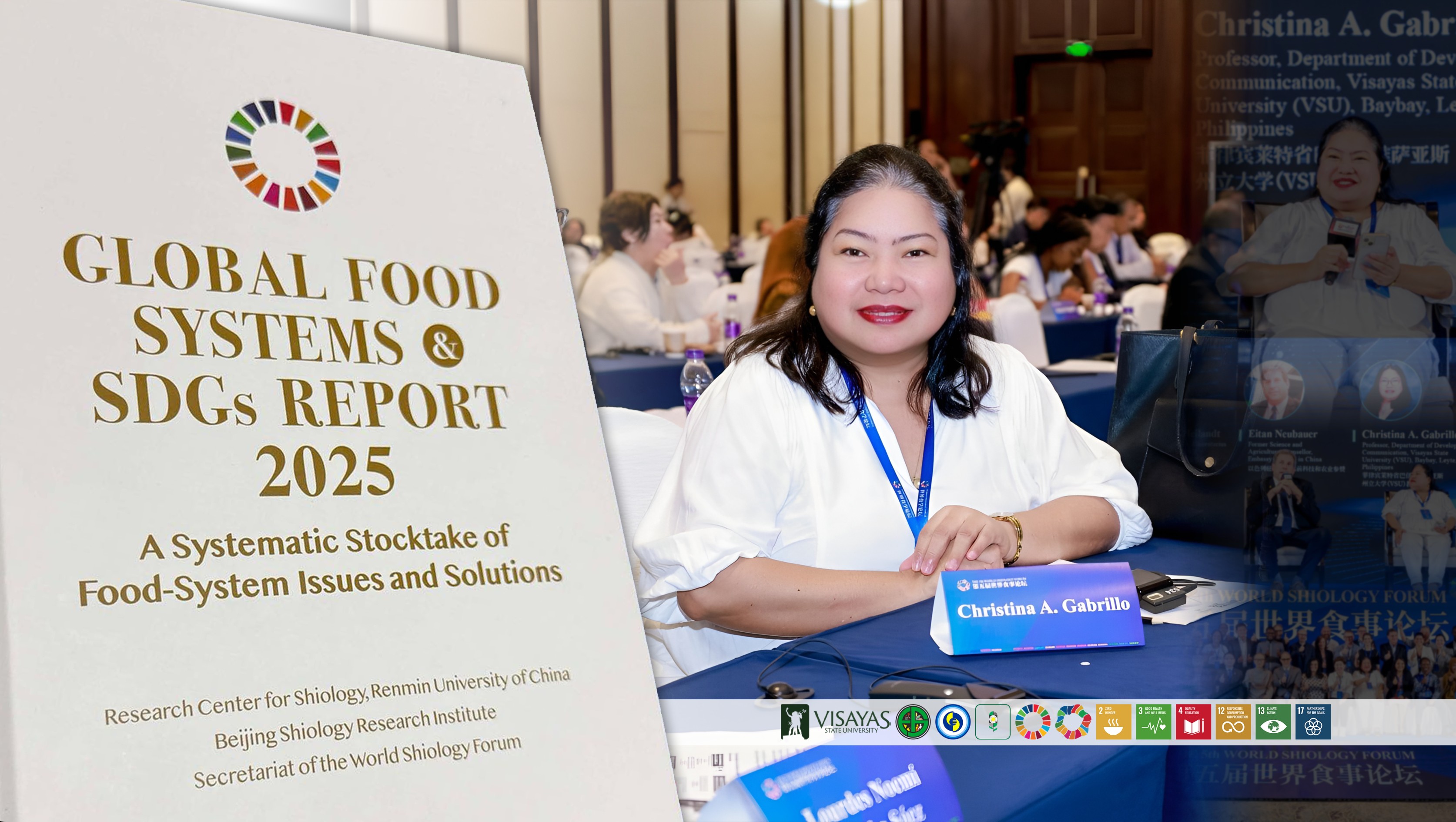
In a landmark milestone for Visayas State University (VSU), Dr. Christina A. Gabrillo, a professor from the Department of Development Communication, has become the first Filipina to participate in the 5th World Shiology Forum, held on October 28-31, 2025 in Haikou, China.
The event gathered over 500 scholars, policymakers, and practitioners from more than 100 countries. The forum advances the relatively new interdisciplinary field of Shiology, a holistic framework that conceives food not simply as nourishment, but as part of a system linking ecology, nutrition, culture, behavior, economics, and governance.
In Haikou, participants discussed global food-system challenges, from hunger and food security to environmental degradation, climate change, and sustainable supply chains.
According to forum experts, food systems today contribute significantly to global greenhouse-gas emissions, consume large shares of freshwater, and have extensive environmental and societal impacts.
Dr. Gabrillo was not only a participant but one of the official panelists, bringing to the table her long experience in development communication, agricultural communication, rural development, and work with farming and coastal communities in Eastern Visayas.
Her voice offered a viewpoint rooted in real experiences of Filipino smallholders, youth groups, and households vulnerable to disasters and climate impacts. These are perspectives often underrepresented in global fora.
This time, she also made history as the sole Filipino co-author of a newly launched publication called Global Food Systems & SDGs Report 2025: A Systematic Stocktake of Food System Issues and Solutions.
The 2025 report, released at the forum, reflects contributions from experts across 115 countries.
Central to the report is a new analytical framework called “Five Food Needs.” According to the report, these are basic sustenance, dietary diversity, food safety, healthy longevity, and sustainable supply.
Dr. Gabrillo’s sections emphasize the role of food cultures, communication, and human behavior especially in archipelagic regions like the Philippines. She draws attention to how cultural identity shapes perceptions around nutrition and food safety, and how governance must consider local realities.
In particular, she shed light on challenges in areas like Eastern Visayas where rural communities, farmers, coastal households, and disaster-vulnerable populations face unique food access and supply constraints.
“It is an honor to represent VSU and VSU-DevCom in a global space that shapes how the world thinks about food. I’m grateful for the chance to bring stories and realities from Eastern Visayas to discussions often led by bigger economies. Our communities deserve to be heard,” she said.
With Dr. Gabrillo’s participation and contribution, VSU now has a direct bridge to global food-system research and discussions. Given her background, her involvement promises potential research collaborations, new program development, and more attention to the food-system realities in the Philippines.
Her presence in the World Shiology Forum and as co-author in a global report symbolically opens a new chapter not only for her career, but for VSU’s role in global food-system discourse.
This article is aligned with the Sustainable Development Goal (SDG) 2: Zero Hunger; SDG 3: Good Health and Well-being; SDG 4: Quality Education; SDG 12: Responsible Consumption and Production; SDG 13: Climate Action, and; SDG 17: Partnership for the Goals.