

#GlobalGreen: Molave Men’s Hall rises as ATI-8 Dormitoryo Verde champion
- Details
- Written by Riza Mae L. Maningo
-
Published: 11 May 2026
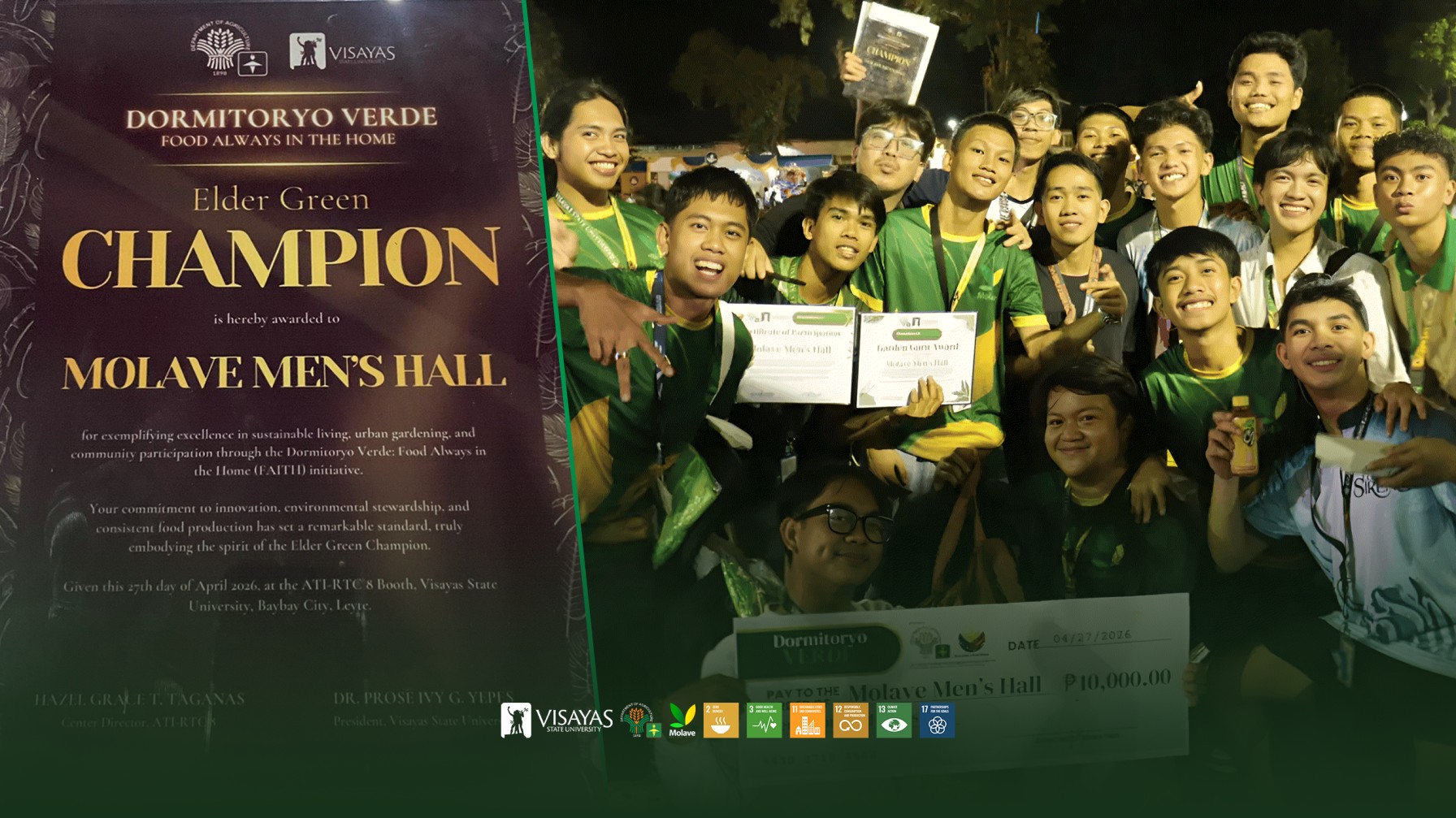
The vibrant spirit of sustainability and student-led innovation took center stage as Visayas State University successfully held the culmination and awarding ceremony of the second year of Dormitoryo Verde, under the banner “Second Bloom: Food Always in the Home (FAITH),” on April 27, 2026, at the Agricultural Training Institute (ATI) booth in the VSU lower campus.
This year’s celebration recognized the notable efforts of dormitory communities in transforming their living spaces into thriving hubs of urban agriculture, environmental stewardship, and collective action.
Following the final evaluation conducted on April 17, 2026, the much-anticipated awarding honored dormitories that exemplified excellence in sustainable gardening and mentorship.
It is worth noting that Dormitoryo Verde’s second bloom this year is defined by its mentorship model, where top-performing dormitories–dubbed as “Elder Greens”--guided other dormitories known as “Space Buds.” This endeavor fostered a culture of collaboration and knowledge exchange through hands-on sessions, technical training, and resources sharing.
Molave Men’s Hall rises as Elder Green Champion
Rising as the overall champion for the second bloom of Dormitoryo Verde is Molave Men’s Hall, reaffirming its leadership in cultivating innovative and purpose-driven green spaces within campus.
By showcasing the "Molave Hilltop Garden and Extension," the group secured a 10,000-peso cash prize. They were additionally honored with special distinctions, including "Best Harvest Haven" and the "Garden Guru Elder Greens" award. Their garden stands as a testament to resilience and growth, having evolved from a small pandemic-era initiative into a sustainable source of food and income for dorm residents.
For Molavean Ian Jay Cabansan, the win was both unexpected and deeply meaningful: “Honestly, this win came as a surprise. We didn't expect it (the win), especially since we competed alongside the same dormitories from last year… That is why this achievement of our dorm means even more to us dormers. It actually reflects the collective effort and bayanihan spirit of Molaveans.”
Their journey was highlighted by teamwork and collaboration–not only within their dormitory but across other dormitories. Their dedication to teach their “Space Buds” remained unyielding even amid challenges such as tropical storm BasyangPH. Molaveans continued to extend their support, helping their mentee-dormitories kickstart and develop their own gardens.
Looking ahead, Molave plans to adopt advanced propagation techniques, apply crop rotation, and expand its mentorship drives. As Cabansan puts it, their garden is not just a space for cultivation but a living example of unity, creativity, and sustainability.
Mahogany Men’s Hall climbs to 1st runner-up
Meanwhile, securing second place is Mahogany Men’s Hall with its “Garden of the Gents,” which also garnered special awards for “Best in Digital Green Thumbs” and “Best in Digital Green Prints”, also receiving 8,000 pesos.
In the Space Buds category, the spotlight shone on Bougainvillea Ladies Cottage, Kanlaon Men’s Hall, and Mulberry Men’s Home, which emerged as the top victors within their respective clusters. Other student dorms such as Daffodil, Camia, Ilang-ilang, Mariposa, Waling-waling, and Daisy were also honored as runners-up for their commendable efforts in the green charge.
Mabolo Men’s Hall earns 2nd runner-up
Despite placing third this year, Mabolo’s “Jardin de Mabolo” stood out not only for its sustainability initiatives but also for its deeper impact on community engagement. The dormitory received the "Roots of Impact Award" and "Green Innovator Award", along with a 6,000-peso cash prize.
What began as a simple backyard garden practice has grown into a dynamic platform for learning and service. Significantly, “Jardin de Mabolo” has gone digital, launching its own web application to share its journey, innovations, and best practices with a wider audience. Its integration of hydroponics–developed with guidance from the VSU Department of Horticulture–demonstrates how modern agricultural techniques can thrive even in limited spaces.
More than production, the garden has also become a vehicle for compassion. Part of its harvest was used to support local habal-habal drivers affected by the ongoing oil crisis, underscoring the dormitory’s commitment to social responsibility.
Reflecting on their journey, Zach Xyrihs A. Estanislao, leader of the Mabolo Agriculture Committee, shared with UIMPA that “as the leader of the committee, I feel grateful–even if we were not able to defend our previous title, just seeing the ‘Mabolonians’ smile and cheer together just proved that we entered the competition not for the title but to cultivate bonds with each other.”
He also added that “Jardin de Mabolo” will continue to flourish beyond the competition, sustained by innovation, teamwork, and a new generation of student leaders ready to carry the torch.
A Thriving Legacy of Sustainability
Dormitoryo Verde is an initiative of the Agricultural Training Institute–Regional Training Center (ATI-RTC 8), designed to strengthen urban agriculture within VSU dormitories.
Now in its second year, the program continues to empower students to take active roles in food security and environmental stewardship.
Expanding on the triumph of its 2025 inaugural run, this year’s initiative witnessed a remarkable surge in participation, growing from five pilot gardens to include all 25 dormitories across the university. Through a collaborative synergy with the VSU University Supreme Student Council (USSC) and the University Inter-Dormitory Student Body (UISB), the program has integrated sustainable stewardship and collective action, fostering composting, backyard gardening, and the cultivation of high-value crops as pillars of food security.
As seeds of knowledge continue to be planted across dormitory communities, Dormitoryo Verde proves that meaningful change can begin in the smallest of spaces. More than a competition, it is a movement that nurtures, not only plants, the values of responsibility, resilience, and a shared vision of a sustainable future within the Viscan community.
With each garden cultivated and each partnership strengthened, VSU moves closer to a campus where sustainability is not just practiced—but lived.
This article is aligned with Sustainable Development Goal (SDG) No. 2: Zero Hunger; SDG No. 3: Good Health and Well-being; SDG No. 11: Sustainable Cities and Communities; SDG No. 12: Responsible Consumption and Production; SDG No. 13: Climate Action; and SDG No. 17: Partnerships for the Goals.