

#DiscoverwithVSU: What slugs and snails can tell us about safer farming and animal health
- Details
- Written by Mike Laurence V. Lumen
-
Published: 06 March 2026
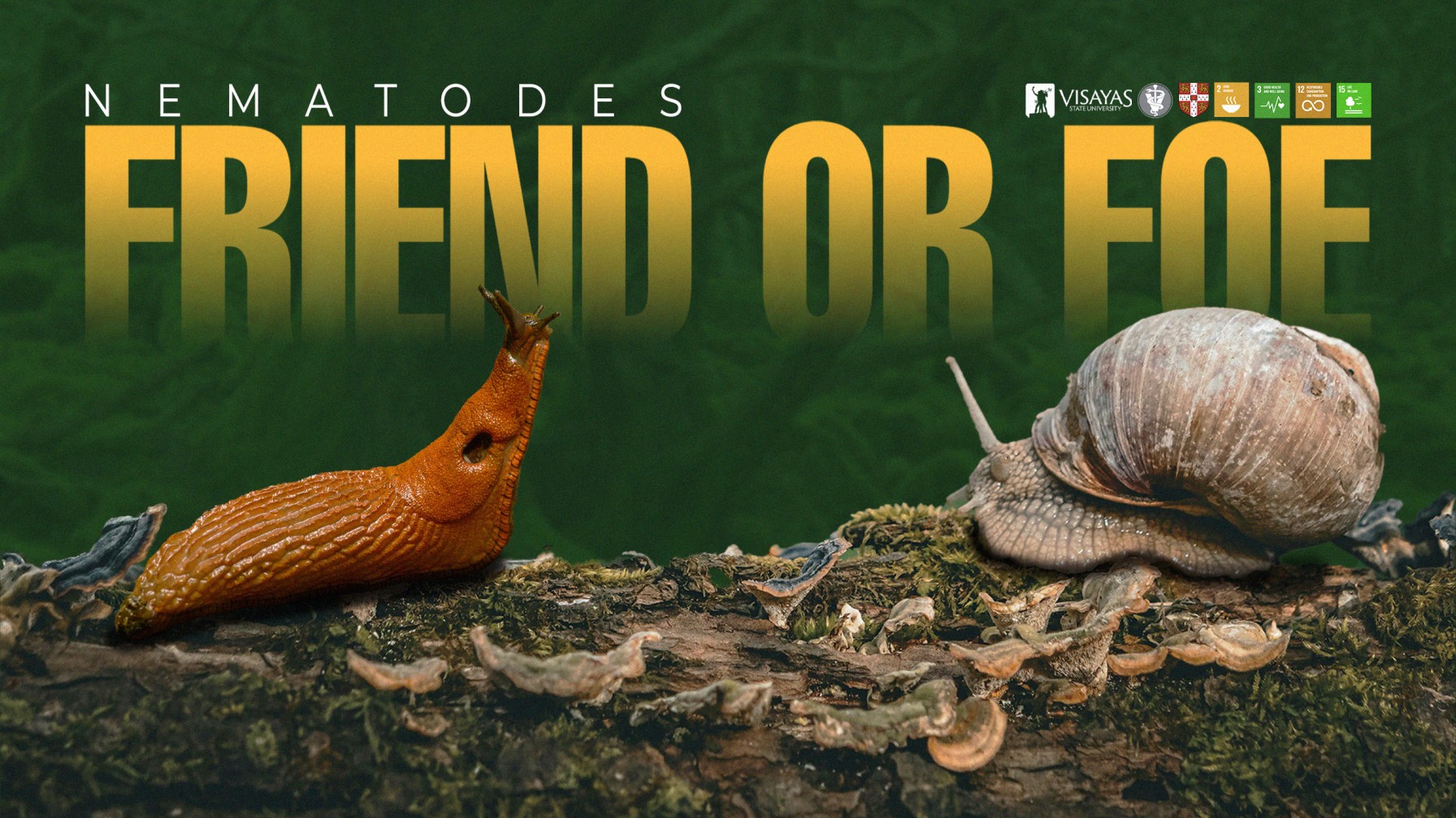
When we see slugs and snails in gardens, we usually think of chewed leaves and slimy trails. Few would imagine that these slow-moving creatures also carry tiny worms that affect farming practices and even animal health.
A recent study, with strong participation from Visayas State University (VSU), took a closer look at what lives inside slugs and snails, and why this matters beyond the forest floor.
The study, “Nematodes associated with terrestrial gastropod molluscs in Belgium and additional characterisation of Pellioditis californica and P. hermaphrodita,” was co-authored by Dr. Marjorie A. Cortes, a faculty member of the VSU-Faculty of Veterinary Medicine (VSU-FVM) together with Wim Bert and Marjolein Couvreur of Ghent University, Belgium, D. De Waele of North-West University, South Africa and Katholieke Universiteit Leuven, Belgium, and P. Rolish Singh of University of Florida, USA. The article came out in the Journal of Helminthology, a scientific journal published by the Cambridge University Press.
The research examined 319 slugs and snails collected from forests, parks, and protected areas in Belgium. Each animal was carefully dissected to check if it carried nematodes, which are microscopic worms that may live in soil, plants, animals, or insects.
The result was striking. Almost one out of every five slugs and snails carried nematodes.
In total, the team identified 11 different nematode species, showing that slugs and snails are far from empty shells. They are moving habitats for organisms that influence agriculture and animal health.
Why this matters to farmers
Among the worms found were Pellioditis hermaphrodita and Pellioditis californica. These nematodes are known for infecting pest slugs and are already used in some countries as natural alternatives to chemical slug killers.
This research showed that these nematodes exist naturally in the environment. For farmers and gardeners, this supports the idea that slug control does not always have to rely on chemicals that harm soil organisms, pets, or water systems.
Understanding where these nematodes occur helps researchers and extension workers explain how biological control can work in real farms, not just in laboratories.
What pet owners should know
The study also detected juvenile stages of Angiostrongylus vasorum, a parasite commonly called canine lungworm, inside slugs. Dogs can become infected when they accidentally swallow slugs while playing outdoors or eating contaminated grass.
This finding matters for communities with pets. It shows why simple habits, like keeping dogs from playing with slugs and washing vegetables from home gardens, can reduce health risks.
This article is aligned with the Sustainable Development Goal (SDG) 2: Zero Hunger; SDG 3: Good Health and Well-being; SDG 12: Responsible Consumption and Production, and; SDG 15: Life on Land.