
Brooking No Distance: VSU AdO brings VSUCAT to island communities
- Details
- Written by Michael Carlo C. Villas
-
Published: 16 March 2026
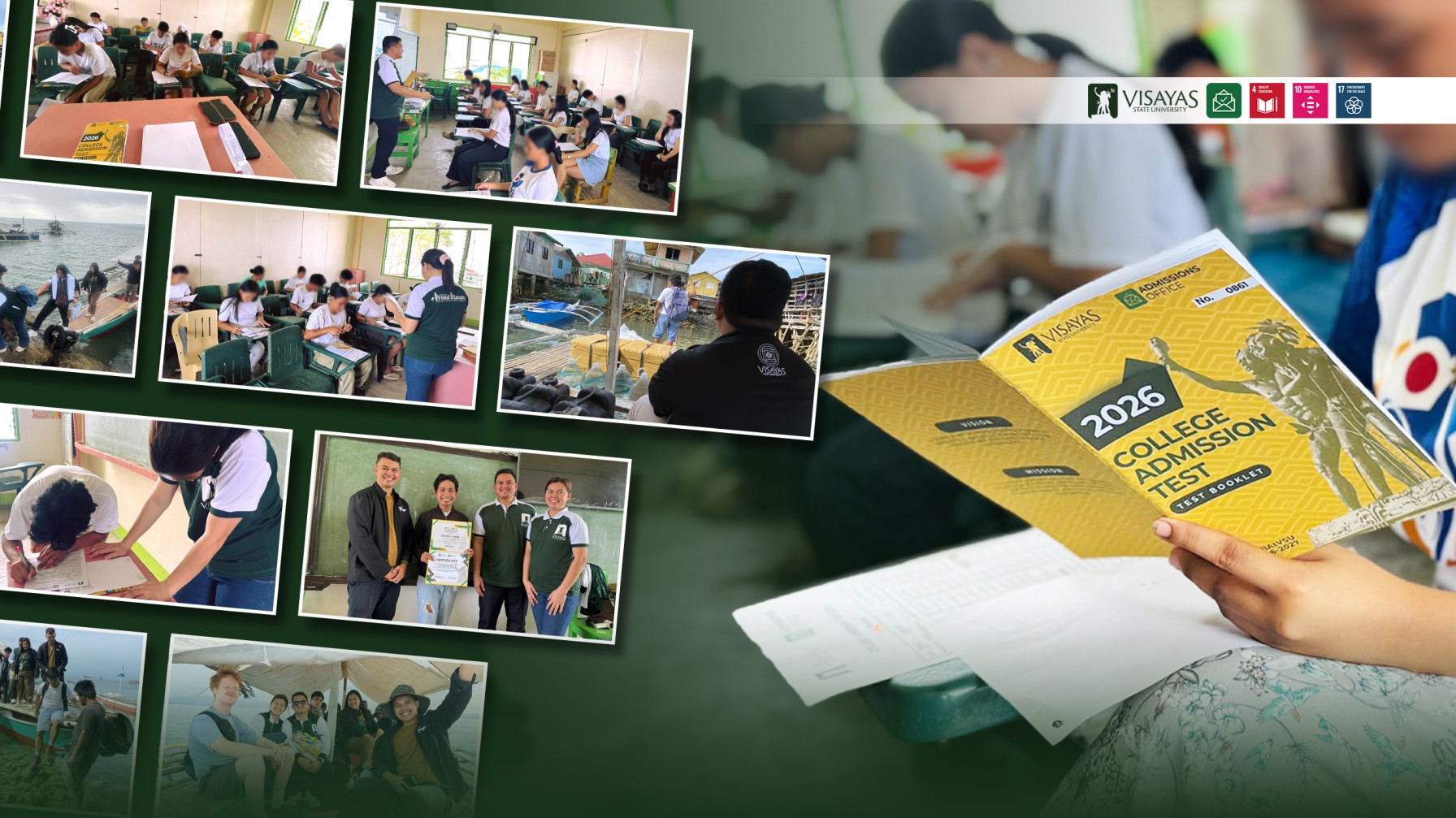
Undeterred by distance, the Visayas State University Admissions Office (VSU AdO) has recently been going around island communities in the Visayas in an effort to make quality higher education accessible to even remote barangays.
In line with the Expanded Affirmative Action Policy for Equity Target Groups approved by the Board of Regents (BOR) through BOR Resolution No. 144, s. 2025, VSU AdO brings the VSU College Admission Test (VSUCAT) to mainland and island communities across the Visayas.
“The Admissions Office has always worked toward one goal—making quality higher education reachable even for students who live far from urban centers,” said Dr. Joseph E. Padilla, VSU AdO director.
“We realized that access should not only be a policy on paper; it has to be physically possible for students to apply,” added Dr. Padilla.
He revealed that there are students in remote areas who want to take the VSUCAT but cannot afford the cost of travel or an overnight stay near testing centers.
“Because of this, we decided to bring the examination to them instead of waiting for them to come to us,” he said.
In 2025, when testing was held again in person, VSU established testing centers in regions VII and VIII in partnership with Department of Education (DepEd) regional offices, allowing more prospective and deserving students to take the VSUCAT.
From 11 testing centers last year, VSU AdO now has 23 administrators from partner testing centers in Leyte, Southern Leyte, Samar, Biliran, Cebu, and Bohol.
“The initiative has significantly broadened participation, particularly among public school students, first-generation college applicants, and learners from geographically isolated areas. The proximity of testing centers has reduced the need to travel to Leyte and Cebu just to take an exam,” Dr. Padilla said in an interview.
Dawahon Island in the municipality of Bato, Leyte was the first offsite island testing center, with Dr. Padilla recalling how overwhelming the reception of the community was and what this meant for families who thought access to a good college education was difficult and oftentimes impossible.
Asked about what made the Dawahon leg of the VSUCAT most memorable, Dr. Padilla disclosed that the trip showed his team the situation of students who want to attend college but do not have the resources.
“That experience reminded us that admissions is not only an administrative function. It is actually the first doorway to social mobility. When access is difficult, even the most capable students are left behind,” he continued.
“These trips reinforced our responsibility not just to select students, but to make sure deserving learners are given a fair chance to enter higher education,” he said.
As of this writing, the Admissions Office just administered the VSUCAT in seven testing centers across the province of Bohol on March 14-15, 2026.
VSU-AdO shows no signs of tapping out, as plans are in the works to open other testing centers in Camotes, Limasawa, Siquijor, and other areas where transportation and communication lines are limited.
Testing centers in Luzon and Mindanao are also future developments in sight, with partnerships with DepEd-CARAGA, VSU alumni, and local government units already underway.
VSU AdO likewise eyes the institutionalization of hybrid admissions where application procedures are developed and streamlined for remote communities.
The purchase of Scranton machines that make checking faster, more efficient, and more reliable complements these efforts and is now in the pipeline as well.
Aside from leading VSU AdO, Dr. Padilla also holds language classes at the Department of Arts, Languages, and Literature and has been recognized as a High-Performing Alumnus in the Spring 2025 cycle of the U.S. Department of State’s Online Professional English Network (OPEN) program.
“Our goal at the Admissions Office is simple: no qualified student should be prevented from entering the University simply because of distance,” Dr. Padilla said.
This article is aligned with Sustainable Development Goals (SDG) No. 4: Quality Education; No. 10: Reduced Inequalities; No. 17: Partnerships for the Goals.