
#DiscoverWithVSU: Why many English Teachers feel anxious and what it means for our schools
- Details
- Written by Mike Laurence V. Lumen
-
Published: 04 April 2026
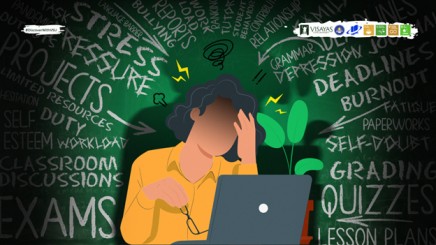
Teaching English in a public junior high school is often seen as routine work–lesson plans, classroom discussions, quizzes, and grading. But behind closed doors, many teachers carry a different reality shaped by pressure, self-doubt, workload, and expectations that go far beyond teaching itself.
A recent study with strong participation from Visayas State University (VSU) takes a closer look at this side of teaching that is rarely talked about. The study, entitled English Language Teaching Anxiety: A Case of Junior High School Teachers, was authored by Dr. Krizia G. Garingalao of Visayas State University and Jonathan J. Palco of Southern Leyte State University. It was published in HCMCOUJS – Social Sciences, an international peer-reviewed journal, and draws from real conversations with public school English teachers in the Philippines.
By focusing on both novice and experienced teachers, the research shows that anxiety does not disappear with experience. Teachers who are new to the profession often feel pressure when managing classrooms, responding to students who struggle with reading and grammar, and standing in front of observers. At the same time, teachers with longer service speak of exhaustion caused by paperwork, tight deadlines, online scrutiny during distance learning, and concerns raised by parents. In both cases, the stress is not limited to teaching English itself.
One of the clearest messages from the study is that teaching anxiety is deeply tied to tasks outside the classroom. Many teachers pointed to paperwork, school activities, reports, and extra assignments as heavier sources of strain than lesson delivery. When these responsibilities pile up, teaching time is squeezed, preparation suffers, and fatigue sets in. For some teachers, weekends and evenings are spent finishing school-related work rather than resting or spending time with family.
This anxiety changes how teaching happens. Some teachers become cautious with teaching skills they feel less confident about such as pronunciation or Literature. Others slow down lessons or simplify tasks because students struggle with basic reading and sentence construction. During the pandemic, many teachers adjusted again, using peer tutoring, project-based outputs, and even home visits just to keep learning going. These adjustments were often made through personal effort rather than structured support.
What makes this research relevant to communities is that it connects teacher well-being with student learning. When teachers are stretched thin, classrooms feel it. Students sense hesitation, stress, and fatigue. Lessons lose momentum. Progress becomes uneven. The study suggests that improving education does not only depend on revising textbooks or changing policies, it also depends on how teachers are supported in their daily work.
Through this research, VSU contributes evidence that can guide school leaders, educational institutions, and local decision-makers when reviewing workloads, task distribution, and support systems for teachers. By listening to teachers’ lived experiences, the study opens space for more thoughtful conversations about how public schools function and what teachers actually need to teach well.
Sometimes, understanding what happens in schools begins not with exams or rankings, but with listening to the people who stand in front of the class everyday.
This article is aligned with the Sustainable Development Goal (SDG) 3: Good Health and Well-being; SDG 4: Quality Education; SDG 8: Decent Work and Economic Growth; SDG 10: Reduced Inequalities, and; SDG 16: Peace, Justice, and Strong Institutions.