

VSU leads regional heritage conservation initiatives
- Details
- Written by Michael Carlo C. Villas
-
Published: 01 April 2026
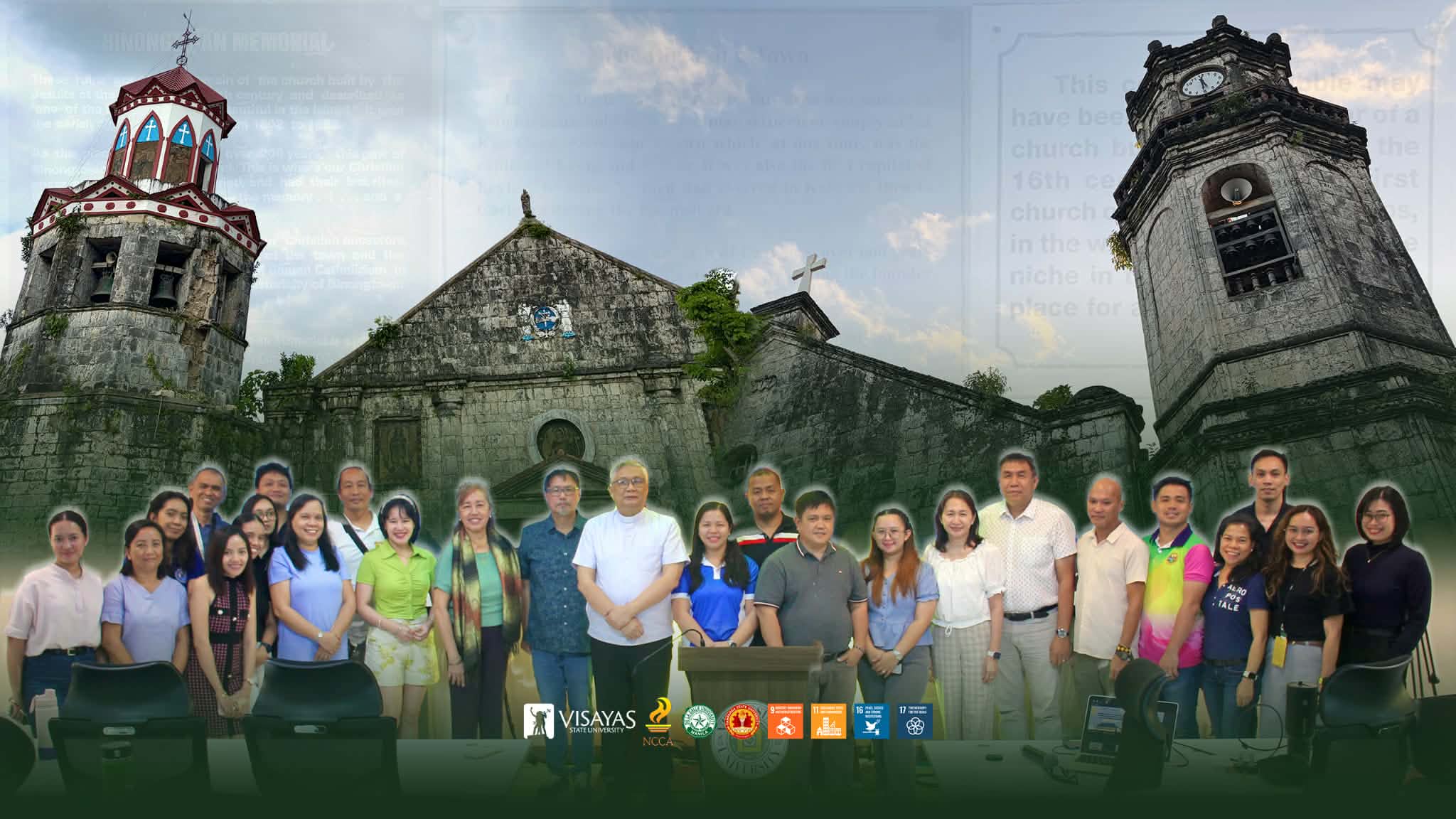
The Visayas State University Center for Socio-Cultural Research and Heritage Studies (CSCRHS) took the lead role in cultural heritage conservation in the region in its most recent research dissemination and stakeholders’ meeting at the Smart Classroom last March 19, 2026.
The National Commission for Culture and the Arts (NCCA)-funded research project entitled “Comparative Analysis of the Typological, Historical, and Conservation Dimensions of the Five Medium Anti-Moro Fortifications in Eastern Visayas,” headed by Dr. Feorillo Petronilo A. Demeterio III of De La Salle University (DLSU), Dr. Wilma M. Cruz of Pampanga State University (PSU), and Mr. John Martin A. Diao and Dr. Guiraldo C. Fernandez of Visayas State University (VSU)-Baybay served as a jump-off point for discussions on possible collaborations with the stakeholders present.
Ms. Ianvie Norean A. Miaga, faculty member of the Department of Philosophy and Social Sciences (DPSS), organized and facilitated the dissemination and fieldwork activities.
Key stakeholders include representatives from the local government units (LGUs) of Hilongos headed by council member, Aline Reoma, and Giovanni “Gev” Olo from the local tourism office and the non-government organization, Leyte Samar Heritage Society (LSHS), led by theater director, Prof. Joycie Alegre, and church historian, Rev. Msgr. Ramon Aguilos.
“What began as an academic research initiative thus matured into a wider collaboration grounded in scholarly trust, institutional fit, and the need to connect historical research with regional heritage work and public discourse,” Dr. Max Teody T. Quimilat, CSCRHS director, revealed in an interview.
VSU, De La Salle University, and Pampanga State University formalized their collaboration through a Letter of Cooperation that intended, among other things, to “advance research, knowledge production, and scholarly exchange” through dissemination activities, capacity-building, and fieldwork.
“The CSCRHS is meant to advance socio-cultural and heritage-oriented work through research, partnerships, and public engagement, and this collaboration exactly does that by linking historical inquiry, heritage interpretation, and regional institutional action,” Dr. Quimilat said.
He stressed that such initiatives are in line with what a global green university should be, which is “not only about ecology in the narrow sense but also about sustaining communities, identities, and cultural landscapes through responsible scholarship and engagement.”
“More concretely, the project is already generating outcomes that matter to both the Center and the university: partnerships and linkages,” he said, referring to talks that have already been initiated with the LGUs of Hilongos, Carigara, Basey, and Maasin and the Leyte Samar Heritage Society that opened doors for the CSCRHS to participate in an Eastern Visayas heritage initiative.
A lecture on large language models and its use in crafting proposals on cultural heritage studies and conservation by Dr. Leslie Anne Liwanag of the DLSU School of Innovation capped the research dissemination and stakeholders’ meeting.
This was followed by field visits to Hilongos and Maasin on the same day and to Carigara and Basey on March 20. These sites are known for their well-preserved heritage churches or what the project prefers to call “anti-Moro fortifications” to emphasize the “defensive and refuge functions” of these churches in the Spanish colonial period.
Dr. Quimilat clarified that the use of “moro” is done critically, as it “names a historically specific defensive architecture and conflict context, not a present-day judgment on Muslim identity.”
“One major lesson from the field is that these sites should not be seen merely as old churches; they are layered places where worship, refuge, insecurity, local memory, and colonial conflict all meet,” he added.
The VSU-DLSU-PSU collaboration is a strong continuation to what CSCRHS has already started with its people-centered research projects last year.
Together with LGUs and cultural heritage conservationist groups, it is set to produce publications and documentation and dissemination efforts throughout Eastern Visayas in the near future.
This article is aligned with Sustainable Development Goals (SDGs) No. 9: Industry, Innovation, and Infrastructure; No. 11: Sustainable Cities and Communities; No. 16: Peace, Justice, and Strong Institutions; No. 17: Partnership for the Goals.