
From research to real-world use: RDC VIII backs ViCARP BRIDGE
- Details
- Written by Elmera Y. Bañoc
-
Published: 19 August 2026
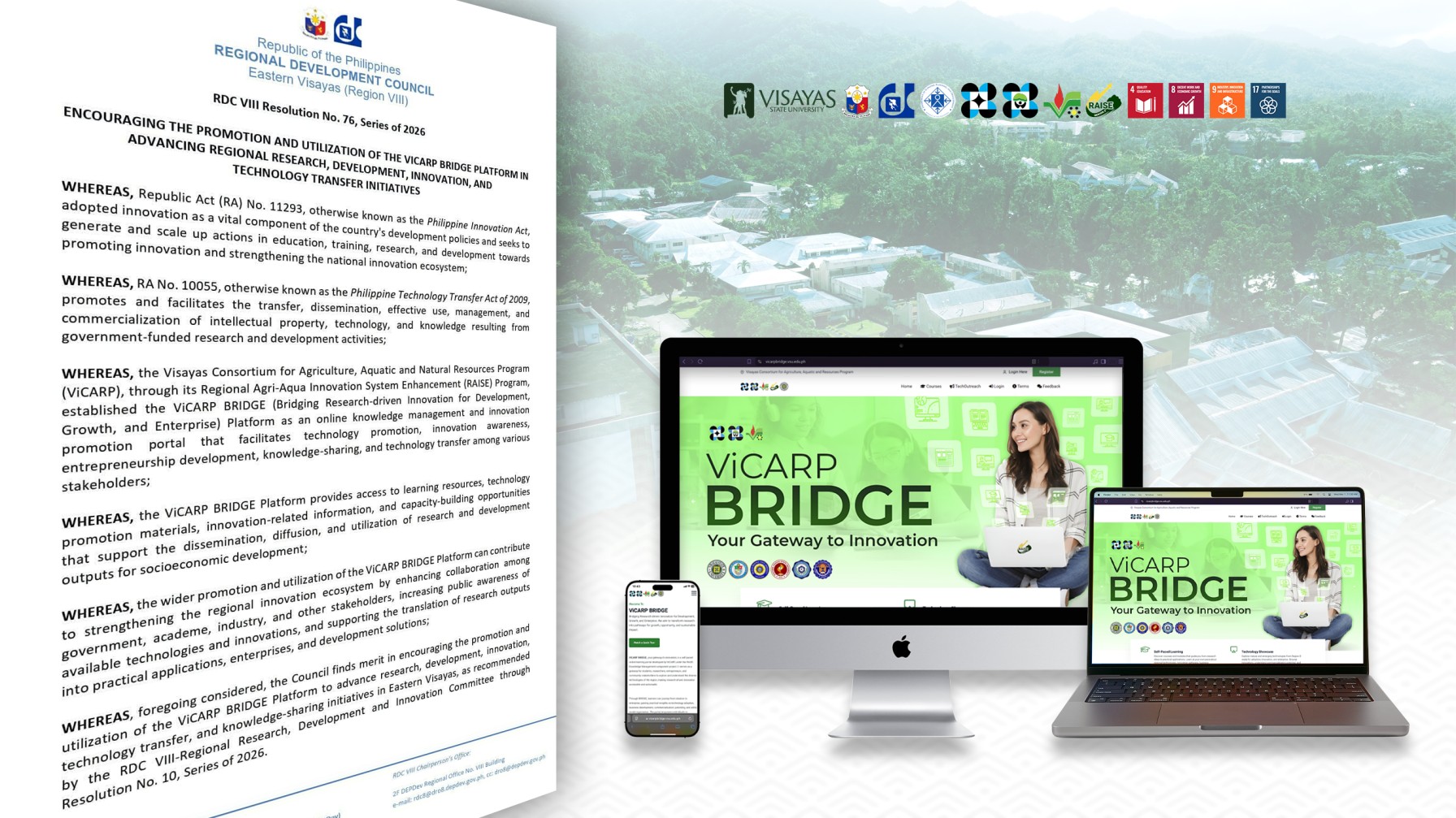
A regional platform designed to bring research, innovation, and technology closer to the people has gained a stronger push from Eastern Visayas’ development leaders.
The Regional Development Council (RDC) VIII has formally encouraged the promotion and use of the ViCARP BRIDGE Platform as a regional resource for accelerating research, development, innovation, and technology transfer across the region and beyond.
The move was adopted through RDC VIII Resolution No. 76, Series of 2026, unanimously approved during the Council’s Second Quarter Full Council Meeting on June 25, 2026, at the Department of Economy, Planning, and Development (DEPDev) Regional Office VIII in Palo, Leyte.
For the Visayas Consortium for Agriculture, Aquatic and Natural Resources Program (ViCARP), the resolution gives a wider regional space for a platform built around a simple idea: useful knowledge should not remain within laboratories, offices, or academic journals; it should reach the people and organizations that can put it to work.
ViCARP BRIDGE, which stands for Bridging Research-driven Innovation for Development, Growth, and Enterprise, was developed through the Regional Agri-Aqua Innovation System Enhancement (RAISE) Program.
The platform features two main components: Self-Paced Learning, which offers online courses for knowledge and capacity-building, and Technology Showcase (TechOutreach), which provides access to research-based technologies and innovations ready for commercialization.
It brings together learning resources, technology promotion materials, innovation-related information, and capacity-building opportunities in one digital space.
ViCARP-RRDCC Chairperson and University President Prose Ivy G. Yepes lauded the strong support of RDC VIII.
“ViCARP BRIDGE gives research and innovation a better chance to reach the people who can use them. With the support of RDC VIII, we hope to see more ideas from our universities and research institutions move beyond the page and find their way into communities, enterprises, and everyday solutions,” Dr. Yepes said.
For researchers, it can serve as a venue for sharing technologies and research outputs. For students and professionals, it offers learning materials that can expand their understanding of innovation and technology. For entrepreneurs and industry players, it can provide ideas and information that may lead to new products, services, or enterprises.
Government agencies and development organizations can also use the platform in connecting research outputs with community and industry needs.
This matters in a region where universities and research institutions generate a steady stream of studies, technologies, and innovations, where the bigger challenge often comes after the research is completed. How does the knowledge reach the people who need it?
ViCARP BRIDGE is designed to help answer that question.
The RDC resolution recognizes the platform within the broader direction of national innovation and technology transfer policies.
It cites the Philippine Innovation Act, or Republic Act No. 11293, which promotes innovation as part of the country's development agenda. It also points to the Philippine Technology Transfer Act of 2009, or Republic Act No. 10055, which supports the transfer, dissemination, use, management, and commercialization of intellectual property, technologies, and knowledge generated through government-funded research.
While these policies provide the larger framework, ViCARP BRIDGE brings that framework closer to Eastern Visayas.
Through the platform, research and development outputs can be presented in forms that are more accessible to potential users. Learning materials can be accessed online. Technology information can be shared beyond institutional boundaries. Opportunities for training and collaboration can also reach a wider audience.
In this sense, the platform is not simply another website. It is intended to function as a meeting point for knowledge, technology, people, and opportunities even in times of disruptions.
It also offers a practical response to government austerity measures during times of crisis by providing a cost-efficient way to share knowledge, deliver learning, and sustain collaboration without relying heavily on physical gatherings.
One of the most important possibilities of ViCARP BRIDGE lies in its ability to connect groups that do not always work in the same space.
Research institutions may have technologies that can address agricultural, environmental, livelihood, or enterprise concerns. Government agencies may have programs that can help these technologies reach communities.
Businesses may have the capacity to produce or distribute them. Farmers, fisherfolk, entrepreneurs, and other users know the problems that need practical solutions.
Bringing these pieces together can make research more responsive to actual needs.
“ViCARP BRIDGE bridges the gap between our innovators in the AANR sector and the communities, farmers, and enterprises, bringing research-based technologies, knowledge, and solutions closer to those who can use them, build on them, and turn them into meaningful impact,” Dr. Santiago T. Peña, Jr., Director of ViCARP and the Vice President for Research, Extension, and Innovation, maintained in a statement.
The RDC resolution specifically recognizes the potential of wider use of ViCARP BRIDGE to strengthen collaboration among government, academe, industry, and other stakeholders. It also sees the platform as a way to raise public awareness of available technologies and help move research outputs toward practical applications, enterprises, and development solutions.
That is where technology transfer becomes more than a technical process. It becomes a matter of making sure that an idea does not stop at publication, presentation, or patent filing.
The regional endorsement also opens opportunities for the platform to become a shared resource for Eastern Visayas.
Instead of people having to search separately through different institutional websites, training materials, technology catalogs, and other sources, ViCARP BRIDGE can provide a common digital space where relevant resources are easier to discover.
Its value can grow as more institutions contribute knowledge, technologies, learning materials, and opportunities.
The platform can also support a culture in which research is viewed not only in terms of academic output but also in terms of what happens after the study is completed.
A research finding can become a technology. A technology can become a product. A product can create an enterprise. An enterprise can generate livelihood.
A training module can help a community acquire a new skill. A piece of knowledge shared online can lead one researcher to another, or connect an inventor with a potential partner.
These possibilities begin with access.
The formal backing from the region's development council gives ViCARP BRIDGE a stronger platform for reaching institutions and communities beyond its original network.
But the real measure of the platform will not be the number of people who visit it.
It will be what happens because they did.
A researcher may find a partner. A student may discover a new field of learning. An entrepreneur may find a technology worth adopting. A community may gain access to a solution suited to its needs. An institution may find a resource that strengthens its own programs.
That is the direction ViCARP BRIDGE is opening for Eastern Visayas, a regional space where knowledge can move more freely, from researchers to users, from universities to communities, and from ideas to applications.
With RDC VIII now encouraging its promotion and utilization, ViCARP BRIDGE takes another step toward becoming more than a repository of information. It can become part of how Eastern Visayas finds, shares, develops, and puts knowledge to work.
This article aligns with United Nations Sustainable Development Goal (SDG) No. 4: Quality Education; SDG No. 8: Decent Work and Economic Growth, SDG No. 9: Industry, Innovation and Infrastructure, and SDG No. 17: Partnership for the Goals.