- Details
-
Written by Prose Ivy G. Yepes
-
Published: 18 September 2026
The State of VSU: Resilient in Disruption. Transformative in Action. Global in Impact.
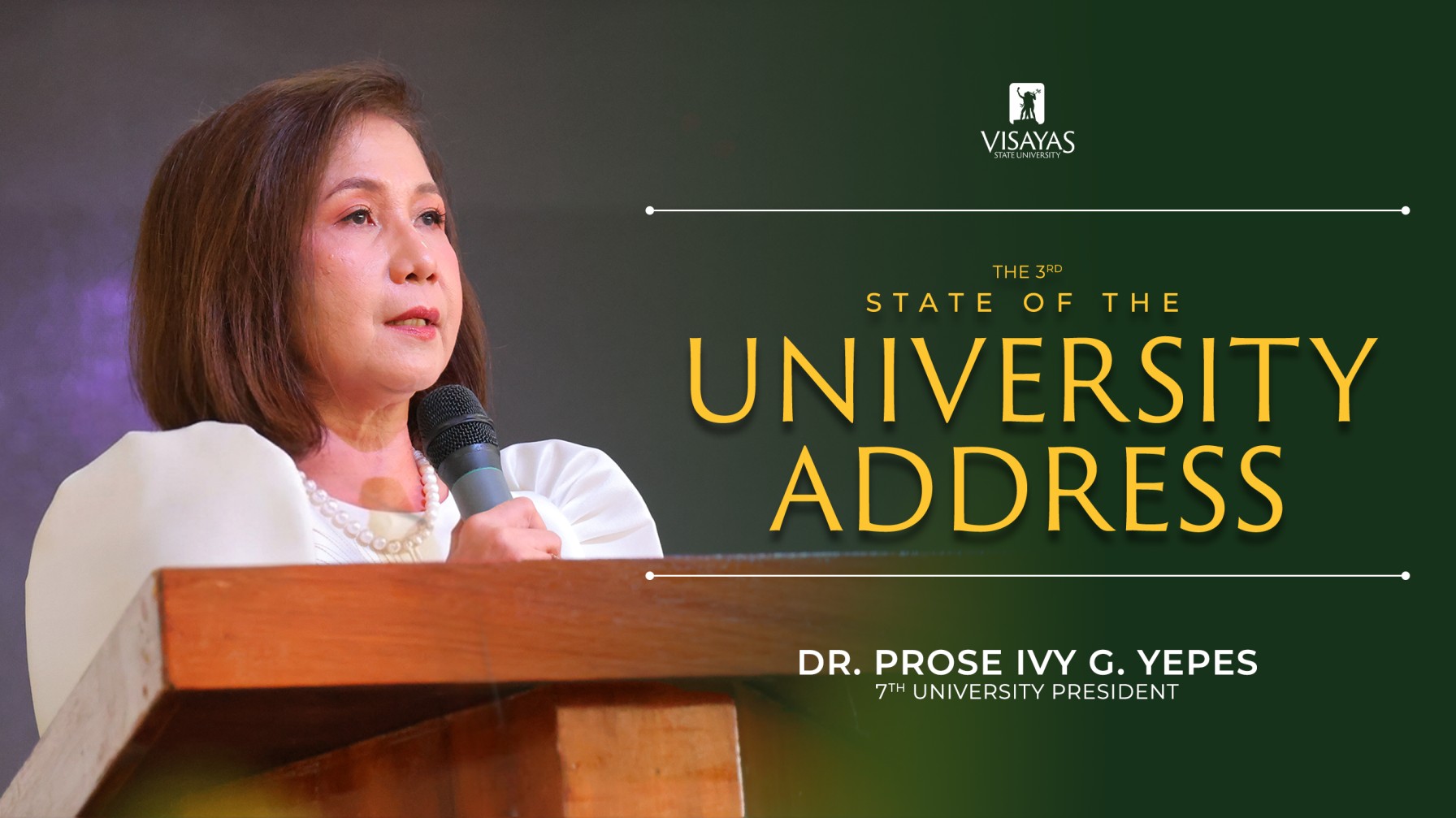
2026 State of the University Address
Dr. Prose Ivy G. Yepes
September 18, 2026
When disruptions came, VSU did not stop. The VSU community rose above the crises.
Warmest greetings to everyone gathered here today for this year’s academic convocation.
To the Chairperson of the Commission on Higher Education, Dr. Shirley C. Agrupis; to the VSU Governing Board members led by Commissioner Myrna Q. Mallari, CHED Regional Office VIII Director, Dr. Maximo C. Aljibe; Honorable Representatives of the Districts of Leyte and Honorable City and Municipal Mayors of the local government units where our five campuses are located; our university officials, members of the academic and administrative councils, faculty members and administrative staff; our students led by the various student leaders, Student Regent, Faculty Regent, Alumni Regent, Officers and members of the VSU Alumni Associations across 5 campuses, partners from the public and private sectors, friends of VSU, and those joining us online—please accept my warmest Friday morning greetings to all of you.
It is good to have the VSU community together today. And as we gather for this academic convocation, we do so at a time when there is much to look back on, much to account for, and much to look forward to.
To everyone who has taken the time to be with us here in person and online, thank you for being part of this occasion. Once again, welcome to Visayas State University and welcome to the academic year 2026-2027.
When disruptions came
The past year did not exactly give us much room to settle. We experienced a lot of disruptions and challenges.
We felt the ground shake, from the earthquakes in Leyte and Southern Leyte to the magnitude 6.9 earthquake that struck Northern Cebu, with tremors reaching communities across the region, including here in Leyte.
Then came a succession of storms and heavy rains that brought strong winds, flooding, and disruptions to communities throughout Eastern Visayas. These affected our students, our faculty and staff, our families, our communities, and the daily life of the University. And once again, we were reminded that not everything that disrupts our lives arrives with a warning.
For many of us, they meant checking the sky before leaving for work. Checking whether classes would push through. Checking on our students. Checking on our fellow VSU employees. Checking the roads. Checking on our families. And sometimes, checking our phones in the middle of the night because another advisory had come in.
Yet, VSU remained open to the work entrusted to it.
The true measure of a university is not how it performs when conditions are perfect, but how it responds when circumstances are difficult. In those difficult months, VSU showed that resilience is not simply the ability to recover, but the courage and capacity to move forward—first by making sure that our people were safe, then by reaching those who needed assistance, and finally by helping our community rebuild.
This was the spirit behind VSU Pangumusta, VSU Pagtabang, and VSU Pagbangon: VSU Pangumusta brought medical, psychosocial, legal, and gender-safety services closer to students and employees affected by calamities; VSU Pagtabang mobilized donations, volunteers, food packs, hygiene kits, clothing, and learning materials for affected students; and VSU Pagbangon brought students, employees, and volunteer responders together to clear debris, restore access, and rehabilitate affected spaces across the campus.
The challenges we faced revealed what we can do when conditions are far from ideal. They revealed how quickly we can adjust when circumstances demand it. And they revealed something even more important: VSU does not measure its strength by the absence of disruption. We measure it by what we are able to do while disruption is happening.
That is where our story begins. Resilient in disruption. And from there, we move to what VSU chose to do next.
The first responsibility was to keep instruction going, being the primary mandate of the university.
Even when conditions were difficult, our students had to keep learning. Classes had to continue, faculty had to adjust, and academic units had to find workable arrangements whenever regular schedules were disrupted. We made use of alternative modes and flexible arrangements when necessary, while taking into account the conditions on the ground.
At the same time, we had to look at the safety of our students, faculty members, and administrative staff as a primary consideration in decisions affecting university operations. When circumstances called for the suspension or adjustment of activities, we acted accordingly.
We worked more closely with the members of the VSU Crisis Management Committee, together with the local government agencies and other volunteer groups, particularly before, during and after emergencies when information, coordination, and immediate assistance were needed on the ground.
One of these is the Strategic Resilience and Incident Management Framework for Disaster and Emergency Scenarios, or the STRIDES Framework. Through BOR Resolution No. 30, Series of 2026, the University adopted the STRIDES Framework as its institutional framework for disaster preparedness, emergency response, crisis management, and organizational resilience.
It provides a campus-wide approach to risk reduction, incident management, continuity of essential services, and recovery, so that instruction, research, extension, and public service can continue even when the University faces disruption.
We are also building this capacity through a training-workshop.
From June 23 to 26, 2026, our key officials and members of the University Administrative Council underwent a four-day Public Service Continuity Plan Training Workshop conducted with the Office of Civil Defense Regional Office VIII. The training focused on how essential university services can continue even when normal operations are interrupted and to come up with a detailed, board-approved Public Service Continuity Plan.
Moreover, in July 2026, the University Disaster Resilience and Management Office launched the Weather Advisory and Information System, or WAIS—a web-based system that provides real-time, localized, and actionable weather advisories for the VSU Main Campus.
We kept learning: Academics
Thus, despite the disruptions, VSU continued to teach, discover, innovate, serve, capacitate, and develop people. And we can see this not only in the programs we offered or the activities we conducted, but also in the results we delivered against the performance indicators set for us under the General Appropriations Act for the fiscal year 2025.
For first-time licensure examination takers, our target was 60%. We achieved 87.19%—equivalent to an accomplishment rate of 145.32 percent.
In 2025, VSU produced 1,133 board examination passers, including 1,005 first-time takers. We also recorded 17 topnotchers across various professional licensure examinations.
VSU was also recognized among the top-performing universities in the country in professional licensure examinations in Agriculture, Veterinary Medicine, Teacher Education, Geodetic Engineering, and Criminology.
Our students have continued to excellently perform this year. So far in 2026, we have produced 946 passers across the licensure examinations in Mechanical Engineering, Criminology, Civil Engineering, Teacher Education, and Food Technology, among others. Among them are 24 topnotchers.
In the February 2026 Mechanical Engineers Licensure Examination, Engr. Jose Arnil C. Corong Jr. secured the first rank.
Khyle Sta. Iglesia made it to 8th place nationwide in the August 2026 Professional Food Technologists Computer-Based Licensure Examination.
In Teacher Education, 22 of our graduates placed among the top performers. Leading them was Rashil Rae R. Recorte, who ranked first in the Secondary Level with a rating of 95.80 percent—the highest rating ever recorded in the history of the Licensure Examination for Professional Teachers in the country.
These achievements bring us back to something fundamental: quality in higher education is ultimately experienced by our students.
Our work in academic quality does not stop with examination results.
All 102 academic programs and their respective specializations across the five campuses have their respective Certificates of Program Compliance from the Commission on Higher Education. This covers 71 programs at the VSU Main Campus in Baybay, 10 at VSU Tolosa, 9 at VSU Isabel, 6 at VSU Alangalang, and 6 at VSU Villaba.
Across our 102 programs, 28 have attained Level IV accreditation under AACCUP, 26 are at Level III, 23 at Level II, and 15 at Level I. Ten programs are presently being prepared for a Preliminary Survey Visit.
At the Main Campus alone, 28 programs carry Level IV accreditation—the highest level reflected in our current program portfolio.
During the academic year 2025–2026 accreditation cycle, our Bachelor of Science in Agriculture, with its eight specializations, retained Level IV accreditation, valid until April 2030. The BS Chemistry, BS Environmental Science, and BS Statistics programs were reaccredited at Level II, while BS Meteorology attained Level I accreditation.
At VSU Tolosa, BS Fisheries was reaccredited at Level III. At VSU Villaba, the Bachelor of Secondary Education with three specializations likewise received Level III reaccreditation.
Our academic programs have to keep responding to the needs of the time. That is why VSU is also preparing ten academic programs for assessment under the ASEAN University Network-Quality Assurance, or AUN-QA.
These are Agriculture, Biology, Computer Science, Development Communication, Economics, Secondary Education, Forestry, Geodetic Engineering, Nursing, and Veterinary Medicine. The Faculty of Engineering is also preparing for Washington Accord re-accreditation of its engineering programs and certification of its faculty members as ASEAN engineers
We are also expanding what VSU can offer to our students.
Beginning this Academic Year 2026–2027, the VSU Main Campus offers the Bachelor of Science in Entrepreneurship and the Bachelor of Arts in Literature, as well as the Master of Science in Applied Economics, following compliance with the necessary CHED requirements.
Additionally, there is a milestone that VSU has worked toward for years. The Doctor of Medicine program is finally here.
Following the approval of our application for a Government Permit to operate the first- and second-year levels of the program, pursuant to CEB Resolution No. 401-2026, VSU welcomed 36 students as the pioneering batch of our Doctor of Medicine program.
They have now begun a new chapter not only for themselves, but also for the University and the communities. Likewise, VSU College of Medicine is blessed to have more than 20 competent and compassionate faculty members who now join the VSU family as regular, COS and affiliate teaching personnel.
Furthermore, VSU held its graduation ceremonies across all five campuses, conferring degrees upon 3,357 graduates, including 738 who earned Latin honors, pursuant to Board of Regents Resolution No. 24, Series of 2026.
During the commencement rites, graduates received not only their diplomas, but also their Transcript of Records and Alumni IDs. We also recognized those who distinguished themselves in professional licensure examinations.
It is also worth noting that VSU Tolosa produced its first-ever Summa Cum Laude courtesy of Mr. Jomari Z. Tubigan, BS Fisheries, and emerged as the top graduate across the entire VSU community.
And so, VSU is not merely producing graduates; we are preparing competent, ethical, innovative, and globally competitive citizens who can take what they have learned here and put it to work wherever life takes them.
We kept discovering: Research
If instruction prepares our people for the future, research allows us to respond to the problems in front of us. At VSU, we have continued to ask questions that matter not only in our laboratories and research centers, but also in our farms, communities, and public institutions.
Our research productivity continues to grow. As of September 2026, VSU has produced 90 Scopus-indexed publications for the year, moving toward our target of at least 100 by year-end. Since 2025, we have already reached 876 Scopus-indexed publications, keeping VSU as the leading university in Eastern Visayas in Scopus-indexed research output.
Our research portfolio is also supported by a growing network of external funding partners. In 2025, VSU secured 304.29 million pesos in externally funded research, supporting work in areas such as food security, agricultural productivity, fisheries, health, environmental protection, and community development.
This momentum continued in 2026, with the University generating 287.05 million pesos in external research funding as of the current year.
But research also needs facilities that can support the work beyond the project proposal. One example is the Central Analytical Services Laboratory, or CASL, which generated 5.54 million pesos in service income in 2025, a 35% increase from the previous year. Its growth shows how VSU’s laboratory capability can serve not only our own researchers, but also those who need analytical services outside the University.
Our Problem-based Research and Innovation toward Optimum Productivity, Enhancing the Environment’s Integrity, and Living Conditions of Communities or PROPEL R4D Agenda gives our research a clear direction: begin with real problems and work toward solutions that can be used.
We see this in our externally funded projects in 2026, most of which are under the auspices of the Department of Science and Technology (DOST). VSU is leading an 11.25-million peso DOST-GIA project on pelagic fish resources, feeding ecology, and fisheries dynamics in the Sibuyan Sea.
We have a 300 thousand-peso project with the International Rice Research Institute on market-driven rice breeding innovations; a 3-million peso DOST-PCAARRD project under Galing AGHAM; 5 million pesos for the deployment of root crop planting materials; another 4 million pesos for root crop food products in response to food and energy security concerns; and 4.8 million pesos for ALALAY VSU, which develops campus-based Anchor Farm systems and agri-food production models.
Research also creates capabilities that remain useful beyond the life of a particular project. In 2025, VSU began operating a Food Testing Laboratory, which generated ₱503,212 in its first year. The laboratory gives the University another capacity to provide food-related testing services while supporting work connected to food safety, product development, and research.
The same is true of the Plant Disease Diagnostic Laboratory, or PDDL, which began generating service income in 2025. Its work gives farmers, researchers, and other users access to specialized plant disease diagnosis—bringing university expertise closer to the problems encountered in actual agricultural production.
These efforts are supported by facilities that give our research, development, and extension activities places to operate, including the RDE Hall, which also began generating income in 2025.
Our research partnerships also extend beyond the country. VSU, through the GRID Center, is part of a five-year project with Vrije Universiteit Brussel and VLIR-UOS on multi-hazard vulnerability in Eastern Visayas using a ridge-to-reef community approach with project cost amounting to nearly 300,000 Euros (equivalent to more or less P22M). We also have the VSU-ViSERDAC and Louisiana State University AgCenter partnership on climate-resilient rice production.
Our work on climate-smart agriculture is also moving into the field through our partnership with Verde Carbon Capture, Inc. In Leyte and Bohol, VSU is helping lead a large-scale effort to reduce methane emissions from rice production through alternate wetting and drying, covering more than 70,000 hectares of rice-growing areas. This brings together climate action, water conservation, farm productivity, and new possibilities for farmers.
Our researchers are working on very specific problems. One team developed an AI-based system for detecting black pod disease in cacao, with the best-performing model reaching 99% accuracy from 2,000 images.
Another study involving 204 pig farms in Leyte and Southern Leyte examined factors associated with African Swine Fever outbreaks. Other studies have looked into the agritourism potential of Baybay City, created the Farm2Table platform to connect farmers with consumers and businesses, addressed HIV education and stigma reduction through Project FINISH, developed localized hazard mapping and community training through Project SIGURADO with LGU Abuyog, and examined why some soils in Eastern Samar are red and what that means for farming.
In Calubian, Leyte, VSU is also working with the University of the Philippines Los Baños to document seven previously unclassified caves, generating data on biodiversity, hydrology, and ecological potential that can help the local government balance conservation with sustainable ecotourism.
In our coastal communities, VSU has also partnered with BFAR Region VIII under the FishCoRe Project to introduce ALWAN, a citizen-science approach to coral reef monitoring that brings local communities into the protection and understanding of their marine resources.
Our research also reaches into the history, culture, and lived realities of Eastern Visayas. Through the Center for Socio-Cultural Research and Heritage Studies, VSU is pursuing a diverse portfolio of externally funded projects that document local knowledge and communities, develop sustainable and gender-inclusive forest management practices with indigenous peoples, examine coastal livelihoods and community-based resilience, and support the development of young researchers in the region.
In 2026, the Center's completed, ongoing, and newly approved projects carry a combined funding of 15.1 million pesos.
We are also seeing this progress in our own journal. The Annals of Tropical Research, VSU’s international scientific journal and the first Scopus-indexed journal in the region, has entered the SCImago Journal Rankings, with a Q4 ranking in Agricultural and Biological Sciences, Environmental Science, and Social Sciences.
So, when we say “we kept discovering,” we are talking about more than the number of papers we publish. We are talking about research that asks difficult questions, studies problems that affect people, and looks for answers that can move from the page to the field, the laboratory, the community, and beyond.
Our research also continues to connect with the Sustainable Development Goals, covering concerns such as food security, health, climate, biodiversity, sustainable communities, energy, and innovation.
This gives our researchers a broader field in which local questions are brought into wider conversations.
In 2025 and 2026, this work has taken many forms: from sweetpotato nutrient management and fisheries, to climate-resilient rice production, biodiversity and forest resilience in Mt. Nacolod, sustainable aquaculture and peatland resources, root crop technologies, and livelihood and food-security initiatives under the GALING PCAARRD Kontra Krisis Program.
These are not simply global targets for us. They are reflected in the questions our researchers ask about food, farms, forests, health, livelihoods, and communities.
Some of these studies begin with very specific problems. In cacao farming, our researchers developed an AI model for detecting black pod disease from photographs, with the best-performing model reaching 99 percent accuracy. In Mt. Pangasugan, our researchers studied how fallen leaves on the forest floor absorb and retain rainwater, helping slow runoff and protect soil.
Research on slugs and snails examined natural biological control and animal health. In Baybay City, our researchers studied the potential of agritourism to create additional income and livelihood opportunities for farmers. And in education, our research examined the experiences of English teachers and how workload and anxiety affect teaching and student learning.
And the work of our researchers is being recognized beyond the University. Dr. Janet Alexis A. De los Santos of the Faculty of Nursing was once again included among the World’s Top 2% Scientists in the Elsevier–Stanford University Global Ranking released in September 2025—one of only 69 Filipino researchers on the list and the only Philippine-based scientist from Eastern Visayas. While VSU was named Most Outstanding Licensor at the 2025 Innovation and Technology Transfer Summit Visayas.
Our faculty-researchers have also received recognition for public service. The Abaca Researchers and Innovators Team—Dr. Romel B. Armecin, Dr. Feliciano G. Sinon, Sr., Ms. Jedess Miladel N. Salomon, Dr. Luz O. Moreno, and Dr. Flora Mia Y. Duatin—was named Regional Winner and National Semifinalist in the Presidential Lingkod Bayan Group Category and later received the Gawad Lingkod Bayan Award at Malacañan.
The Padayon Beterinaryo team—Dr. Harvie Portugaliza, Dr. Lotis Balala, Dr. John Philip Lou Lumain, Dr. Ana Marquiza Quilicot, and Dr. Agnes Taveros—was also a Regional Winner.
Dr. Moises Neil Seriño was a Regional Winner in the Individual Category, while Dr. Janet Alexis A. De los Santos was named Regional Winner and National Semifinalist for the Dangal ng Bayan Award.
At the institutional level, VSU was named the 2025 Tanglaw Awardee as the Most Outstanding Research Institution by DOST-PCAARRD, where the university received a 5 million peso grant for research, development, extension, and innovation infrastructure upgrading and capability building.
Moreover, VSU received the Platinum Award from IPOPHL for intellectual property creation, protection, and commercialization, affirming the university as a powerhouse of intellectual property (IP) generation.
That recognition is also being matched by new infrastructure for innovation. In September 2025, VSU and DOST-FPRDI opened the Regional Forest Products Innovation and Training Center here in Baybay—the first facility of its kind in Eastern Visayas and one of only three university-based innovation hubs of its kind in the country.
With nearly ₱10 million worth of advanced wood and bamboo processing equipment, the center gives our researchers, students, and communities a space to turn local materials into higher-value products and new enterprise opportunities.
We kept innovating: Innovation
Over the past years, we have continued to build that path through intellectual property protection, technology transfer and commercialization, start-ups and spin-offs, the VSU Technomart and Pasalubong Center, student and faculty innovations, and partnerships with industry, government, and other institutions.
In 2025, we brought the VSU Technomart and Pasalubong Center back into operation, giving university-developed products and other local products a physical space where they can reach customers. Relaunched on April 15, the center generated ₱1.19 million in gross income during the year. As we speak, the Technomart and Pasalubong center has generated a total of 1.56 million pesos gross sales.
The relaunch was also accompanied by clearer operating systems, including a new Technomart Operations Manual approved by the Board of Regents through BOR Resolution No. 100, Series of 2025.
We continue to build on our research strengths in agriculture, environment, food technology, biotechnology, health, and other areas relevant to the region. We are also building research capacity that can continue to work for the University and for users beyond the University.
In 2025, VSU conducted training on the preparation of feasibility studies and business plans for faculty, staff, and students—giving potential innovators a better understanding of how an idea can be assessed not only for its technical merit, but also for whether it can work as a viable enterprise.
The direction is clear: create an environment where a good idea can move beyond the classroom or laboratory and have a chance to become something useful.
One measure of this progress is our intellectual property portfolio.
In 2025, VSU has a total of 31 patents, 119 utility models, 4 industrial designs, 67 copyrights, 14 trademarks, and 37 plant variety registrations.
In 2026, we added three granted invention patents to this portfolio. Among them is the patent on Tissue Culture Medium for Bambusa tulda Roxb. and Tissue Culture Method Thereof, developed by Dr. Catherine C. Arradaza and her research team; Automated Detection and Counting of Hepatocytes developed by Mr. Michael Anthony Jay B. Regis and his tea, and; Nutritional Composition for Newborn Kids and Method for Preparing Thereof, developed by Dr. Lolito C. Bestil, Ms. Merlyn Rojas, and Dr. Warren D. Come.
These numbers tell us that our researchers are not only producing knowledge. They are also creating technologies, designs, processes, and other outputs that can be protected and eventually brought into use and generate income.
We can see this in the growing number of technology adopters over the years.
Our technologies have been taken up for hydroponics, protected and sorjan farming, food processing, vacuum frying, cassava and sweetpotato products, tableya production, oyster mushroom processing, and other agri-food technologies.
Through the National Coconut Research Center–Visayas, we are also expanding our capacity for coconut value-adding through a new steam-retort facility under the DTI Shared Service Facilities Program.
By 2023, one adopter alone—the Fatima Multi-Purpose Cooperative—had taken up 14 VSU technologies. This is the kind of progression we want to see: one technology becoming a product, a product becoming a business, and a business creating income for a community.
In 2024 and 2025, adoption continued with technologies such as makapuno biscotti, cassava chippy, the trailer-type abaca portable power stripper, hydroponics lettuce, and the semi-direct copra dryer and charcoal pit.
These show that our research is beginning to find a place in actual production.
And this year, we kept moving.
We brought back AbanTeknolohiya 3.0, strengthening our links with the business sector and giving our researchers and students another venue to pitch technologies. A VSU team composed of BS Mechanical Engineering and BS Computer Science students also emerged as champion in the student technology pitching category.
Through these initiatives, we are giving students and young innovators more room to develop ideas through start-ups, innovation activities, and the movement from capstone projects toward actual enterprises.
We also continued building opportunities for young innovators through Project LIYAB, and advanced SIBOL under the CHED Technology Business Incubation Program.
Our innovation agenda is also taking a regional shape through USWAG Eastern Visayas, a DOST TBI Consortia established to drive innovation and accelerate startup growth in Region VIII.
We will further advance our innovation ecosystem through the proposed establishment of a Knowledge, Innovation, Science and Technology (KIST) Park at VSU, with the support of DOST and Philippine Economic Zone Authority (PEZA). Our university is among the 6 universities across the country identified by DOST to establish a KIST Park.
The KIST Park will serve as a platform for startups, technology incubation, spin-offs, collaborative innovation, livelihood generation, and investment opportunities with industry locators that will further enhance and expand VSU’s innovation and knowledge ecosystem.
We kept serving: Extension
At VSU, serving our communities has always meant taking what we teach and discover and bringing it closer to the people who can use it.
Over the years, our extension work has reached farmers, fisherfolk, families, schools, local governments, community organizations, and other groups across Eastern Visayas and beyond.
And this work continues to grow not simply in the number of programs we conduct, but in the number of partnerships we build and communities we reach.
Through Saving Minamanwa, our faculty worked with DepEd and the Mamanwa community in Southern Leyte to develop a bilingual learning resource based on years of ethnographic research, helping bring indigenous knowledge and language into the classroom.
In 2025, we reached 69% of active partnerships, one of our key performance indicators indicated in the General Appropriations Act (GAA). This is more than three times the target of 20, allowing us to reach 345% accomplishment rate. For extension programs and projects, the target was 35.
We implemented and supported 60 programs and projects, or 171.43 percent of the target.
Our extension programs have been carried out with local government units, national government agencies, farmers, fisherfolk, academic institutions, community organizations, and development partners.
These partnerships allow VSU to bring its expertise where it is needed—and, at the same time, give us a better understanding of the realities faced by the communities around us.
This is where our iCARE Extension Agenda or the Impactful Community Advancement through Responsive Extension gives greater direction to our work.
Rather than treating extension as a collection of separate activities, iCARE brings our efforts under a broader framework that connects research, instruction, and community engagement. Its fifteen program thrusts cover areas such as agriculture and natural resources, water and energy, health and livelihood, biodiversity, climate resilience, education, governance, and other community concerns.
And now, we are taking this work a step further. Through ALALAY VSU, under the MATATAG ViCARP framework funded by DOST-PCAARRD, we will soon establish a campus-based Anchor Farm-to-Community system where production, demonstration, technology validation, and extension come together. The idea is straightforward: produce, demonstrate, model, and replicate.
In this way, VSU itself becomes part of the solution to a very real concern in Eastern Visayas—access to food, livelihood opportunities, and more resilient local production.
We are also building a bridge between research and the people who can use it. Through ViCARP BRIDGE, a regional platform developed under the RAISE program, VSU and VICARP are bringing research outputs, technologies, and learning resources closer to farmers, enterprises, communities, and local governments. Its recent endorsement by the Regional Development Council VIII gives this work a wider regional platform.
We invested on people: Our students are our future
After talking about how we have kept serving our communities, I want to turn to the people at the heart of everything we do: Our students.
For many students, the first question is a very practical one: Can I afford to stay in school?
This is why scholarships and financial assistance remain an important part of student support at VSU. Year after year, the University provides and facilitates scholarships and other forms of financial assistance to help our students stay in school and complete their degrees.
For Academic Year 2025–2026, VSU provided 24.61 million pesos in internally funded scholarships, while externally funded scholarships and financial assistance, including the CHED Tertiary Education Subsidy (TES) and Tulong Dunong Program (TDP), amounted to 118.56 million pesos. Together, these programs extended financial support to thousands of Viscans, made possible through the University's own resources, government assistance, and support from external partners.
This year, three more Viscans received the Bounty Cares Scholarship. They receive a monthly allowance and a laptop, along with support for their academic work. This is already the third consecutive year that Bounty Cares has supported VSU students.
We also opened more opportunities for qualified first-year students from low-income families through our Admission Scholarship under VSU’s Affirmative Action Plan. For 2026, 582 of the 2,604 first-year students enrolled at the Main Campus were admitted through the Affirmative Action pathway, representing 22.35 percent of the cohort.
The admissions profile also shows that 1,248 students, or 47.9 percent of the enrolled cohort, are first-generation college students—students who are among the first in their families to pursue higher education.
Just recently, we also moved toward a more convenient system for students through the LANDBANK CashLite Program, which will make campus transactions easier and facilitate the release of scholarship stipends.
Supporting our students goes beyond financial assistance.
Through the BOR-approved Optimized Number for Efficient or O.N.E. Copy Policy, graduating students now submit only one hardbound copy of their thesis, dissertation, or other scholarly manuscript, together with its digital version, pursuant to BOR Resolution No. 37, series of 2026.
We have also continued to pay attention to their everyday experience at VSU. Our student services provide guidance and counseling, career and job placement, scholarship assistance, housing, student organization support, and other services that respond to the needs of students.
We are also giving our students opportunities to learn in actual industry settings. Through our partnership with Charoen Pokphand Foods, students in Animal Science and Veterinary Medicine have gained hands-on exposure to livestock management and feed production, while the partnership has also opened pathways toward employment and professional practice.
VSU received the DOLE Academic Workforce Integration Award for its work in strengthening career pathways through the University’s Job Placement Office. The office serves as a hub for career development, employment assistance, and connections between students and employers.
We also strengthened our support for mental health and student well-being through the training of Department-Based Guidance Facilitators in peer support and responsible care, mental health talks across our component campuses, and a Mental Health Forum that reached thousands of students.
We also introduced Kahupayan: Self-care in Communion with Nature, giving students space for mindfulness, guided movement, and reflection. These efforts recognize that student support is not only about responding when someone is already in distress. It is also about creating a campus where students feel comfortable asking for help, supporting one another, and taking care of themselves.
University life should also give students room to discover what they can do beyond the classroom. That is why we give them opportunities to lead. Our student organizations are spaces where students learn to organize, speak, make decisions, take responsibility, and work with people who may not always agree with them.
The University Supreme Student Council was named the national winner of the National Kabataan Fair at the 12th Philippine I Transform! Leaders’ Convention.
Student mobility has continued to grow through our international linkages, giving Viscans opportunities to participate in exchanges, conferences, academic programs, and other experiences abroad.
We opened another door through the seven-year Student and Staff Exchange Agreement between VSU and Ghent University in Belgium, covering academic years 2027–2028 to 2033–2034. For our students, this means opportunities to study, train, conduct research, and gain experience in another country.
Moreover, VSU students also made their mark in the Young Farmers Challenge, with two Hospitality Management teams emerging as provincial winners and receiving start-up capital for their ventures, VeggieCrisps and Jack N Scoop.
And just this September, three of our BS Agricultural and Biosystems Engineering students won the Regional Young Farmers Challenge–Intercollegiate Component with a farmer-centered solar drying innovation.
We invested on people: Building the people who build VSU
A university does not become stronger simply because it has more programs, more buildings, or more equipment. It becomes stronger when the people who teach, conduct research, manage its operations, and serve its students continue to grow with it.
That is why we invested in the people who build VSU.
As of September 2026, VSU has 155 faculty members who have completed their Doctorate degrees, 347 who have completed their Master’s degrees, and 116 who hold Bachelor’s degrees. Across our five campuses, we now have 618 regular faculty members. 25% hold Doctorate degrees, 57% hold Master’s degrees, and 18% hold Bachelor’s degrees.
We will continue to support our faculty members who want to pursue further studies whether here in the Philippines or abroad, through the VSU Fellowship Grant and following the existing policies. We want our faculty to have the opportunity to pursue advanced degrees, deepen their fields of expertise, and return to VSU with more to teach, more to research, and more to contribute.
Moreover, our faculty members continued to take VSU beyond the classroom and beyond the country.
Engr. Eldon De Padua brought home three distinctions from the 2025 Kobe University Comprehensive Course on Research Proposal Writing and Oral Presentation—Class Valedictorian, Best Paper, and Best Oral Presenter. Engr. John Allan Gulles received Best Presentation at an international seminar in Thailand, while Dr. Roger Bustamante received Best Paper at the 2025 SUC-ACAP Biennial Conference.
Our faculty have also been recognized in their wider fields.
Dr. Janet Alexis De los Santos was again named among the World's Top 2% Scientists, for the third consecutive year. She was also named Outstanding Eastern Visayan for Education and Research at the inaugural Outstanding Eastern Visayan Awards. Dr. Ea Kristine Clarisse Tulin-Escueta was likewise named Outstanding Eastern Visayan for Science, Technology, and Engineering.
These recognitions are especially meaningful because they place the work of our faculty in the larger story of Eastern Visayas.
And the recognition extends into national scientific circles. In 2026, Dr. Ana Marquiza Quilicot, Dr. Cyrill John Godinez, and Dr. Janet De los Santos were inducted as regular members of the National Research Council of the Philippines, while several other VSU researchers, including Dr. Ea Tulin-Escueta, were inducted as associate members.
We also saw our faculty grow through international exposure.
Mr. Charlindo Torrion was the only Filipino participant in the 2025 International Summer School on Climate Change and Related Risks at Fudan University in Shanghai, China.
Dr. Joseph Padilla was recognized as a High-Performing Alumnus of the U.S. Department of State's Online Professional English Network, while other faculty members continued to represent VSU in international conferences, training programs, and professional gatherings.
Dr. Harvie P. Portugaliza, Dean of the Faculty of Veterinary Medicine, has been selected as the recipient of the prestigious Kei-Ichiro Maeda T&C Memorial Award 2026 by the Asian Association of Veterinary Schools, in recognition of his research on African Swine Fever risk in Leyte.
And these opportunities are not limited to the sciences.
Dr. Jerry Imbong received the Best Book in Philosophy at the National Book Awards. Dr. Christina Gabrillo became the first Filipina to participate in the World Shiology Forum.
Dr. Mark Ratilla represented the Philippines in an agriculture productivity mission in Nepal, while Assoc. Prof. Joselle Cayetano represented VSU at the Association of British Orchestras conference in London.
Five of our faculty-artists were also selected as adjudicators for the 2026 Philippine Association of State Universities and Colleges (PASUC) National Culture and the Arts Festival in Iloilo City.
Indeed, our faculty members are growing, and VSU grows with them.
We also opened more room for career advancement. In 2025, the University revised its Institutional Promotion Guidelines for Faculty Members, expanding the positions that may be filled through institutional promotion and updated its Faculty development plan.
Our administrative staff are part of this story, too.
In 2025, the University conducted 39 in-house Learning and Development activities across the VSU system. These covered faculty orientation and onboarding, psychological safety at work, gender sensitivity, data privacy, public service procedures, and disaster preparedness, among others.
We also encourage our administrative staff to pursue further studies.
We conducted succession planning, administrative systems training, human resource information system training, public financial management training, training on the new procurement law, and public service continuity training among others. These may not always make headlines, but they shape how well the University works every day.
We also strengthened our Strategic Performance Management System through a dedicated enhancement workshop and came up with a board approved revised SPMS manual, helping align individual and institutional performance with the University's strategic priorities and targets.
On the other hand, the updating of the Merit-Based Systems for both academic and administrative personnel, faculty manual and workload guidelines and the PRAISE manual are underway, hoping to have these approved by the board within this year or first quarter of next year.
In 2026, Atty. Karen Abegail Monteron ranked first nationwide in the Organization of Data Privacy Professionals Bronze Badge Certification Examination, with a score of 99 percent. Atty. Riza Therese P. Manongsong placed second nationwide with 98 percent.
In student affairs, Kent Jan A. Beldia, our Coordinator for Counseling and Responsive Care, was elected President of the Philippine Guidance and Counseling Association–Eastern Visayas Chapter.
In recognition of their honesty and concern for others, seven VSU personnel received on-the-spot awards after turning over lost wallets and personal belongings containing money, identification cards, receipts, and other important items. They are Mardel Pabroquez, Christopher Urate, Lemuel Llano, Fredejune Barit, William Sabando, Lloydgin Mark Navarro, and Alfredo Florendo Jr.
These are examples of professional growth and character that happen outside the classrooms and offices. They show that our people are building expertise and the right attitude in the work they do and bringing that expertise and pride back into the University.
VSU is recognized by CHED as a Delivering Higher Education Institution under the Scholarships for Staff and Instructors’ Knowledge Advancement Program or SIKAP, giving our faculty members and administrative staff another avenue for advanced study.
And sometimes, building our people means recognizing the quiet work that happens far from the podium. Some answer questions, process documents, maintain facilities, solve problems, and make sure that the work of others can move forward.
All of them build VSU.
That is why, when we speak of building the University, we are also speaking about giving our people room to learn, to advance, to lead, and to be recognized for the work they do.
We invested in people not simply to fill positions, but to build a University capable of doing and serving more.
We strengthened the institution: Good governance, sound finance, better service
A university can have good programs and good people, but it also needs an effective and efficient system that manage public funds properly, make decisions more transparent, keep services running, and allow the University to respond when circumstances change.
Let me begin with our financial performance.
As of December 2025, VSU managed an available appropriation with 87% obligated and 83.08% of those obligations disbursed. Our internally generated income and other receipts also reached 100.00% of the year’s target.
This year, VSU received recognition from the Department of Budget and Management for its financial reporting. The University achieved 100% compliance in the submission of its Budget and Financial Accountability Reports and placed second in the Best Annual Performance Review Presentation, with a percentage 95.17.
In the 2025 Annual Agency Performance Review, VSU likewise earned a “Very Satisfactory” rating, with an overall score of 4.25. The University posted a 98.71% Budget Utilization Rate against allotment and 97.24% against program, and delivered 13 of the 14 key performance indicators under the FY 2025 General Appropriations Act.
We also received recognition from PhilHealth as one of the top three government institutions for consistent and timely premium remittances.
On procurement, we continued to strengthen how we plan, prioritize, and spend public resources. We enhanced the preparation of Line Item Budgets and Project Procurement Management Plans to ensure that procurement activities are strategically aligned with the University’s KPIs, targets, and priority programs.
These efforts were further supported through capacity-building and training in public financial management, promoting more efficient, responsive, transparent, and accountable use of University resources.
These efforts were also recognized by the Commission on Audit through its Audit Observation Memoranda on VSU’s 2025 transactions, which commended the University’s work in land use and infrastructure development planning, gender and development, and in reducing delays in document submission.
These are a reminder that good stewardship is seen not only in the results we achieve, but also in the quality and discipline of the systems behind them.
We also continued developing the Supply, Procurement, and Property Management Information System, while the Finance Management Systems, the Enhanced Strategic Performance Management System, the Accommodation Management System, the Learning and Development System, and the Electronic Records System moved forward as part of our wider digitalization initiative.
The Finance Management, Supply and Property Management and Procurement Manuals are also progressing for board review and approval, hopefully within this year.
We also began moving toward a more participatory way of deciding where University resources should go.
In February 2026, we launched CO-LAB 2027, bringing university leaders, administrators, and stakeholders into the discussion of priorities for the FY 2027 budget. The process produced a ranked portfolio of proposed projects for funding and implementation. We continued this process on September 16, bringing the same participatory approach into the next round of budget planning and prioritization.
Good governance is not only about keeping records. It is also about making better decisions before money is spent. And when public bidding produces savings, those savings should not simply disappear into a spreadsheet. They should create room for other priorities.
So, where procurement generated savings from completed projects, these were redirected to other needs of the University, allowing us to stretch limited resources further. That is one of the simplest measures of good financial management: getting more from what we have.
We have already seen what this can mean in practice. Our shift to a largely digital VSUCAT system was recognized by the Development Academy of the Philippines under its 2025 Productivity Challenge, after the University reduced annual paper use by an estimated 125,088 sheets.
The University also pioneered the LANDBANK Government Purchase Card Program in Eastern Visayas, giving VSU another way to handle certain government expenditures while reducing cash handling and simplifying transactions. And just this month, we took another step toward a cashless VSU through the LANDBANK CashLite Program.
Beginning with the initial rollout on September 2, students, faculty, and administrative staff were introduced to digital payments and financial services. The system can also help facilitate the timely release of scholarship stipends.
We strengthened quality management, too. VSU successfully passed its ISO 9001:2015 re-certification audit with no major non-conformities, while preparations for the wider introduction of ISO 9001:2015 included awareness sessions across the component campuses and the digitization of customer feedback.
Meanwhile, several major infrastructure projects were completed and turned over.
- Enhanced Department of Mechanical Engineering (DME) Building completed on September 8, 2025.
- Production and Post-Harvest Facility, Department of Horticulture completed on October 31, 2025.
- DALL–DPSS Building Renovation — completed on November 30, 2025.
- University Student Services Office (USSO) Building Renovation — completed on December 14, 2025, providing additional space for student affairs and services and the Office of the Vice President for Student Affairs and Services
- On June 4, 2026, the newly constructed Vertebrate Anatomy Laboratory and Morgue of the Department of Biological Sciences, and the replacement and upgrade of the University Power Generator or New Powerhouse respectively, were turned over.
Moreover, the newly rehabilitated and upgraded VSU Amphitheater, the Phase 1 Academic Building, now housing the Faculty of Management and Economics, and the Phase 1 Digital Learning Spaces Center were also turned over on June 29.
But the work does not stop with projects that have already been completed.
At VSU Tolosa, three major infrastructure projects are currently moving forward.
The Two-Storey Science Laboratory is under construction through GAA funding. The Multi-Purpose Hall or Activity Building is likewise undergoing renovation and reconstruction. The VSU Tolosa S.H.I.E.L.D. facility is also under construction.
At VSU Alangalang, development is also taking shape beyond the new Administration Building.
The campus is seeing improvements in its entrance gate and access road, as well as in water, lighting, security, transportation, and other support facilities.
These include elevated water tanks, solar lighting units, perimeter fence and guard house improvements, rehabilitation of the Electro-Mechanics Building, CCTV and campus information systems, and other facility upgrades. VSU Alangalang also has a new mini-bus, adding transportation support for the campus.
At VSU Isabel, we also moved beyond the infrastructure reported in our previous State of the University Address.
This year, ₱17 million worth of equipment for the campus electrical distribution system was included in the 2026 Capital Outlay.
At VSU Villaba, we are likewise expanding support for its technical-vocational and micro-credential programs through the acquisition of technical and scientific equipment and farm machinery.
The campus is also included in the University's long-term infrastructure plan, with a proposed Two-Storey Academic Building with smart classrooms and laboratory rooms.
VSU also signed a Contract of Usufruct with the Municipality of Villaba for the use of the old municipal building, which is being repurposed for classrooms, offices, student services, and community programs. This gives the campus additional space to accommodate its growing student population and widen access to higher education in Northern Leyte.
At the VSU Main Campus, we are also preparing for the next phase of growth.
On May 4, 2026, we broke ground for the Two-Storey Female Undergraduate Dormitory, which will provide additional residential space for our students and a new male dormitory will rise hopefully by 2027.
We are also moving forward for the Phase I construction of the College of Medicine building, and Phase II construction of the Digital Learning Spaces Center with approved budget amounting to Php 150 million and Php 87 million, respectively.
The Digital Learning Spaces center will house most of the Student Affairs and Services offices to include 9 FSSC offices, USSC-F and USSC-Main campus offices, a prayer room and mutli-faith room, guidance and counseling rooms and office, student publication, culture and arts offices among others. Some will be part of the Phase III construction which we will submit for FY 2028 budget proposal.
We will soon commence the construction of new comfort rooms in the Faculty of Engineering complex and Faculty of Agriculture and Food Science complex, repair the comfort room of the SAS building with a total amount of 6 million, 1st batch of major repairs of dormitories including Zea Mays and Coconut male dormitories and female cottage dormitories - Daisy, Bougainvilla and Camia, rehabilitation of the Convention Center, and the Department of Animal Science.
The University Gym will also have its major repair and hopefully we can procure a new university bus.
Moreover, the university allocates 21.7M for another batch of laboratory equipment upgrading, installation of CCTV phase 1, Upgrading of primary electrical and distribution transformers along identified buildings and facilities - phase 1, UHS laboratory equipment, FE and DFST laboratory equipment among others, in 2027. For 2025 and 2026, the university utilized around 27.6M pesos and allocated 31.7 M pesos respectively.
We will also be investing in facilities that support a cleaner, safer, and more sustainable campus. This includes the construction and installation of hydration systems where students, employees and other stakeholders can have a free supply of safe and potable water while inside the campus; construction of an Integrated Waste Recovery and Hazardous Substance Facility.
These facilities will strengthen the University's capacity to properly manage, recover, and process waste, while providing appropriate spaces for the safe handling of hazardous substances in support of our environmental and campus safety programs.
The University is also moving toward the modernization of its Learning Resource Center to create a more responsive and technology-enabled learning environment.
With an estimated project cost of 45.82 million pesos, the initiative aims to provide students and the VSU community with a library that supports digital learning, collaboration, access to information, and more flexible ways of engaging with learning resources.
At the same time, we have begun looking more carefully at the infrastructure we already have.
Anchored on the BOR-approved 10-year Sustainability Transition and Infrastructure Rehabilitation Program, for the past two years, we have been working on the rehabilitation plans and the application of the occupancy permits of the more or less 100 infrastructure facilities, including dormitories, staff housing, accommodations, and others.
We have already submitted documents of 4 infrastructure for the issuance of necessary occupancy permits while the teams continue to comply with the requirements for the rest of the existing buildings and infrastructure facilities.
This year, the University continued its work on its lifeline infrastructure, including roads, water systems, drainage, electrical systems, and GIS. An inventory and assessment of our utility infrastructure was completed to guide future repairs and investment.
We are also looking at our campus as part of the heritage we have inherited.
This year, a team from the National Commission for Culture and the Arts visited VSU to discuss the proposed Heritage Lane in the Lower Campus, opening the way for a more deliberate effort to preserve and present the University's historic spaces and the stories they carry.
This matters because maintaining a university is not only about building something new. It is also about taking care of what we already own.
We also looked at the cost of keeping the University running.
VSU received a 100% compliance rating—the highest possible, equivalent to a five-star rating—under the Department of Energy’s Government Energy Management Program following its April 2026 audit. Then, just yesterday, September 17, 2026, the University received another five-star rating, further recognizing its efforts in energy management and efficiency.
The University has expanded the use of inverter air-conditioning units and LED lighting, implemented operating schedules for air-conditioning, and continued the Green Day Policy. Solar installations are also now supporting selected buildings and campus systems.
More recently, VSU installed a hybrid solar power system for critical ICT infrastructure. The system supports the Data Center and Administration Building, provides backup connectivity during power interruptions, and is estimated to reduce electricity consumption by about 36 kilowatt hours per day.
Through a Public-Private Partnership (PPP) agreement, VSU is poised to embark on a 2.6–3.0 MW solarization project with zero investment from us, a major step toward advancing the University’s commitment to clean energy, sustainability, and climate action.
The project is expected to significantly increase VSU’s use of renewable energy, reduce dependence on conventional power sources, and contribute to long-term energy cost savings and the University’s transition toward a greener, more energy-resilient campus. We shall also engage with other PPP projects that are already submitted to PPP Center for private investors to consider, including accommodation facilities, the VSU Market, among others.
And that brings us to another part of institutional management: using our resources wisely and productively.
VSU, through the Business and Resource Generation Office or BARGO, monitored 34 income-generating projects in 2025, covering facility rentals, accommodations, food and agricultural production, and other services.
These projects generated a total gross income of 50.36 million pesos in 2025 and 22.million pesos in net income from January to June 2026, reflecting the growing contribution of these activities to the University’s internally generated resources. They also provided employment for 120 job-order personnel.
The point is simple: Some of the University's resources come from putting the facilities, services, and opportunities we already have to better use. And when those resources are managed properly, they give the University another source of support for its programs and operations.
So when we say “We kept strengthening the institution,” we are not talking about one office or one accomplishment.
We are talking about how money is managed, how decisions are made, how services are delivered, how buildings and equipment are maintained, how technology is used, how energy is conserved, how risks are handled, and how additional resources are generated.
Good governance is not something people see in a single ceremony. They see it when a process becomes simpler. When a payment moves faster. When a report is submitted on time. When a building is maintained instead of allowing it to deteriorate. When a power interruption does not stop an essential service. When a peso saved from one project can help fund another.
That is where good governance becomes real. And that is the kind of institution we are building at VSU: sound in its finances, disciplined in its systems, careful with its resources, responsive in its services, and ready for what lies ahead.
We kept leading: Governance and stewardship
As we look toward the next decade, we are also taking a more deliberate approach to how VSU uses its land, buildings, energy, water, and other resources.
The Board of Regents has approved the Ten-Year Sustainability Transition and Infrastructure Rehabilitation Program, which gives us a longer view of how our campuses need to change.
This is important because many of our buildings and campus systems were designed for a different time. Today, they have to respond to higher demands for energy efficiency, reliable water and power, better waste management, disaster preparedness, and climate resilience.
The program therefore goes beyond building rehabilitation. It brings together green infrastructure, renewable energy, water and resource management, climate and disaster resilience, and sustainability in university governance and operations. The long-term direction for a university that is regenerated, green, resilient, and ready for the future.
One example we can already see is the LINIS VSU.
Through this program, we are putting a more organized waste management system in place across the University—from segregation and scheduled collection to the proper handling of residual waste. We have also begun coordinating with the City of Baybay for the regulated disposal of residual waste.
Soon, we will implement a home-based internationalization project titled, “Integrated Solid Waste and Wastewater Characterization for Sustainable Campus Waste Management and Resource Innovation.”
We are also looking at resilience and ease of entry access in a broader sense.
Our Weather Advisory and Information System, for example, gives the University localized and timely weather information that can support preparedness and decision-making on campus and is being upgraded into a multi-hazard dashboard.
Also, the development of a Radio Frequency Identification (RFID) is already conceptualized for adoption and implementation for ease of entry access into the campus, accounting of VSU and private vehicles and greenhouse gas or GHG inventory.
Good governance also means asking who benefits from the way the University plans and uses its resources.
In 2025, VSU ranked sixth among state universities and colleges nationwide in gender and development budget allocation, with the Philippine Commission on Women recognizing the University's work in gender-responsive programs, women's empowerment, and inclusive services.
These initiatives point in the same direction.
A green university is not simply a university with more trees or more solar panels. It is a university that pays attention to how it builds, how it consumes energy and water, how it manages waste, how it prepares for hazards, and how it protects the resources that future generations will inherit.
That is the kind of transition we are working toward at VSU: a campus that uses its resources more wisely, responds better to changing conditions, and provides a safer and more sustainable environment for teaching and learning, research, and service.
We kept adapting: Digital transformation initiative
And this brings us to another important part of that transition—the digital transformation.
If sustainability changes how we manage our physical campus, digital transformation changes how the University works.
For this, we are proposing VSU DIGITS: Digital Innovation for Green, Intelligent and Transformative Systems, our digital transformation roadmap for 2027 to 2029.
The idea behind VSU DIGITS is not simply to acquire more software or put more transactions online. It is about connecting the way we work.
At present, many university functions depend on separate systems, offices, and processes. The direction of DIGITS is to bring these into a more connected digital environment, one where information can move more efficiently, services are easier to access, and decision-makers have better information when they need it.
This is where initiatives such as OneVSU Mobile, the OneVSU Portal, the OneVSU Enterprise Resource Plan, and the University Executive Dashboard come in.
One of the key performance indicators under VSU DIGITS is the implementation of an electronic daily attendance tracking system. As part of this effort, we launched on September 14 the adoption of a mobile application with facial recognition for VSU employees.
The system provides a more convenient and efficient way of recording attendance, while also giving the University a more reliable and streamlined approach to monitoring daily attendance.
VSU has also introduced the Management Approval Tracking System (MATS), a unified electronic platform of the Office of the University and Board Secretary for the submission, review, and approval of proposals and resolutions.
It allows authorized users to track approval statuses in real time, receive notifications on pending actions, and participate in meetings and agenda decisions digitally.
For our students, faculty, staff, alumni, researchers, and partners, the goal is a simpler point of access to university services and information.
For our administrators, the goal is a clearer picture of what is happening across the University—from finance, human resources, procurement, payroll, and university assets to academic affairs, REI and student services. And for university leadership, reliable and timely data can support better planning and more informed decisions.
The VSU DIGITS roadmap places this within a much wider transformation. It covers digital governance, digital learning, research and innovation, student and stakeholder experience, smart green campus systems, digital infrastructure and cybersecurity, and the development of a digital culture and workforce.
This is also where our sustainability and digital agenda meet.
Digital systems can help us see where energy and water are being used, reduce unnecessary paper and manual processes, monitor campus facilities, strengthen disaster preparedness, and give us better information for planning.
Sensors, dashboards, automation, data analytics, and eventually AI can help us identify patterns that would otherwise be difficult to see.
But technology, by itself, does not transform a university. The real change happens when people, processes, data, and technology begin working as one system—with proper attention to cybersecurity, responsible data governance, digital inclusion, and the ethical use of technology and AI.
We kept connecting: International partnerships
If there is one thing that has changed in VSU over the past year, it is the way we see our place in the world.
By the end of 2025, VSU now maintains partnerships with 85 international institutions across 21 countries, spanning Asia, Europe, North America, and the Pacific—from Japan, South Korea, Thailand, Indonesia, and Malaysia to Belgium, Germany, the United Kingdom, the United States, and Fiji. We also welcomed 63 international partners, visiting professors, and experts to the University for exploratory meetings, faculty exchanges, and academic and research activities.
Three of our graduate students were selected for international programs in Indonesia and Japan, joining highly selective academic programs alongside students and researchers from other countries.
At the same time, we are bringing the world to VSU.
Engr. John Christan Gaviola completed a postgraduate specialization at the University of Geneva focused on geological and climate-related risks, bringing home knowledge that directly connects with the work we do in a disaster-prone region.
In Belgium, Dr. Norberto Milla and Dr. Justine Bennette Millado joined VSU's academic delegation in meetings with leading Flemish universities, helping shape a long-term research and capacity-building program with Ghent University, Hasselt University, KU Leuven, and Vrije Universiteit Brussel.
And in South Korea, our Animal Science faculty expanded research links with Chungbuk National University in areas such as animal genomics, genetic conservation, and agricultural biotechnology. These engagements also brought new research techniques into VSU, including bioinformatics training for our faculty, students, and researchers.
Our campuses are becoming spaces where international scholars, researchers, educators, and students can meet with our own academic community.
Our partnership with Belgian universities has now moved into a new level of institutional leadership. VSU secured a nearly 300,000 Euros VLIR-UOS TEAM grant for VIVAR²es, our first research initiative under the program as the lead implementing local institution. Over five years, VSU, Vrije Universiteit Brussel, and the City Government of Baybay will work together on a ridge-to-reef approach to reducing vulnerability to multiple hazards in Eastern Visayas. Out of more than 250 proposals submitted, only 37 were selected.
This is what we want our international partnerships to do: bring global knowledge closer to local problems.
The same principle is evident in our work with the Louisiana State University AgCenter, where exchanges, capacity-building, and fieldwork in Leyte are being used to advance research on climate-resilient rice production.
We are creating more pathways for students and faculty.
The university became one of only 22 higher education institutions in the Philippines selected by Fulbright Philippines for the Consortium for Study Abroad in the Philippines—and the only partner institution from Eastern Visayas. This opens another pathway for international students and faculty to engage with VSU and for our own academic community to participate in a wider global network.
After more than a decade of partnership, VSU and Ghent University have now established a seven-year Student/Staff Exchange Agreement covering academic years 2027–2028 to 2033–2034. Under the agreement, VSU students may undertake study, internships, and graduate research in Belgium, while Ghent students may come to VSU for internships and research. Faculty exchanges are included as well.
Our 15-year partnership with Hiroshima University has recently moved to a broader inter-university agreement on academic and educational exchange. Both institutions are among the leading universities in their respective countries in the Times Higher Education Sustainability Impact Rankings. During the same visit to Japan, VSU was also the only Philippine university invited to the 6th University Presidents for Peace Conference, where we joined university leaders from 11 countries and regions and signed the University Presidents for Peace Declaration.
When we say “From Eastern Visayas to the world,” we are not saying that VSU is leaving its roots behind. We are saying that we are taking our roots with us.
Because when the world begins to notice VSU, it is not simply noticing a university in Eastern Visayas. It is beginning to see what a university rooted in Eastern Visayas can contribute to the world, not through one recognition alone, but through several independent assessments that look at different parts of what a university does—how it innovates, how it help solve problems, how it serves society, how visible its work has become, and how well it connects with the wider academic community.
We kept rising: Global rankings
This year, VSU recorded its strongest performance yet in the World University Rankings for Innovation, or WURI. This is only our second year of participation.
And in that short time, VSU moved 72 places—from 375th in 2025 to 303rd among the Global Top 500 Innovative Universities in 2026.
In 2025, VSU was recognized in only three WURI categories. This year, we were recognized in 12 categories, with several results placing VSU among the best universities in the world.
We ranked 3rd globally in Funding for Sustainability and 3rd in Interdisciplinary, Convergent, and Integrated Research. We placed 4th worldwide in SDG- and ESG-Based Responses to Past and Present Global Challenges.
We also ranked:
- 19th in Future-Oriented Responses to Global Uncertainty and Geopolitical Risk;
- 20th in Infrastructure and Technology;
- 26th in Crisis Management;
- 32nd in Ethics and Integrity;
- 34th in University Brand and Reputation;
- 53rd in Financial Impact-Driven Technology Transfer;
- 71st in Student Mobility and Openness;
- 73rd in Cost-Effectiveness Management; and
- 81st in Curricular Innovation for Future-Readiness.
In 2026, VSU also entered the QS World University Rankings for the first time. This was an important moment for the University because it placed VSU in one of the most widely recognized global assessments of higher education. VSU placed in the 1101–1200 band worldwide and 173rd in Southeast Asia. More importantly, VSU was the only university from Eastern Visayas included in the 2026 QS World University Rankings. Our strongest QS indicators were in academic reputation, citations per paper, and faculty-to-student ratio.
In the January 2026 Webometrics Ranking, VSU returned to the Top 10 universities in the Philippines, while remaining Top 1 in Eastern Visayas. In EduRank 2026, VSU remained Top 1 in Eastern Visayas and ranked 19th among the top 100 universities in the Philippines. VSU also ranked 2,089th in Asia and 5,696th globally. And in UniRank 2026, VSU is ranked 25th among Philippine higher education institutions. It also returned to Top 1 in Eastern Visayas and remained the only university from the region in the national Top 50. Globally, VSU placed 6,242nd among more than 14,000 universities and colleges included in the assessment.
One major milestone for VSU. From 1001-1500 in 2025, we moved to the 301–400 global bracket of the Times Higher Education (THE) Impact Rankings this year. That is our highest placement to date. And in the Philippines, VSU emerged as the highest-ranked State University and College in the country, and second among Philippine universities, next to Ateneo de Manila University. The 2026 results covered 160 participating Philippine higher education institutions and 1,646 institutions worldwide.
Under SDG 16: Peace, Justice and Strong Institutions, VSU ranked 15th in the world. Under SDG 5: Gender Equality, we ranked 32nd worldwide. And under SDG 15: Life on Land, we ranked 91st globally.
We also placed in the 101–200 global bracket for SDG 2: Zero Hunger and SDG 14: Life Below Water. And in the 201–300 bracket for SDG 9: Industry, Innovation and Infrastructure and SDG 17: Partnerships for the Goals.
But I think there is something more important than the numbers themselves. We did not create programs simply to improve our rankings. We did not conduct research simply to move up a table. We did not work with communities simply to earn a place in an assessment. We did these things because they are part of what a university is supposed to do. The rankings came afterward.
We kept moving: Ways forward
With all the achievements of VSU most especially on our sustainability initiatives, the world began to take notice. But global rankings are not our destination. The rankings should be considered as milestones not the mission.
On that note, this is the final challenge for the VSU community. From resilience to excellence to impact to global leadership, I am calling everyone to move on to the next chapter of VSU’s SUSTAIN agenda anchored on the university’s vision. We will not simply aspire to become a globally recognized green university. We shall become a university whose global recognition is a result of the significant difference we make in the lives of our students, people in the communities, the environment, and the nation.
As we move forward, we will institutionalize regular listening sessions. We will not only have meaningful dialogues when there are issues to resolve, but also as a continuing practice of university governance. We will continue to create opportunities for management, employees, and students to speak openly, raise concerns, share ideas, and engage with one another. Our employees and students should know that there is a place for their voice in the university because good decisions do not come only from offices and meetings. They also come from listening to the people who experience VSU every day.
At this moment, I would like to express my deepest and most sincere gratitude to our five Vice Presidents—VPAA Dr. Rotacio Gravoso, VPSAS Dr. Aleli Villocino, VPREI Dr. Santiago Peña, Jr., VPAF Dr. Moises Neil Sereno, and VPPD Dr. Glenn Pajares—for their leadership, commitment, and unwavering support.
My heartfelt appreciation also goes to our VITA Campus Administrators—Mr. Bon Anthony Costilas of VSU Villaba, Dr. Catherine Chan of VSU Isabel, Dr. Quenstein Lauzon of VSU Tolosa, and Dr. Denny Catindoy of VSU Alangalang—as well as to all our Faculty and College Deans, Department Heads, REI Directors, Office Directors, and Unit Heads who continue to lead their respective units with dedication and purpose.
I likewise extend my sincere thanks to our colleagues in Student Affairs and Services, Guidance and Counseling, Registrars’ and Admissions Offices, Finance, Administrative Services, GENSO, Planning, BARGO, Research Centers, and all other offices and units whose work keeps the University moving forward.
And to our faculty members, office clerks and administrative staff, support personnel, utility and ground maintenance workers, drivers, research assistants, farm and field workers, and our security and safety service personnel—thank you for your invaluable contributions.
Every accomplishment we celebrate today is a collective achievement. Behind every milestone are people who planned, taught, researched, served, maintained, supported, protected, and worked tirelessly—often quietly and behind the scenes—to make things happen.
Without your dedication, teamwork, and shared commitment to VSU, none of these accomplishments would have been possible.
To our student leaders and volunteers, my heartfelt thank you for working with us in providing solutions to the concerns of our students and for always working for the students’ welfare.
Allow me to also convey my sincere gratitude to the CHED Administration both in the central office and regional office VIII, our Board of Regents, to our education champions in Congress and the Senate, past and present Chairpersons of the Senate Committee on Higher, Technical and Vocational Education; to Congressman Carl Nicolas C. Cari of Leyte-District V; Congressman Jude Acidre, the Chairperson of the House Committee on Technical and Higher Education, thank you for your support and assistance in making the establishment of our College of Medicine possible; To CHED and its Technical Panel for the timely offering of the Doctor of Medicine program here in VSU; To the officials of the City Government of Baybay, PNP, BFP, and volunteer groups, thank you for your constant support and active partnership with the University. And to all those I failed to mention, please accept my heartfelt gratitude.
And to all those I failed to mention, please accept my heartfelt gratitude.
National Scientist Emil Q. Javier once reminded us that the work of Filipinos in science and education should “serve as inspiration to the generations of Filipinos yet to come.”
I believe that is also what we are building at VSU—not only a university that achieves, but a university that gives the next generation something to believe in, something to build on, and something worth carrying forward.
This is our work. This is our moment. And this is how our university strides forward—VSU STRIDES FOR EXCELLENCE AND IMPACT.
To all of you, this address is also your story. The progress we celebrate carries your support, your trust, and your contribution. For that, we are deeply grateful.
Daghang salamat, and thank you very much for this great opportunity to stand before you. Mabuhay tayong lahat! Mabuhay ang Visayas State University!