

#DiscoverWithVSU: How fallen leaves in Mt. Pangasugan help slow floods and protect soil
- Details
- Written by Mike Laurence V. Lumen
-
Published: 06 February 2026
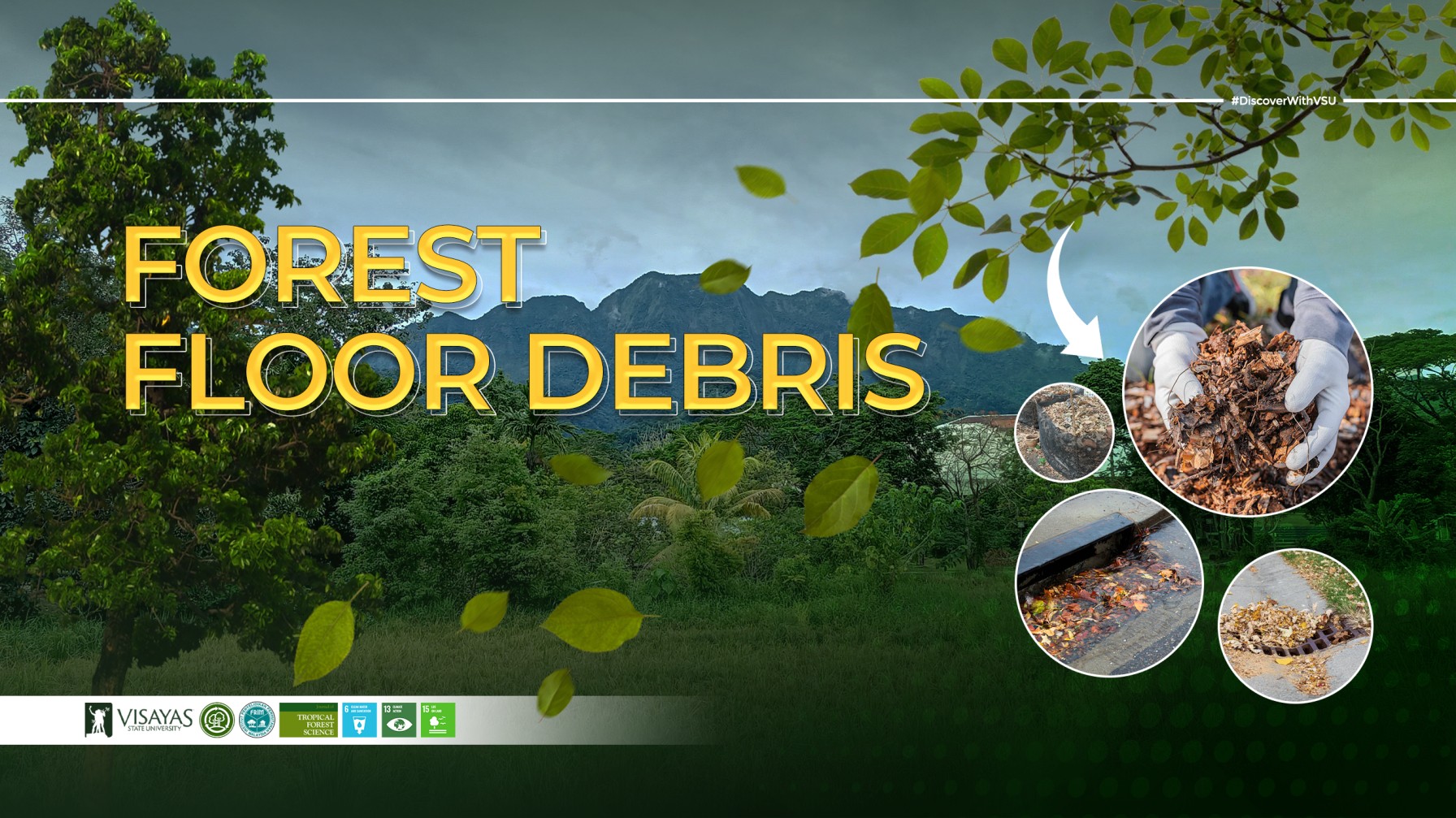
In Mt. Pangasugan, rain is both a gift and a threat. It feeds forests and farms, but when it falls hard and fast, it can also wash soil away, trigger landslides, and flood communities downslope.
A recent study by researchers from Visayas State University (VSU) takes a closer look at a part of the forest that rarely gets attention but strongly shapes how rain behaves–the litter layer, made up of fallen leaves, twigs, and decomposing plant material on the forest floor.
The study, published in the Journal of Tropical Forest Science in 2025, examined how well this litter layer holds water across five tree-based systems in Mt. Pangasugan including natural forest, narra plantation, mahogany plantation, rainforestation areas, and abandoned kaingin sites.
The research was authored by Mark Matthew Auguis, a VSU BS Forestry and MS Forestry graduate, and co-authored by Dr. Angelica P. Baldos and Dr. Dennis P. Peque of VSU’s Faculty of Forestry and Environmental Science (VSU-FFES), with fieldwork carried out in one of the university’s most studied landscapes.
What the team found has direct implications for land use, forest management, and community safety.
Natural forests performed best. Their forest floors absorbed and retained more rainwater than other land cover types. This slows surface runoff, keeps soil in place, and reduces the volume of water rushing downhill during heavy rains.
Tree plantations followed close behind. Narra and mahogany, both widely used in reforestation and rehabilitation, showed strong water-holding capacity through their leaf litter, particularly in the less-decomposed layers. Even without the complexity of natural forests, these plantations helped manage rainfall better than degraded areas.
The weakest performers were abandoned kaingin sites. With thinner litter layers and less canopy cover, these areas allowed rain to move quickly across the surface, carrying soil with it. The result is greater exposure to erosion and higher risks during intense rainfall.
To capture these differences, the researchers ran soaking experiments on litter samples collected from Mt. Pangasugan, tracking how quickly the material absorbed water and how much it could hold over time. Most of the absorption happened within the first 100 minutes, an important window during heavy rainstorms.
For communities living below forested slopes, these findings help explain why what happens uphill does not stay there. A healthy forest floor can reduce the force of rain before it reaches rivers, farms, and settlements.
The study also adds weight to VSU’s long-running work on rainforestation and tree-based land management. Mt. Pangasugan, studied and managed by the university for decades, continues to serve as a living research site where ecological processes are observed under real conditions.
Sometimes, the difference between soil staying in place and soil washing away is a layer of leaves doing its job.
This article is aligned with the Sustainable Development Goal (SDG) 6: Clean Water and Sanitation; SDG 13: Climate Action, and; SDG 15: Life on Land.