

#GlobalGreen: DOE gives VSU 100% compliance rating in energy efficiency
- Details
- Written by Claudette Meli Hoff E. Garduce
-
Published: 17 April 2026
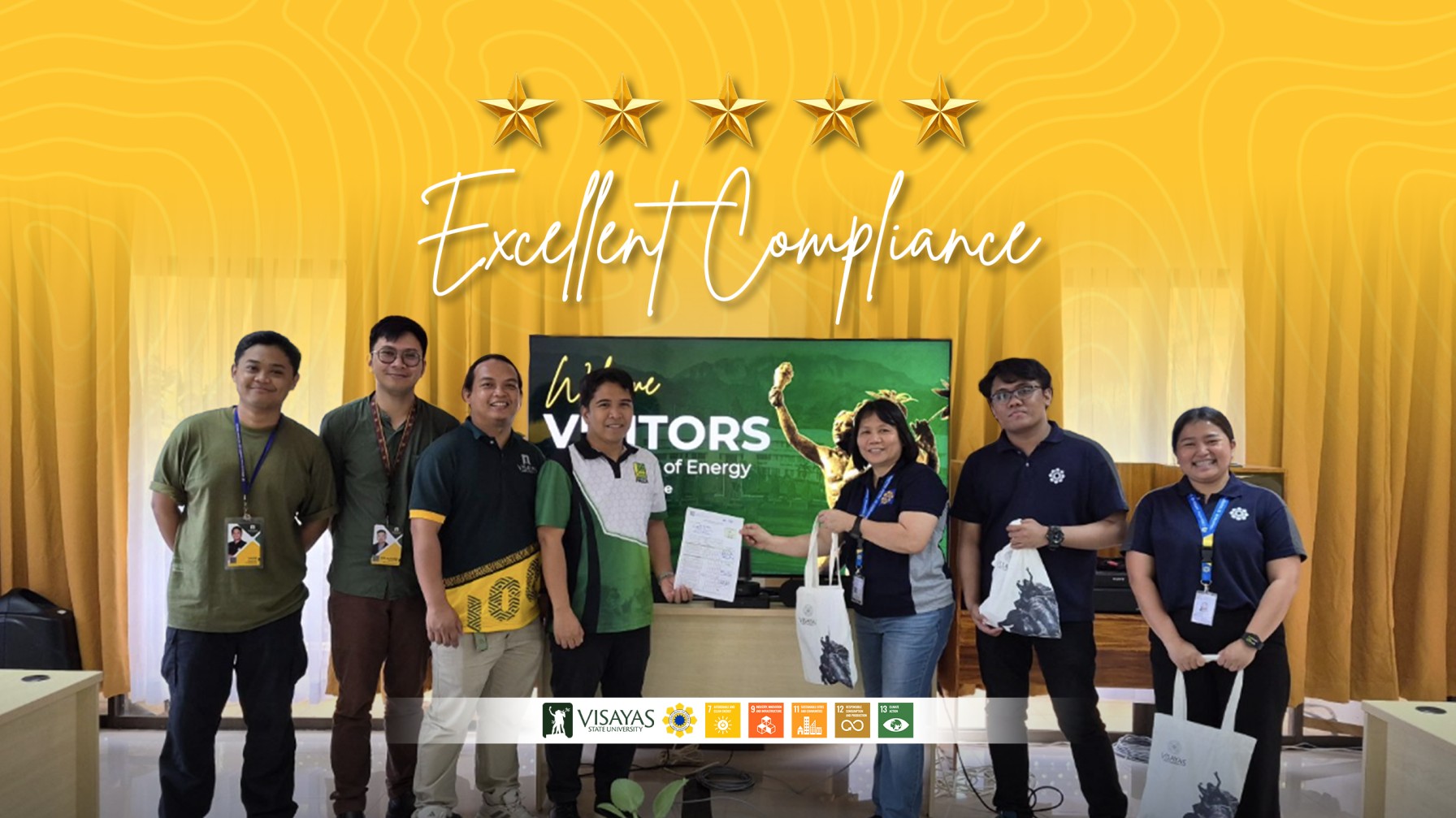
Visayas State University, long known as a "dark green school" for its lush campus and commitment to energy conservation, achieved a five-star equivalent or 100% compliance rating, the highest possible recognition under the Government Energy Management Program (GEMP), in a recent audit conducted by the Department of Energy (DOE) on the VSU main campus last April 8, 2026.
According to the DOE’s rating system, "Excellent Compliance" means the university strictly observes and implements energy efficiency policies.
This recent assessment also verifies that the university has fully institutionalized its energy conservation efforts which includes the formal designation of Energy Efficiency and Conservation (EEC) Officers and the consistent adoption of the GEMP online system for monitoring fuel and electricity consumption.
The evaluation magnifies several core areas where VSU is leading fuel and electricity conservation efforts: Smart Cooling, with approximately half (52.41%) of the university's air-conditioning units (ACUs) have already been converted to energy-efficient inverter technology; Operating Discipline, with ACUs strictly operated for only 6 to 7 hours a day (9:00 AM to 3:00 PM), as mandated by university directives; LED Lights, with nearly all (90.91%) of the campus lighting system upgraded to LEDs; Vehicle Maintenance through which the university maintains rigorous logbooks and preventive maintenance schedules for its service vehicles to ensure peak fuel efficiency.
"Best Practices" that go beyond standard requirements, as noted by DOE auditors, sets VSU apart from the rest.
Auditors commended the implementation of the “Green Day Policy” that promotes a car-less Wednesday and a four-day work week.
The university is also leaning towards renewable energy including current initiatives such as solar power integration with the university having installed solar panels at the Administration Building and the Department of Computer Science and Technology (DCST) building, micro-mobility which includes plans to pilot solar charging stations in the near future to accommodate e-bikes, and existing solar-powered streetlights and specialized solar installations on campus to maintain internet connectivity.
While the 100% rating is a milestone, the DOE supplied VSU with a roadmap that the institution can use to achieve even greater sustainability.
Some of the recommendations made include the conversion of the remaining non-inverter ACUs to finalize the shift to LED lighting and improve the visibility of EEC signages as a reminder to the community to unplug devices during idle times.
The successful audit was attested by Philip Caesar Ebit, VSU’s Energy Efficiency and Conservation Officer, Engr. Feihl Sinon, Director of Renewable Energy Research Center, and Dr. Moises Neil Seriño, Vice President for Administration and Finance.
Dr. Seriño reaffirms the university's dedication to pursue the recommendations of the DOE.
“As a proactive response to DOE’s energy audit last 2025, VSU integrated experts' recommendations into its BOR-approved energy management plan. This year’s on the spot audit reflects VSU’s collective commitment to responsible energy use and efficient management of resources across university operations. We are very thankful for the observation of the auditors from DOE for VSU’s compliance on energy efficiency,” he said in a statement.
As a pioneer in energy-saving initiatives in the region, VSU as a #GlobalGreen university models sustainable solutions in energy conservation for other SUCs and government agencies in the country, proving that academic excellence and environmental stewardship go hand-in-hand.
This article is aligned with Sustainable Development Goal (SDG) No. 7: Affordable and Clean Energy; SDG No. 9: Industry, Innovation, and Infrastructure; SDG No. 11: Sustainable Cities and Communities; SDG No. 12: Responsible Consumption and Production; and SDG No. 13: Climate Action.