

President’s Notes | 2026 Visayas Regional Scientific Meeting
- Details
- Written by Dr. Prose Ivy G. Yepes
-
Published: 11 June 2026
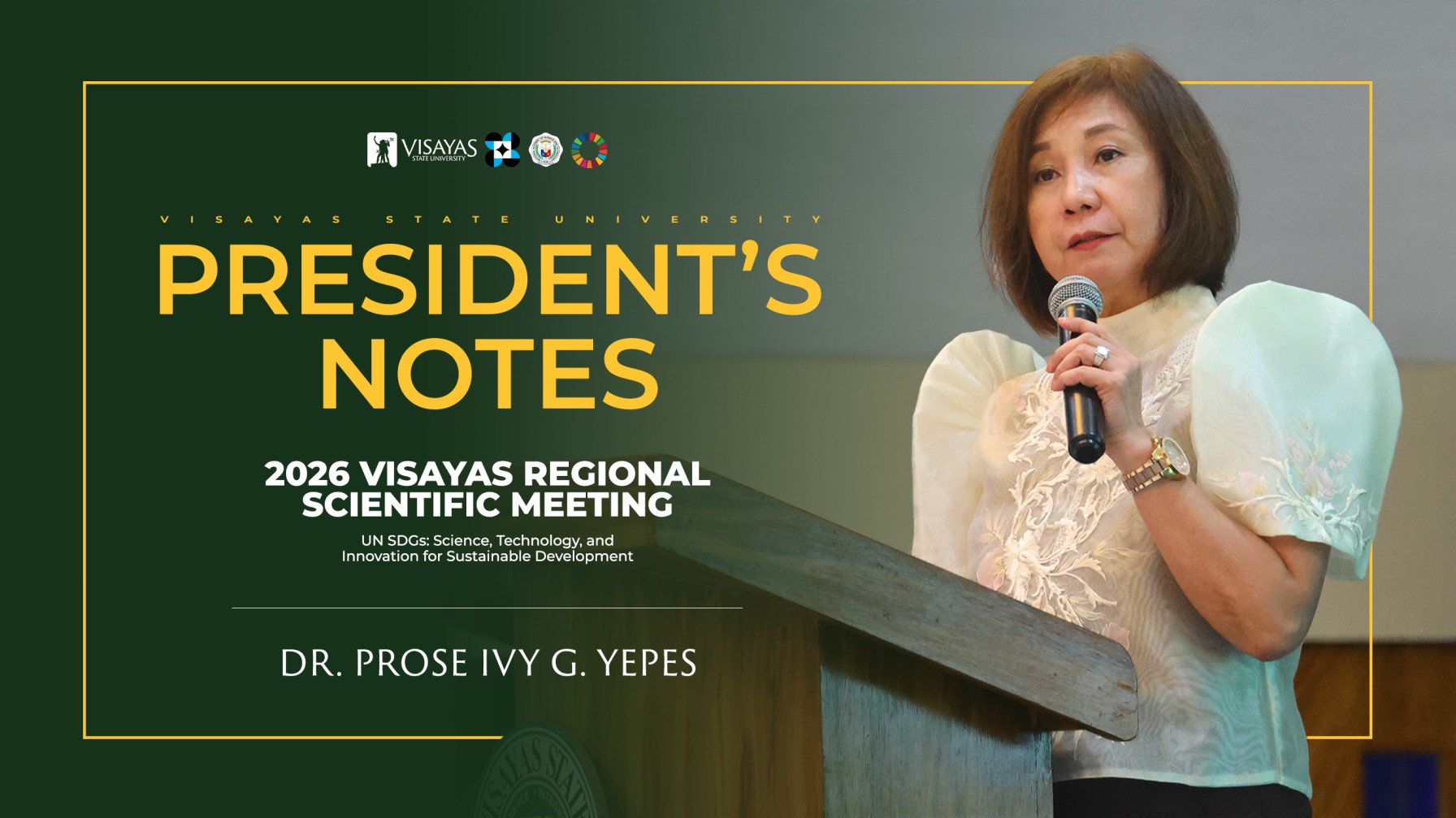
Plenary Lecture during the National Academy of Science and Technology, Philippines 2026 Visayas Regional Scientific Meeting, June 3-4, 2026, Tacloban City, Leyte.
Greetings of peace and solidarity!
To the good Secretary of DOST, Dr. Renato U. Solidum; President of NAST Philippines, Academician Jaime C. Montoya; NAST Philippines Director, Dir. Luningning E. Samarita-Domingo; DOST-VIII Regional Director, Dr. John Glenn D. Ocaña; DOST-VI Regional Director and keynote speaker, Engr. Rowen R. Gelonga, other regional directors, distinguished academicians, fellow SUC presidents and representatives; to all distinguished guests, fellow educators and researchers, government leaders, development partners, colleagues from industry and civil society, and all participants committed to shaping a more sustainable and inclusive future for our communities, a pleasant afternoon!
It is both an honor and a responsibility to speak before you today on the theme: Science, Technology, and Innovation for a Just Transition.
Today, I would like to share reflections from the perspective of Visayas State University as one of the premier universities in agriculture and fisheries, and more importantly, as a regional institution committed to serving the people and communities in the Visayas.
Our region continues to face interconnected challenges that directly affect the lives and livelihoods of millions of people.
We confront the realities of climate change through stronger typhoons, flooding, drought, and coastal degradation. We face persistent food insecurity, energy crisis, declining fisheries resources, rural poverty, biodiversity loss, and the increasing vulnerability of farming and fishing communities.
At the same time, we are witnessing another important concern: the growing disengagement of young people from agriculture and fisheries sectors that remain fundamental to our economy, culture, and food systems.
Yet despite these challenges, the Visayas remains a region of enormous promise. We possess fertile lands, rich marine ecosystems, resilient communities, indigenous knowledge systems, and institutions capable of driving transformation.
Most importantly, we have people who continue to adapt, innovate, and persevere despite adversity. And so the question before us is no longer whether transformation is needed.
The question is: How do we ensure that this transformation is sustainable, inclusive, resilient, and just?
This is where Science, Technology, and Innovation, or STI, becomes critically important.
A just transition means using science, technology, and innovation to modernize agriculture, fisheries, and rural economies while ensuring that farmers, fisherfolk, women, youth, indigenous peoples, and vulnerable communities benefit from the transition rather than being left behind by it.
Because innovation, by itself, is not enough. Innovation becomes meaningful only when it improves not only productivity, but also people’s lives.
A truly just transition must therefore balance four important pillars:
Sustainability supports progress that meets current demands while maintaining the capacity of future generations to meet their own needs.
Inclusion ensures that communities, sectors, and vulnerable groups are included and benefit from the process of transformation.
Resilience builds the ability of people, communities, and ecosystems to adapt to and recover from climate, economic, and social challenges.
And innovation, which means to generate new ideas, open opportunities, and help communities move toward more inclusive and sustainable growth.
In other words, a just transition should be people-centered, planet-friendly, and future-ready. Science must solve real problems. Technology must become accessible. Innovation must create opportunities. And development must uplift communities while protecting ecosystems for future generations.
In this transformation, universities have a very important role to play. Why do universities, like VSU, matter?
Universities are uniquely positioned because they bring together education to equip learners with the skills, values, and mindset needed to thrive in an evolving society; research to create knowledge that informs decisions, improves lives, and responds to pressing issues; innovation to use research and create solutions that respond to society’s needs; extension to bring the universities closer to the communities it serves; and public service to apply knowledge and expertise to support good governance, public service, and national development.
Today, universities are being called to do more than produce graduates or publish research papers. Universities must evolve from knowledge centers into transformation hubs for communities and regions.
They must become institutions that connect science with society, innovation with inclusion, and research with real-world impact. As DOST reminds us, "Agham na Ramdam." The true measure of science is not what we discover, but how many lives we improve.
For institutions in agriculture and fisheries, this responsibility becomes even more urgent because the future of food systems, environmental sustainability, and rural development depends heavily on our ability to generate solutions that are locally grounded and socially responsive.
Allow me now to share how Visayas State University is redefining its efforts to significantly contribute to this vision of STI for a just transition.
We recognize that transformation cannot be achieved through isolated projects alone. It requires an integrated ecosystem that combines instruction, research, innovation, extension, and partnerships. At VSU, we frame this contribution around three major pillars.
Human capital is the foundation of a just transition.
At VSU, we believe that the future of agriculture and fisheries depends on preparing graduates who are not only technically competent, but also sustainability-oriented, innovation-driven, and community-centered.
This means integrating climate resilience, sustainable resource management, entrepreneurship, digital innovation, and experiential learning into our academic programs.
We continue to strengthen community immersion, field-based learning, and interdisciplinary approaches so that our students understand the realities faced by farmers, fisherfolk, and rural communities.
We want our graduates to become not only professionals, but also innovators, advocates, and leaders of societal transformation.
Because ultimately, the future of agriculture and fisheries will depend on whether the next generation sees these sectors not as industries of survival, but as fields of innovation, opportunity, and nation-building.
Under VSU’s ELEVATE Program Framework, the university ensures that its instructional services remain high-quality, flexible, resilient to disruptions, and globally relevant, while nurturing graduates who are adaptive, ethical, innovative, and prepared to lead in an interconnected and VUCAD (volatile, uncertain, complex, ambiguous, and disrupted/digital) world.
At VSU, our research and innovation initiatives shall be focused on the thematic areas stipulated in VSU’s PROPEL research and innovation agenda and roadmap which includes:
- Agriculture, Forestry, Fisheries and Natural Resources;
- Water, Energy and Food Security;
- Building, Infrastructure and Transport;
- Health and Wealth;
- Biodiversity and Environmental Management;
- Climate Change;
- Governance and Transformative Change;
- Data Science and Analytics;
- Education and Training;
- Circular Economy, Social Sciences and Gender and Development;
- Blue Sky Research.
But more importantly, we are guided by an important principle: Research should be locally grounded, community-responsive, and scalable across the Visayas. Innovation, in turn, must move beyond laboratories and create tangible impact in farms, fisheries, forests, and communities.
Whether we are working on resilient crops, sustainable aquaculture systems, renewable energy technologies, or digital agriculture platforms, the goal remains the same: To improve livelihoods, strengthen resilience, and support sustainable development.
And in a region highly vulnerable to climate change, STI must also become a tool for adaptation, disaster resilience, and long-term ecological stewardship.
This is where the idea of a “just transition” becomes most visible. At VSU, we understand that communities are not merely recipients of innovation. They are our partners and co-creators in developing technologies.
Through extension programs, farmer and fisherfolk trainings, LGU collaborations, community-based initiatives, and partnerships with industries and development organizations, we strive to ensure that knowledge and technologies reach the people who need them most. These are the ways forward of VSU’s community engagements under the iCARE program framework.
We will further advance our innovation ecosystem through the proposed establishment of a Knowledge, Innovation, Science and Technology (KIST) Hub at VSU, with the support of DOST and the Philippine Economic Zone Authority (PEZA).
As shown in the slide, Batangas State University already hosts a KIST Park, and VSU is among the universities identified to develop its own KIST Hub.
Once established, the KIST Hub will serve as a platform for startups, technology incubation, collaborative innovation, livelihood generation, and investment opportunities. Our vision is to bring together universities, local governments, industries, and communities to create regional economies that are both inclusive and sustainable.
As we look ahead, the challenge before us is larger than any single institution. The future of the Visayas will depend on how effectively we build regional ecosystems for science, technology, and innovation. Allow me to propose several important directions.
First, we must strengthen regional STI ecosystems by deepening collaboration among universities, government agencies, industries, and communities. Just recently, DOST and Samar State University (SSU), together with other SUCs in the region, LGUs, NGAs, and industries, had launched USWAG, which stands for United Start-ups and Start-up Enablers for Wealth Creation, Acceleration, and Growth.
Second, we must accelerate climate-resilient agriculture and fisheries systems that prioritize sustainability, biodiversity protection, and food security.
Third, we must democratize access to innovation developed by our own experts contextualized on our own local and community needs so that even smallholder farmers and fisherfolks, women, youth, and remote communities can benefit from technological advancement.
Anent to this, we just launched the BRIDGE project of the Visayas Consortium for Agri-Aqua and Natural Resource Program (ViCARP) that bridges research-driven innovation for development, growth, opportunity and sustainable impact. Specifically, this is an online platform that provides free online courses and showcases technologies of researchers from the different SUCs in the region and other member institutions and agencies of ViCARP.
Fourth, we must empower the next generation of innovators, entrepreneurs, scientists, and community leaders.
And fifth, we must nurture a community of practice where knowledge, experience, and innovation are continuously exchanged for the common good.
As I conclude, allow me to emphasize that a just transition is not simply about technological advancement. It is about ensuring that science, technology, and innovation uplift communities, protect ecosystems, and create shared prosperity.
True to our slogan, "VSU Strides for Excellence and Impact,” anchored on our guiding principles we call STRIDES, universities like VSU must continue serving not only as centers of learning, but as catalysts of sustainable and inclusive transformation for the Visayas and beyond.
And if we succeed in building and strengthening innovation ecosystems that are people-centered, climate-responsive, and socially inclusive, then the Visayas will not only adapt to the challenges of the future. It will help lead the future.
Thank you for listening and for the opportunity to speak before all of you.
This lecture aligns with Sustainable Development Goal (SDG) 1: No Poverty; SDG 4: Quality Education; SDG 8: Decent Work and Economic Growth; SDG 9: Industry, Innovation, and Infrastructure; SDG 10: Reduced Inequalities; SDG 11: Sustainable Cities and Communities; SDG 13: Climate Action.