

#VSUGrad2026 | Valedictory Speech of Albert Victor M. Senillo (Magna Cum Laude)
- Details
- Written by Albert Victor M. Senillo
-
Published: 24 July 2026
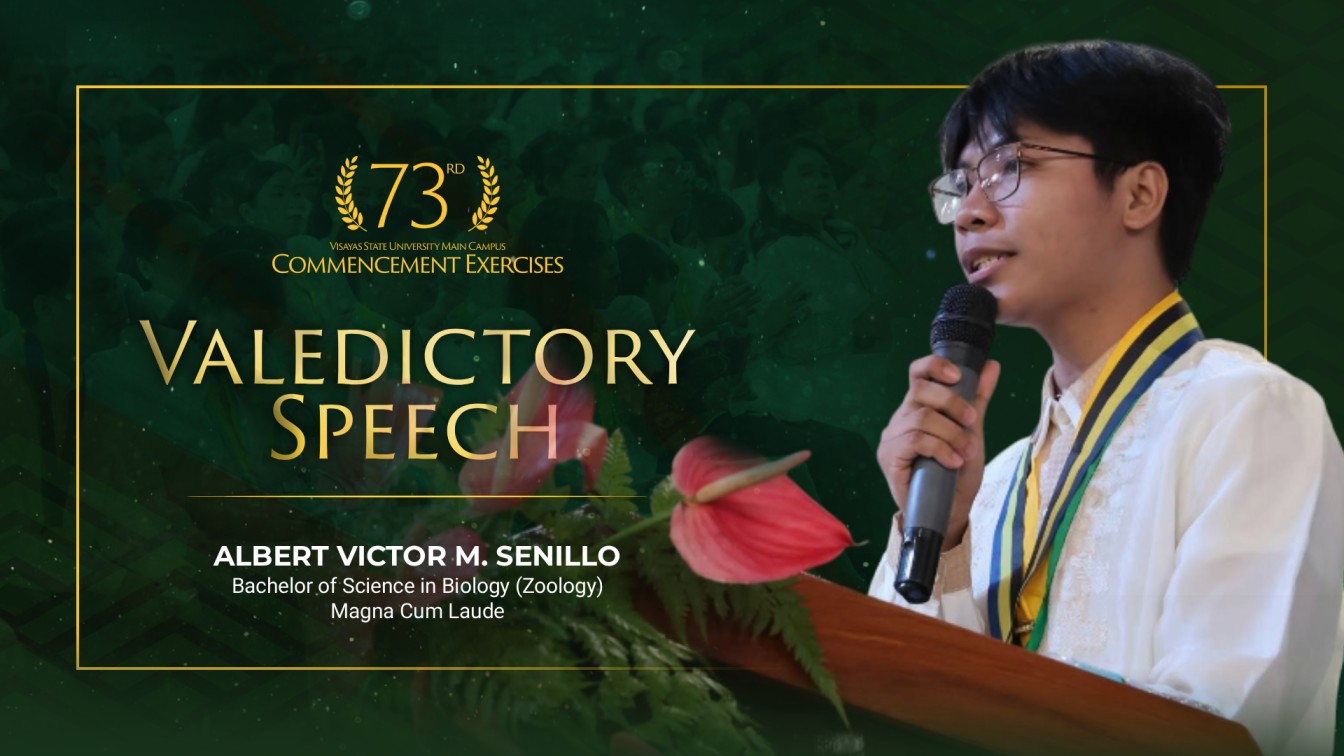
To our university president, Dr. Prose Ivy Yepes, university officials, faculty members, staff, honored guests, proud parents and families, and my fellow members of the Class of 2026, a pleasant morning to us all!
There is a question I wish someone had asked me when I first entered Visayas State University. Not "What do you want to become?,” rather, "Who might you fail to notice while becoming it?"
Four years ago, if you had asked me what I hoped to gain from studying here, I would have spoken about knowledge, opportunities, and the dream of building a meaningful career. And I think I would have been right. Those are, after all, some of the reasons we come to a university. But somewhere between my first day and this morning, another lesson was quietly unfolding around me. It just simply took me years to notice it.
I have always found it fascinating how easily our eyes are drawn to what stands out. We notice the tallest building in a city. The standing ovation after a performance. The names engraved on medals. We remember remarkable achievements and extraordinary moments because they ask to be remembered. But only later do we remember the hands that built the building, the countless rehearsals behind the performance, and the quiet sacrifices that came long before a medal was ever awarded.
We often say that education teaches us how to think, how to ask questions, and how to understand the world around us. And it certainly does. But after four years at this university, I have begun to wonder whether that is only half of what education is meant to accomplish. Because somewhere along the way, without ever announcing itself, VSU quietly began teaching me something else.
It taught me how to notice.
Not only ideas, discoveries, or opportunities. It taught me to notice people. To notice that the brightest people are not always the loudest. That some of the strongest people carry the heaviest burdens. That behind a smile may be someone quietly wondering whether they are doing enough. That every achievement has unseen sacrifices behind it. And that this university has always been held together by people whose work often goes unnoticed.
The longer I stayed here, the more I realized that the most meaningful things in life rarely announce themselves. They quietly wait for someone willing to pay attention. And if education has truly changed the way we see the world, then perhaps it should also change the way we see one another.
This leads me to a question I hope we continue asking long after we leave this place.
What kind of society are we building if we only celebrate what is visible? If we applaud the person standing on the stage but forget the many people who quietly built the stage itself? If we recognize the names that receive awards but overlook the countless names without whom those awards would never have existed? If we become so fascinated by excellence that we slowly lose our ability to recognize dignity?
I don’t think this is only a question for universities. I think it is a question for all of us. Because the things we repeatedly choose to notice eventually become the things we choose to value. And the things we fail to notice often become the people we unintentionally leave behind. That is why paying attention is never a passive act. It is a moral one.
The way we look at the world shapes the way we live in it. And sometimes, the more clearly we learn to see, the harder it becomes to ignore. Harder to ignore that not everyone began this journey from the same place. Harder to ignore students who had to balance exams with work, responsibilities at home, grief, or uncertainties that rarely found their way into classrooms. Harder to ignore communities where access to education, healthcare, or even opportunities that many of us consider ordinary still remains a privilege rather than a guarantee.
I hope education sharpens our vision. But I also hope it never narrows it. I hope it never becomes a ladder that lifts us so high we stop seeing those who are still climbing. Because I don’t think the purpose of learning is simply to rise above others. I think it is to return with clearer eyes, wider compassion, and a deeper commitment to make the path a little more possible for the people who will walk it after us.
There was a time when I believed that learning meant finding answers. Perhaps that is still true. But these four years taught me that some of the most meaningful discoveries begin with learning to ask better questions. Questions that changed not only the way I understood the world, but also the way I understood the people around me.
They taught me to look beneath appearances. Beneath achievements. Beneath titles. To remember that behind confidence there may be fear. Behind silence there may be courage. Behind success there are almost always unseen sacrifices. And behind every person sitting here this morning is an entire constellation of people who helped make this moment possible.
And with that, I realized that perhaps gratitude is one of the purest forms of paying attention. Because gratitude asks us to slow down. It reminds us that none of us are entirely self-made. It teaches us to look backward before we dare look ahead. So before we close this chapter of our lives, allow me to notice the people who quietly became part of my own story.
First, I thank the Lord. Looking at everything I went through, I can no longer explain this journey by my own efforts alone. There were opportunities I never imagined, doors I could not have opened myself, and seasons when His faithfulness quietly arrived through the kindness and presence of other people. If this university taught me how to notice, then perhaps one of its greatest lessons was helping me recognize that grace often appears quietly, woven into ordinary moments and ordinary people.
To my Papa, Mama, my Ates and Kuyas, and the rest of my family, thank you so much for carrying burdens I did not fully understand until I was old enough to recognize them. Thank you for believing in possibilities that often felt larger than our circumstances, for supporting not only my education but also the person I was becoming. I know that every opportunity I have received rests upon sacrifices, prayers, encouragement, and love that were never mine alone.
To the Department of Science and Technology through the DOST-SEI Scholarship Program, thank you for opening doors that may have otherwise remained closed. Thank you for reminding students like me that when a nation chooses to invest in education, it also chooses to invest in hope. And to every Filipino taxpayer, thank you. A part of this journey was made possible because of your quiet contribution. I hope that wherever life takes me after today, I may honor that investment by using science not only to advance knowledge but also to improve lives.
To my teachers, especially those from the Department of Biological Sciences, and to my thesis committee, Sir Darius, Ma'am Mazo, and Doc Phil, thank you for believing that education is more than the transfer of knowledge. Through your own lives, you taught me that teaching is also an act of believing in another person’s capacity to grow.
To the Guidance and Counseling Services Office, especially Ma’am Cobico and Sir Kent, thank you for reminding me that asking for help is never a sign of weakness. During seasons when my own thoughts felt overwhelming, your kindness, patience, and willingness to listen helped me find clarity. Thank you for creating a space where I never felt judged for needing support.
To my closest friends, I can’t mention each of you by name, but you know who you are. Thank you for walking with me through different seasons of my life. Thank you for listening when words were difficult to find, for reminding me to rest when I only wanted to keep going, and for filling even the hardest days with laughter that somehow made everything feel lighter. More than anything, thank you for reminding me that I was never meant to walk this journey alone.
To my family in the College of Arts and Sciences Supreme Student Council, thank you for showing me that leadership is, above all, an act of service. Thank you to every officer I served alongside those two years, and to our advisers, Sir Diao, Sir Junrey, and Ma’am Ianvie, for trusting us with responsibilities that shaped not only the leaders we became, but also the people we continue to become.
To the staff members of this university, thank you so much. Thank you for preparing our classrooms before we arrived, maintaining the spaces where we learned, keeping this campus safe, caring for the grounds we proudly call home, and quietly making our everyday lives easier in ways many of us may never fully realize. Universities are remembered for their graduates, but they are sustained every day by people whose names are rarely called onto stages like this one.
And finally, to Visayas State University. Thank you for becoming so much more than a place where I earned my degree. You became a place where strangers became lifelong friends, where questions slowly became convictions, where uncertainty gradually transformed into purpose, and where countless ordinary days quietly shaped the person standing before you this morning.
Looking back now, I realize that while I came here hoping to build a future, what I found along the way was a community that helped build me. Perhaps that is the greatest gift this university has given any of us. Not simply an education, but the people through whom that education became possible. And perhaps that is exactly what I have been trying to say all along.
My fellow members of the Class of 2026, thank you. Not because we walked this journey flawlessly. Because we didn’t. We stumbled. We doubted ourselves. Some days, we simply survived. Yet somehow, we kept showing up, especially for one another.
We entered this university carrying different stories, different fears, and different definitions of success. Yet somewhere between our late-night conversations, our victories, our difficult goodbyes, and countless ordinary moments that never found their way into our photographs, we quietly became part of one another’s stories.
If these four years have taught me anything, it is that the people who change our lives are rarely the loudest. More often, they are the ones who stay, who listen, who encourage, who believe, who notice. Because sometimes, changing a life begins with nothing more extraordinary than helping another person feel seen.
Soon, this campus will begin telling new stories. Other students will occupy the classrooms we once hurried into. They will walk the same paths, ask the same questions, and carry dreams entirely their own. And perhaps that is exactly how it should be. Because universities were never built simply to preserve memories. They exist to prepare people who will leave them and help shape the world beyond their gates. And the question, by then, is not whether we are leaving. It is what kind of people will be leaving.
I hope our education never becomes a wall separating us from those whose lives look different from our own. I hope it becomes a bridge leading us back toward them. Because one of the greatest privileges of education is that it becomes increasingly difficult to look away. Once we understand the realities others face, compassion is no longer optional. It becomes a responsibility.
So wherever life takes us after this morning, I hope we carry more than our degrees. I hope we carry curiosity humbly enough to keep asking questions. Integrity that refuses convenience over what is right. Compassion that reaches beyond the people who look like us, think like us, or live like us. And above all, I hope we carry eyes that never lose their ability to notice.
Notice the child who believes education was never meant for someone like them. Notice the community that has learned to survive despite being forgotten. Notice the worker whose labor quietly makes your own possible. And when a friend says, "I'm okay," have the courage to ask again.
Because we often imagine that changing the world begins with extraordinary acts. But I no longer believe that. I think it begins much earlier. It begins the moment we refuse to overlook another person’s humanity. The moment we choose to see what others pass by. The moment someone who has long felt invisible finally feels seen.
So, Class of 2026, as we step into lives that will undoubtedly look different from one another, may we never lose the kind of vision these past four years have quietly been teaching us. May success never narrow the way we see others. May knowledge never make us indifferent. May ambition never make us forget our humanity. And may every room we enter become a little kinder, every community we serve become a little stronger, and every person we encounter leave feeling a little less invisible because we were there.
Because in the end, the measure of our lives will not be found in how many people knew our names. It will be found in how many people felt seen because we knew theirs.
Thank you very much, and may God bless us all.