
Excellence with Purpose: Stories of VSU’s Class of 2026 valedictorians
- Details
- Written by Riza Mae L. Maningo
-
Published: 22 July 2026
At Visayas State University, academic excellence has never been meant to end with just a distinction.
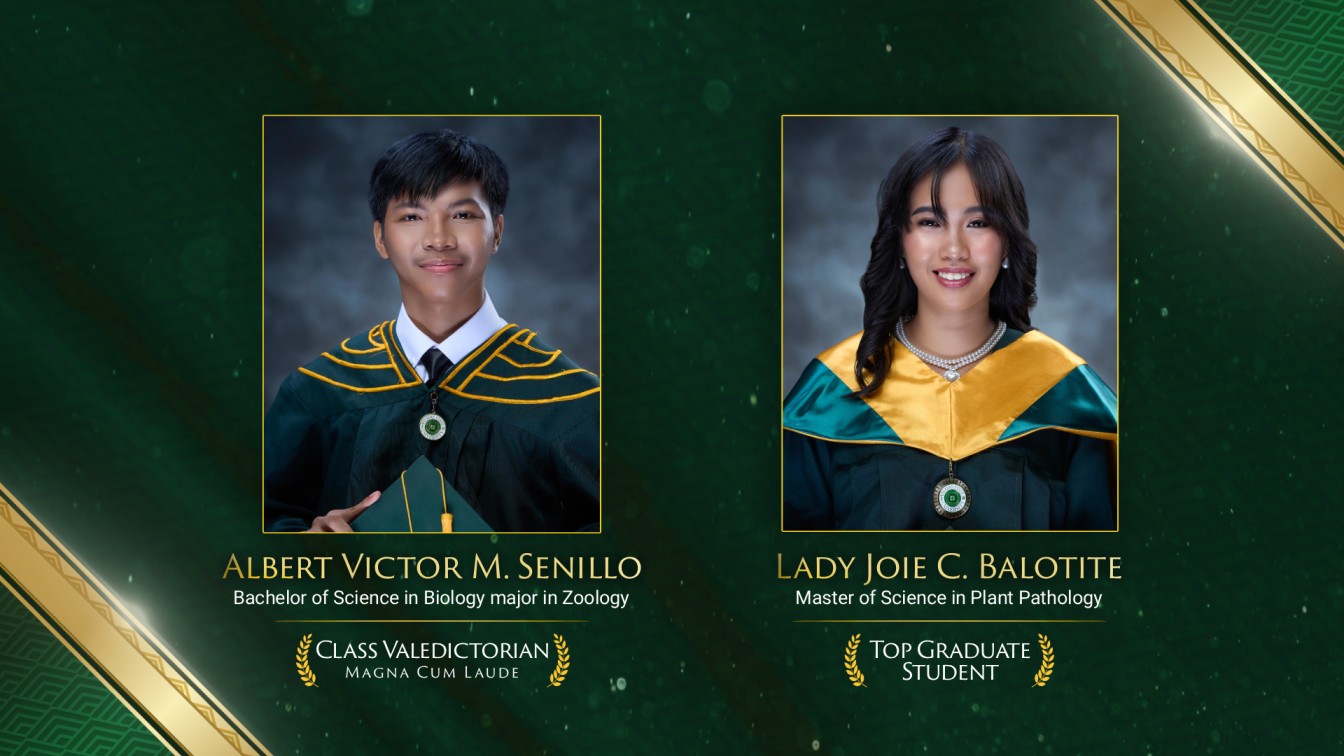
For Albert Victor M. Senillo and Lady Joie C. Balotite, being named the top graduates of the VSU Class of 2026 is not simply the culmination of years spent earning high grades. It is the result of journeys that challenged them to become more than excellent students—to become scientists, researchers, leaders, educators, and people whose knowledge is ultimately meant to serve others.
Albert, a Bachelor of Science in Biology major in Zoology, will graduate as the undergraduate valedictorian with a GWA of 1.25 and the distinction of Magna Cum Laude.
Joie, meanwhile, will lead VSU’s graduate students as valedictorian of the Graduate School with a GWA of 1.14 from the Master of Science in Plant Pathology program.
Their stories are different.
Albert’s journey at VSU began with a young man who was more comfortable listening than speaking, who struggled with anxiety, and who once found it difficult to imagine himself standing and talking before an entire graduating class.
Joie’s journey unfolded as a mother and professional who returned to graduate school while raising her young son, working, conducting research, and navigating the demands of family and academic life.
But their stories converge in one important way.
At VSU, excellence became meaningful to them not because it placed them above others, but because it taught them how to use what they had learned for others.
A continuing VSU story
In many ways, the stories of Albert and Joie continue a narrative that VSU has been telling through its top graduates year after year.
In 2025, Jose Enrique E. Reyes, a Bachelor of Science in Marine Biology graduate from Talisay, Cebu, and Jacklyn E. Olaer of the Master of Science in Development Communication program were named the top students of their respective graduating groups.
Jose Enrique graduated Summa Cum Laude with a GWA of 1.187, while Jacklyn topped the Graduate School with a GWA of 1.092.
Their achievement was notable not only because of their academic standing, but because of the way their VSU education had brought them closer to the realities of the communities they hoped to serve.
For Jose Enrique, marine biology was never simply about studying marine organisms.
During his internship with the City Environment and Natural Resources Office (CENRO) in Tagbilaran, Bohol, he worked with local patrollers and fisherfolk in reef checks, fish counts, and species monitoring.
The experience led him to confront the realities faced by fishing communities and to understand that environmental science could not remain distant from the people whose lives were directly affected by environmental problems.
“Dili lang ni research para maka-graduate. Dapat motabang pod sa community. Walay meaning ang science kung layo siya sa mga tao,” he said.
[It is not just conducting research as a graduation requirement. It should also help people. Science has no meaning if it is distant from the people.]
That principle shaped his thesis on marine protected area enforcement, which sought to connect scientific research with local knowledge and lived realities.
Jacklyn’s journey reflected a similar commitment to using education as a tool for service.
After finding her way into Development Communication, she discovered a field that allowed her to combine communication, research, and community engagement.
Her work connected academic knowledge with the realities of farmers, youth, and local development workers. Through VSU-led extension initiatives, she helped translate complex ideas into materials and messages that communities could understand and use.
Her journey was also shaped by personal loss and difficult seasons.
But the people she encountered at VSU helped her continue.
“If you carry pain, you can turn that into strength not just for yourself, but for others who have gone through the same,” she said.
Jose Enrique and Jacklyn showed how academic excellence could be grounded in empathy and purpose.
A year later, Albert and Joie now carry that story forward in their own distinct ways.
The questions they ask are different.
The communities they hope to serve are different.
Their personal journeys are different.
But the underlying principle remains familiar: at VSU, education is at its most meaningful when it moves beyond the individual and responds to the needs of the community.
From a quiet student to a scientist and servant-leader
Albert did not enter VSU as the kind of student people would immediately expect to become valedictorian.
He was shy and solitary, more comfortable listening than speaking. Being the center of attention made him anxious, and working with unfamiliar people often pushed him outside his comfort zone.
“I was very solitary,” he recalled. “I had friends who basically adopted me, but I still preferred spending time on my own, quietly listening rather than speaking.”
But the VSU experience would gradually challenge him to step forward.
Through his academic training in the Department of Biological Sciences, his involvement in student organizations, his research work, and his experiences in leadership and community engagement, Albert found himself doing things he once would have avoided.
He attended meetings.
He worked with people with different personalities.
He handled responsibilities that affected others.
He grappled with his anxiety to connect with people.
And, eventually, he learned that leadership did not require him to become the loudest person in the room.
“Leadership isn't about holding a position but about serving others well,” he said.
As Head of the Committee on Sanctions, he learned that institutional responsibilities require both fairness and empathy. Through community initiatives such as CAS We CARE for the Community and Environment, he saw how university engagement could bring together students, faculty members, local officials, parents, and children in efforts that respond to actual community needs.
These experiences became part of a larger VSU education—one that moves beyond the classroom and laboratory.
For Albert, the university became a place where he was not only trained to become a scientist, but also challenged to understand the responsibilities that come with knowledge.
When science leaves the laboratory
Albert’s undergraduate research began with a question about gastrointestinal parasites and the environment.
His thesis examined gastrointestinal nematode contamination in river sediments, generating baseline information on an environmental dimension of disease transmission that had received little attention in the Philippine context.
The work was technical, but its implications were deeply human.
Rivers are part of everyday life for many communities. They are used for bathing, washing, fishing, and other activities. Understanding what may be present in these environments is therefore not merely an academic exercise. It is a public health concern.
The research eventually brought Albert to his first international scientific conference where he won third place.
But the achievement did not feel like a victory he could claim for himself alone.
He thought of his adviser, his family, and his friends—the people beneath his wings, who had encouraged him to present his work even when he doubted himself the most.
“Achievements like that are never achieved lightly and, most of all, never earned alone,” he said.
This realization has shaped the great scientist he hopes to become one day.
His training at VSU and his internship at the IHoPE Laboratory of the University of the Philippines Los Baños strengthened his skills in parasitological and molecular methods, morphometric analysis, and GIS.
But beyond technical expertise, these experiences strengthened his belief that research must eventually return to the people.
“Being a scientist isn't just about asking good research questions,” he said. “It's also about making sure that the knowledge we generate ultimately contributes to healthier communities, a better environment, and a better quality of life for others.”
That belief reflects the true #ProudViscan spirit that VSU seeks to develop—one who understands that research is not an end in itself, but a means of responding to the needs of society.
The graduate student who made room for both motherhood and research
For Joie, the road to becoming VSU’s top graduate student was shaped by a different kind of challenge.
She was not only pursuing a master’s degree.
She was also raising a child.
After completing her undergraduate degree, Joie had imagined herself working, pursuing graduate studies, and continuing to grow professionally. But motherhood came first.
She returned to work only a month after giving birth to her son, Akio, whom she raised primarily on her own with the support of her family.
When she eventually returned to VSU graduate school, she did so with a clear understanding of what was at stake.
The DOST-ASTHRDP scholarship helped make her graduate studies possible. But completing the degree still required the daily work of balancing motherhood, research, professional responsibilities, and academic demands.
Then came a personal goal that gave her journey an even deeper meaning.
She and Akio would graduate in the same year.
“I need to finish my MS on time para magdungan mi ni Aki ug graduate this 2026,” she wrote.
[I need to finish my MS on time so that Aki and I can graduate this 2026.]
When that dream finally became reality, it represented more than two academic milestones.
It represented years of choosing to continue.
There were nights when Joie waited for her son to fall asleep before studying or working on academic requirements.
There were also days when Akio accompanied her during her research activities.
In her greenhouse experiments, he helped fill pots with sterile soil, grind leaf samples, and water plants. When he was not helping, he explored the grass and collected insects.
For Joie, these moments showed that motherhood and scholarship did not have to exist in separate worlds.
Her son became part of the story of her research journey.
“I want him to always know this: we did it together,” she said.
Research that serves the people who depend on the land
Joie’s research focused on Sweetpotato Leaf Curl Virus, a disease affecting sweetpotato—a crop that she believes deserves greater recognition for its contribution to food security, nutrition, climate resilience, and rural livelihoods.
Her study optimized the detection of the virus and found genetic variability suggesting that the pathogen continues to evolve.
The findings point to the need for stronger disease surveillance, the production and distribution of virus-free planting materials, and regulatory measures to help prevent further spread.
But behind the technical language of plant pathology is a concern that Joie understands deeply.
When diseases affect crops, the consequences do not remain in the field.
They can affect farmers’ livelihoods, food supply, prices, and the welfare of communities that depend on agriculture.
“Research is ultimately about service,” she said.
Her commitment to service was also shaped by her experience as a teacher.
While working in a public school, she visited students in their homes and saw the realities that could not be fully understood from inside the classroom.
One former student later told her:
“Ma'am, dili siguro ko mugraduate run ug wala ko nimo giadto sa amo balay.”
[Ma’am, I probably would not have graduated if you had not visited our home.]
The experience changed the way she understood education.
For Joie, teaching was not simply about delivering lessons. It was about seeing the person behind the student.
That same perspective now informs her work as a researcher.
Knowledge, she believes, must not remain confined to laboratories, academic papers, or conference presentations. It must eventually reach the farmers, communities, and institutions that need it the most.
A tradition of excellence that keeps becoming more meaningful
The stories of Jose Enrique and Jacklyn in 2025, and Albert and Joie in 2026, reveal a continuing pattern in the kind of students VSU brings to the forefront.
They are scholars who ask questions beyond the requirements of a degree.
They are researchers who see the people behind the data.
They are communicators who believe knowledge should be understood and shared with the community.
They are leaders who see positions as opportunities for service.
And they are individuals whose personal struggles have deepened, rather than diminished, their capacity to understand others.
This is the kind of excellence that VSU seeks to cultivate.
At VSU, Albert found opportunities that pushed him beyond his natural inclination toward solitude. His academic training, research experiences, leadership responsibilities, and community engagement helped him discover that he could contribute meaningfully even when he was not the most outspoken person in the room.
Joie returned to VSU’s graduate community with the responsibilities of a mother and professional. Through her mentors, the Department of Pest Management, the Graduate School, and the broader academic environment, she continued to develop as a researcher while pursuing a personal dream that she could share with her son.
For both, VSU became more than a place where they completed degrees.
It became a community that helped them grow into people capable of using their education beyond the university.
Albert hopes to be remembered not only as a valedictorian or awardee, but as someone who remained curious, advocated for kindness, and tried to leave people and places better than he found them.
Joie hopes to leave a legacy built on scientific contribution, compassion, integrity, and service to society.
Their stories affirm a defining principle of VSU’s educational mission: that excellence is most meaningful when it is connected to purpose.
The university’s top graduates do not emerge from a life without struggle.
They arise from classrooms, laboratories, fieldwork, organizations, communities, families, and personal battles that have taught them how to persevere.
Albert learned that strength does not mean carrying every burden alone.
Joie learned that motherhood and responsibility need not mean the end of one’s dreams.
Together, their stories form a continuing VSU narrative: one in which academic achievement is not the final destination, but a platform from which graduates can serve, lead, discover, communicate, and create meaningful change towards the society that they belong to.
Albert Victor M. Senillo and Lady Joie C. Balotite, together with the Class of 2026, will soon leave the university carrying their degrees and the recognition that comes with them.
But what VSU hopes they carry even farther is something less visible and more enduring: the courage to keep learning, the gratefulness and humility to acknowledge the people who helped them along the way, and the commitment to use their knowledge in service of a country and a world that needs people who can do more than excel.
They need people who can make excellence truly matter.
This article is aligned with the Sustainable Development Goal (SDG) 4: Quality Education; SDG 5: Gender Equality; SDG 6: Clean Water and Sanitation; SDG 13: Climate Action; SDG 15: Life on Land; and SDG 17: Partnerships for the Goals.