

VSU’s Abaca Researchers and Innovators earn presidential award for empowering farmers
- Details
- Written by Elmera Y. Bañoc
-
Published: 28 January 2026

The Abaca Researchers and Innovators Team of Visayas State University (VSU) brings national pride to the university and to the Philippine abaca industry after being named a recipient of the Gawad Lingkod Bayan ng Pangulo Award (Group Category) under the 2025 Gawad Lingkod Bayani.
The team formally received the award from President Ferdinand R. Marcos Jr. duly represented by Executive Secretary Ralph G. Recto during the PAGPUPUGAY 2025: Parangal sa mga Lingkod Bayani ceremony on January 28, 2026 at Malacañang Palace.
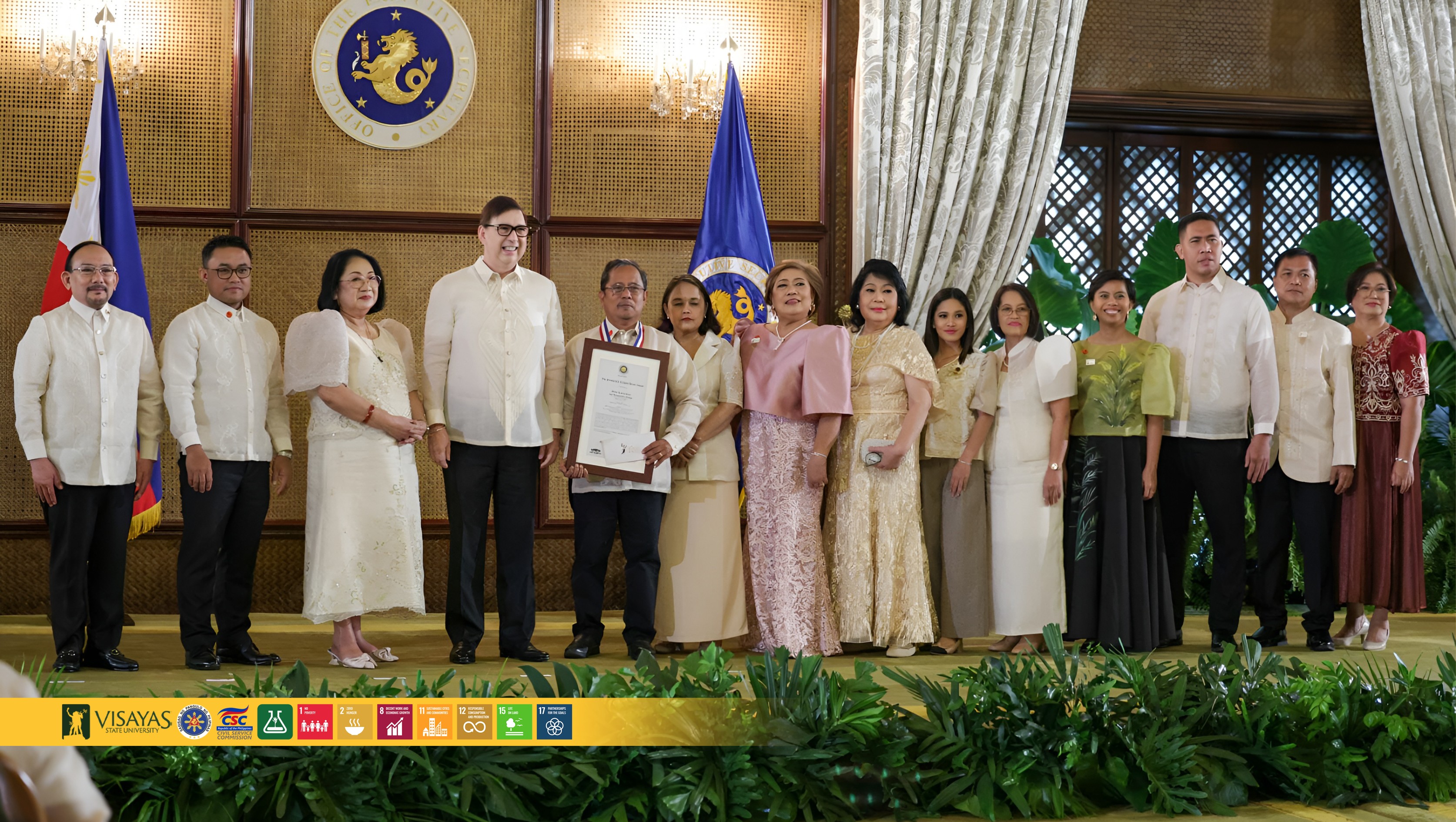
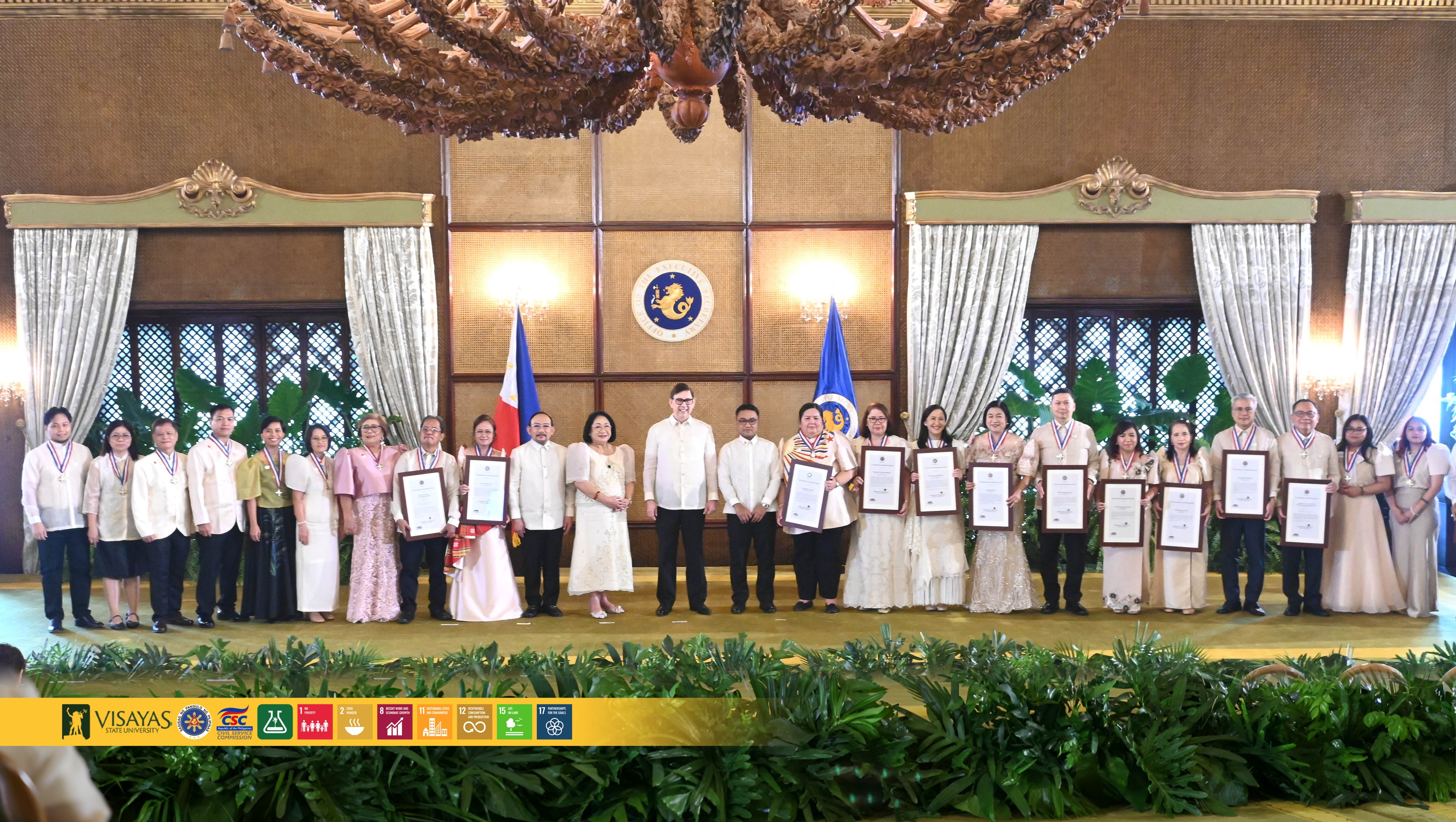
Courtesy: Presidential Photojournalists Association
The team comprises Dr. Romel Brigoli Armecin (Team Leader), Dr. Feliciano Gono Sinon, Sr., Ms. Jedess Miladel Nuñez Salomon, Dr. Luz Ordiz Moreno, and Dr. Flora Mia Y. Duatin, all from the National Abaca Research Center (NARC).
The Gawad Lingkod Bayan ng Pangulo Award is among the highest honors granted by the Civil Service Commission (CSC) to public servants whose collective efforts have produced extraordinary and lasting impact on society.
“This award belongs not only to our team, but to every abaca farmer who believed in science and walked with us through the years. Our work has always been driven by a simple goal: to help farmers improve their lives through better technologies and better opportunities”, Dr. Armecin stressed.
This recognition comes after years of collaborative efforts in generating technologies and knowledge products that address long-standing challenges in the abaca sector. Their initiatives cover the entire value chain which includes varietal improvement and disease management to fiber quality enhancement, postharvest processing, and product development.
Among their major accomplishments are the development of rapid mass propagation of healthy planting materials using tissue culture, the registration of the commercially grown abaca variety Inosa, and the distribution of 18,405 planting materials that rehabilitated about 16 hectares of abaca plantations.
They also provided nine (9) portable abaca stripping machines to boost the production of high-quality fibers. Beyond technologies, the team helped establish the Abaca Coalition, uniting key stakeholders across sectors, and played a crucial role in securing the PhP50-million Sogod Opportunities for Abaca Rehabilitation (SOAR) Program in Southern Leyte.
These initiatives laid the groundwork for the 2023 Regional Abaca Summit and continued to drive industry revival in neighboring provinces, supporting an industry that contributes around $80 million annually to the Philippine economy.
Through rigorous research and continuous field validation, the team has indeed developed science-based solutions that enable farmers to increase productivity, reduce losses, and improve fiber quality. These innovations have helped growers obtain better prices, lower production costs, and achieve higher farm profitability.
As a result, many abaca-growing communities have reported improved yields, better-quality fibers, and increased household incomes, outcomes that directly contribute to poverty reduction and rural development.
By forging partnerships with government agencies, industry stakeholders, and development organizations, the team has also helped align local initiatives with national goals for agricultural modernization and inclusive growth. Their work significantly contributed to sustaining the Philippines’ position as the world’s leading producer of abaca and ensuring that production systems remain competitive, resilient, and environmentally sound.
“This national recognition reinforces VSU’s commitment to public service through science and innovation, and honors our researchers’ tireless work to uplift farmers and strengthen the abaca industry,” President Prose Ivy G. Yepes said.
VSU has, in the past, consistently earned recognition for public service, with this recent award confirming the university’s commitment to uplifting the lives of farmers and agricultural communities.
This article is aligned with the Sustainable Development Goals (SDG) No. 1: No Poverty; 2: Zero Hunger; SDG 8: Decent Work and Economic Growth; SDG 11: Sustainable Cities and Communities; SDG 12: Responsible Consumption and Production; SDG 15: Life on Land, and; SDG 17: Partnership for the Goals.