
VSU, LGU Matag-ob forge ‘Project BALSAH’ partnership for resilient, thriving communities
- Details
- Written by Claudette Meli Hoff E. Garduce and Riza Mae L. Maningo
-
Published: 28 May 2026
What if a fruit basket could become a blueprint for development?
In the quiet and determined municipality of Matag-ob, Leyte, a local vision rooted in agriculture, sustainability, and community empowerment has found a steadfast partner in Visayas State University (VSU).
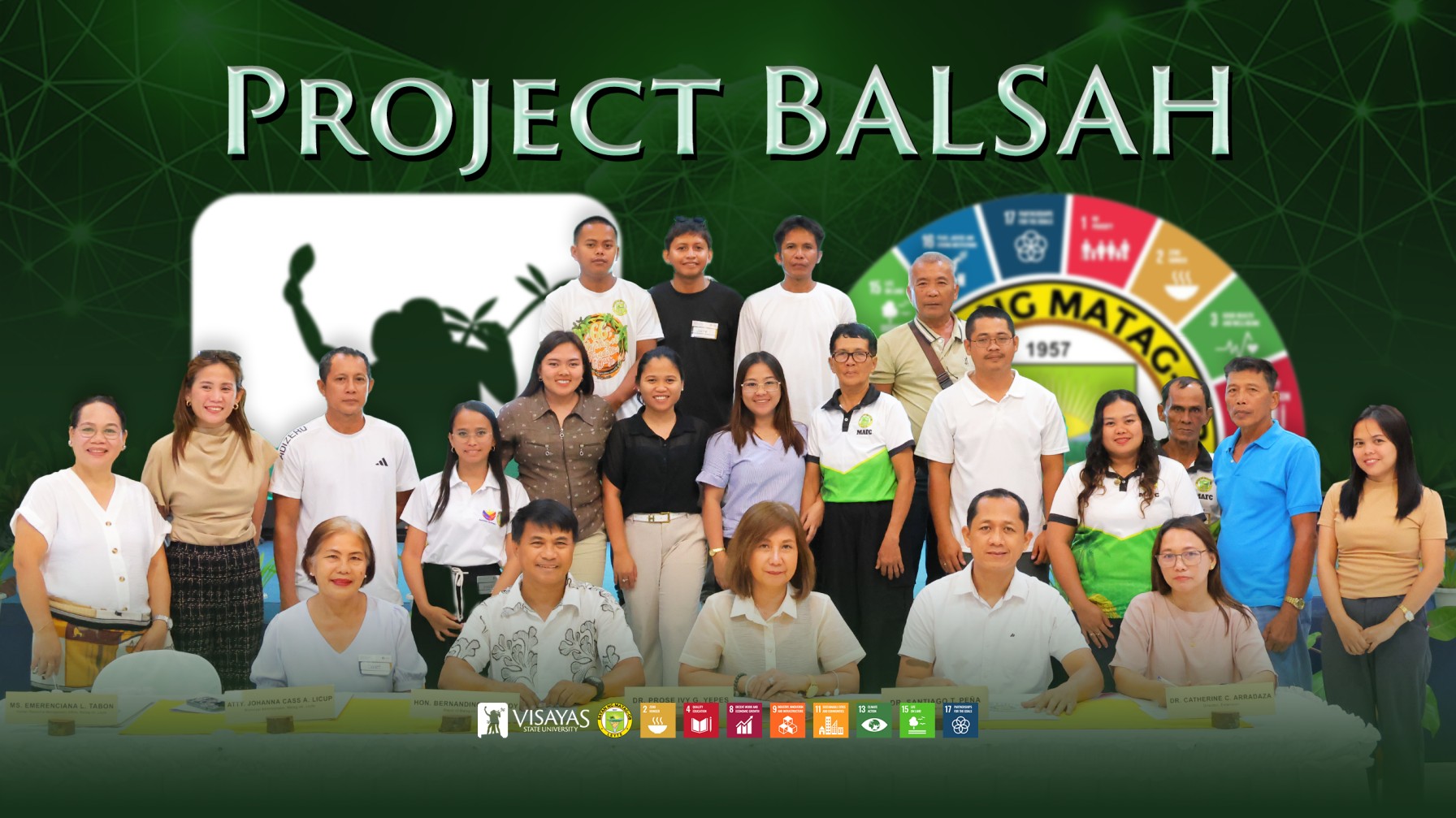
On April 27, 2026, the Local Government Unit (LGU) of Matag-ob and VSU formally entered into a Memorandum of Understanding (MOU) for Project “BALSAH” Matag-ob at the VSU RDE Hall.
Representing the parties in agreement were Municipal Mayor Hon. Bernardino G. Tacoy for the LGU of Matag-ob and VSU President Dr. Prose Ivy G. Yepes, marking the beginning of a five-year alliance that foregrounds the university’s continuing commitment to nation-building through research, extension, and community engagement.
What on our tilled earth is ‘BALSAH’?
Inspired by the local concept of a fruit basket, ‘BALSAH” reflects the gathering of diverse resources, ideas, opportunities, and innovations into a shared platform that benefits communities. The name likewise mirrors Matag-ob’s long-term aspiration of becoming the “fruit basket” of the region–where fruit-bearing trees and agricultural products flourish, and where food abundance and sustainability become accessible realities for its people.
Rooted in its rural landscapes, the municipality of Matag-ob sustains its local economy through a dedicated focus on agriculture and farming. As a fourth-income class municipality, its livelihood is deeply intertwined with the production of rice, corn, and coconut, complemented by livestock raising and essential infrastructure support that drive the local economy.
Yet behind this vision lies a deeper story: one of local ambition strengthened by academic expertise.
From local intent to institutional partnership
Earlier this year, through a Letter of Intent dated January 29, 2026, the Municipality of Matag-ob formally sought institutional partnership with VSU to advance collaborative initiatives spanning agriculture, research and extension, geospatial planning, flood mitigation, disaster resilience, and sustainable local development.
In response, VSU expressed its openness to the partnership on February 6, 2026, affirming the university’s readiness to extend its technical and intellectual resources to communities seeking meaningful development pathways.
To facilitate the groundwork, VSU designated Dr. Catherine C. Arradaza, Director for Extension under the Office of the Vice-President for Research, Extension, and Innovation (OVPREI), as focal person tasked with coordinating the preparation of agreements and identifying programs and activities under the emerging partnership.
This early mobilization allowed VSU to deploy faculty experts, researchers, extension personnel, and technical specialists to conduct consultations, field visits, planning sessions, and exploratory activities even before specific project agreements are finalized.
Each initiative under Project BALSAH will be supported by project-specific Memoranda of Agreement (MOAs), ensuring that objectives, timelines, responsibilities, and monitoring systems are clearly defined and aligned with community priorities.
Serving as coordinating officials for the collaboration are Dr. Arradaza on behalf of VSU, alongside Municipal Environment and Natural Resources Officer (MENRO) Charmaine T. Parac, and Municipal Agriculturist Claudia C. Ibañez for the LGU of Matag-ob.
Bringing VSU expertise closer to communities
For VSU, the partnership is another affirmation of its expanding role beyond the classroom and laboratory–bringing science, innovation, and expertise directly to communities that need them most.
Under the MOU, VSU and the LGU of Matag-ob will institutionalize partnership anchored on evidence-based governance, research and technology transfer, sustainable agriculture and fisheries, veterinary medicine, geospatial and spatial planning, disaster risk reduction, climate resilience, and inclusive community development.
The agreement also opens opportunities for VSU students through internship, practicum, and on-the-job training (OJT) engagements within the municipality’s programs and offices, allowing students to gain hands-on experience while contributing meaningfully to local development initiatives.
“Through Project BALSAH, VSU provides direct scientific and technical support to uplift local livelihoods of Matag-ob,” Dr. Arradaza said.
“With this partnership, we are bringing VSU’s innovation and expertise in advancing agriculture in fruit and nursery management, livestock and poultry production, veterinary medicine, disaster resilience, and cultural mapping directly to the people of Matag-ob,” she added.
A partnership built on knowledge and action
At its core, Project BALSAH demonstrates how universities and local governments can co-create solutions that are responsive to community realities. Through technical assistance, joint research, training, extension services, innovation programs, and resource mobilization initiatives, the partnership creates a framework where academic expertise meets grassroots needs.
As Matag-ob works toward realizing its vision of becoming a regional “fruit basket,” VSU’s growing network of partnerships with local government units offers valuable opportunities for shared learning and cross-community innovation. Similar to Matag-ob’s aspirations, some communities have long established themselves as agricultural production hubs—offering lessons that may help guide emerging development initiatives.
One such example is the partnership formalized between VSU and the Municipal Government of Dalaguete, Cebu through a Memorandum of Understanding signed on March 26, 2026. Widely known as the vegetable basket of Cebu, Barangay Mantalongon in Dalaguete has long served as a major production and trading center for highland vegetables, shaping the municipality’s agricultural identity and local economy.
Recognizing the value of firsthand learning, the LGU brought the VSU team to Mantalongon to closely observe how the local vegetable market operates—from the handling and trading of produce to its transport and distribution. More importantly, the visit allowed university experts to gain a deeper understanding of recurring realities faced by farmers and traders, including post-harvest concerns, market accessibility, and fluctuating prices.
These field observations are expected to guide VSU’s technical recommendations and extension initiatives in Dalaguete, enabling interventions that are more responsive to actual conditions on the ground. At the same time, the experience equips the university with valuable insights that may inform future partnerships with other local government units, particularly those sharing similar agricultural aspirations.
For Matag-ob, whose Project BALSAH envisions transforming the municipality into a thriving “fruit basket” of the region, lessons drawn from established agricultural communities like Mantalongon may offer practical perspectives in shaping sustainable systems for production, market access, and local enterprise development.
In this way, VSU serves not only as a provider of expertise, but also as a bridge for knowledge-sharing—bringing lessons learned from one community to help empower another.
For municipalities like Matag-ob, access to scientific expertise and evidence-based planning can strengthen local governance and resilience. For VSU, such collaborations reinforce its mandate as a premier institution advancing sustainable development through instruction, research, extension, and innovation.
Nurturing a future of resilient communities
As climate uncertainties, agricultural challenges, and local development concerns continue to shape communities, partnerships such as Project BALSAH reflect a growing truth: sustainable progress flourishes when institutions work hand in hand.
In Matag-ob, the vision of becoming a regional “fruit basket” is no longer merely an aspiration—it is now being nurtured through a partnership grounded in shared knowledge, collective action, and the belief that empowered communities can grow stronger, one seed of collaboration at a time.
This initiative is aligned with Sustainable Development Goal (SDG) No. 2: Zero Hunger; SDG No. 4: Quality Education; SDG No. 8: Decent Work and Economic Growth; SDG No. 9: Industry, Innovation, and Infrastructure; SDG No. 11: Sustainable Cities and Communities; SDG No. 13: Climate Action; SDG No. 15: Life on Land, and; SDG No. 17: Partnerships for the Goals.