
CHED-RO8 approves AB Literature offering at VSU DALL for AY 2026-27
- Details
- Written by Victor S. Neri
-
Published: 27 May 2026
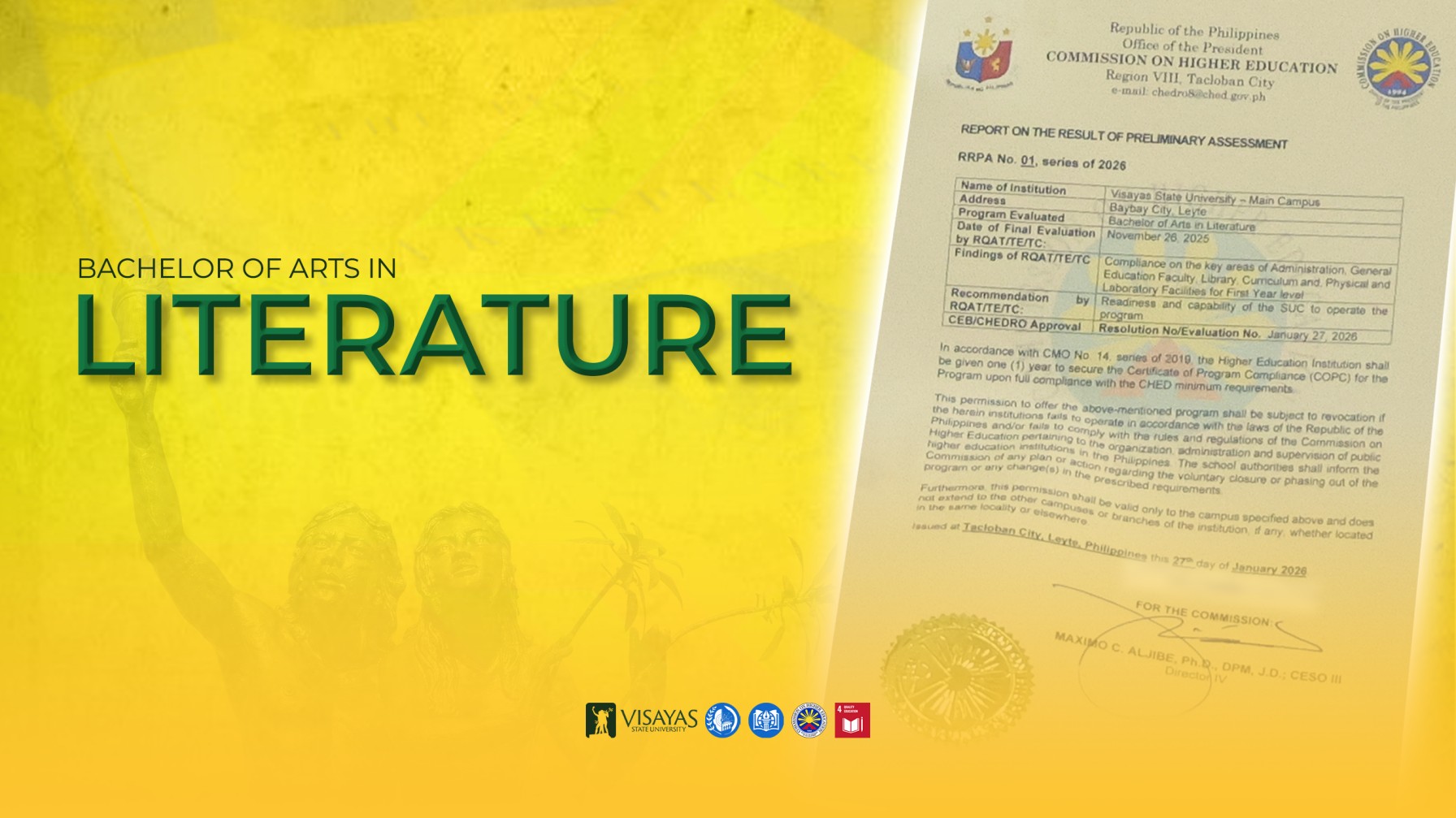
The Commission on Higher Education (CHED) approved the offering of the Bachelor of Arts in Literature (AB Lit) at the Visayas State University Department of Arts, Languages, and Literature (VSU DALL) for the first semester of AY 2026-27 after granting the program a Report on the Result of Preliminary Assessment (RRPA) early this year.
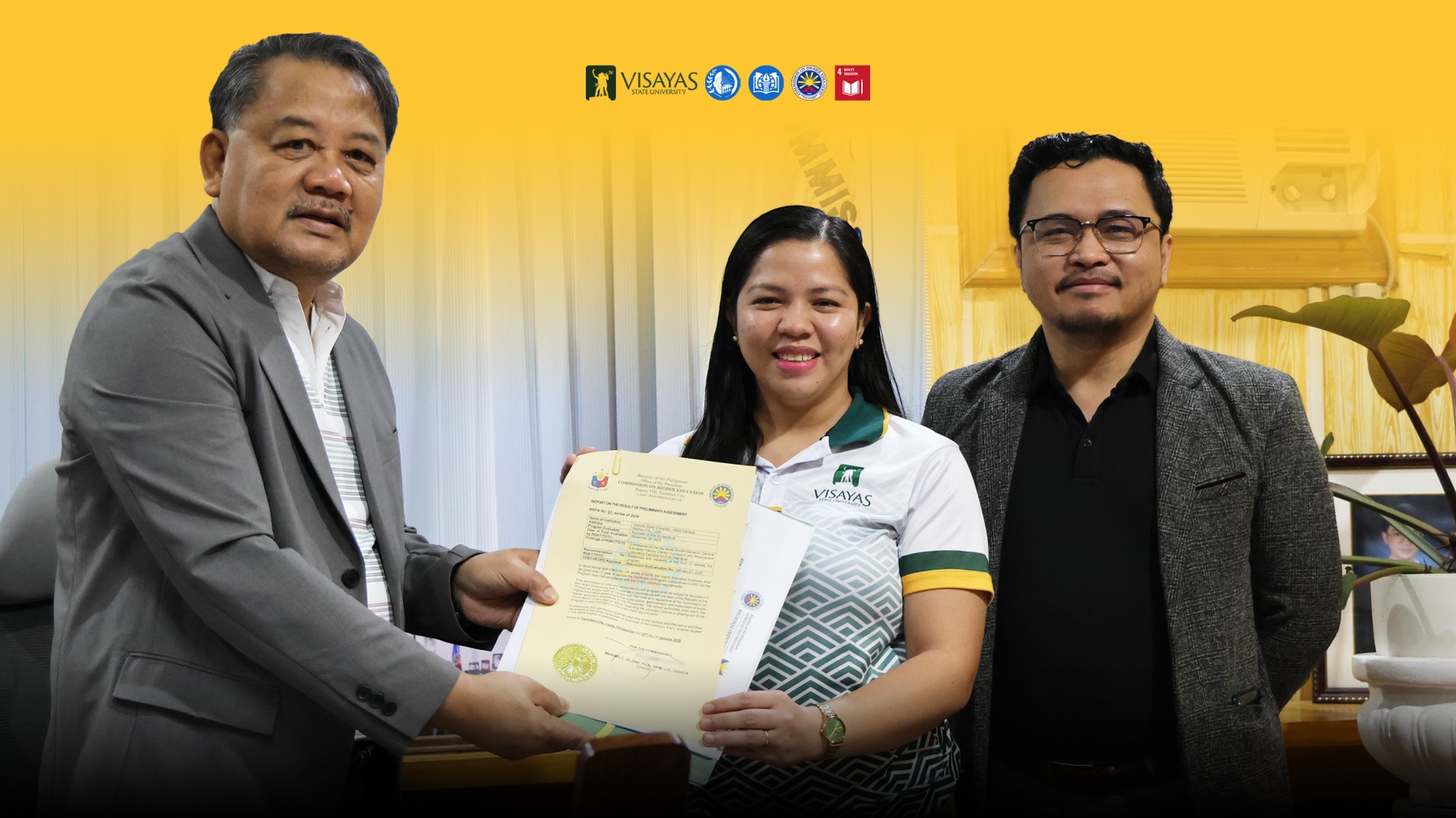
Dr. Maria Vanessa E. Gabunada, FHSS Dean, and Assoc. Prof. Michael Carlo C. Villas, DALL AB Literature Coordinator, received the RRPA from Dr. Maximo C. Aljibe, Regional Director of CHED Regional Office VIII in Tacloban City.
Set for the first semester of AY 2026-27, AB Literature is the second program offering of the DALL after Bachelor of Arts in English Language Studies (ABELS), the third in the Faculty of Humanities and Social Sciences (FHSS) that also runs the Bachelor of Arts in Philosophy (AB Philo) program under the Department of Philosophy and Social Sciences (DPSS), the third Bachelor of Arts (AB) program in the university, and the first Literature program in the Literary and Cultural Studies track on Leyte island. The other university that offers a similar program in the region is the University of Eastern Philippines (UEP) in Catarman, Northern Samar.
“VSU has long been recognized for its strong programs in agriculture, sciences, and technology. Offering AB Literature,” stressed FHSS Dean Gabunada, “balances this strength by reinforcing the humanities and ensuring a more holistic education.”
“The AB Literature program supports VSU’s vision of being a global green university by adding depth in education and the humanities. Literature nurtures analytical skills, creativity, and empathy–qualities urgently needed today to confront social issues, misinformation, and division. In a time of globalization and digitalization, AB Literature also strengthens Filipino identity and cultural literacy by engaging students with both local and world literatures,” she added.
Beginnings and features
Work on the Literature program began in 2023 under the leadership of Dr. Jett C. Quebec, former Head of the then Department of Liberal Arts and Behavioral Sciences that later separated into two departments, DALL and DPSS. Together with the Institute of Strategic Research and Development Studies (ISRDS), these departments comprise the FHSS that, in turn, emerged from the defunct College of Arts and Sciences (CAS).
The technical working group responsible for tending the AB Lit program from proposal to CHED approval consisted of Assoc. Prof. Michael Carlo C. Villas, as chairperson, with Instructor Mary Grace P. Enaya, Dr. Precious C. Domingo, Asst. Prof. J-Annie G. Ebit, Instructor April Rose V. Alojado, DALL Head, Dr. Cherry N. Rola, and FHSS Dean, Dr. Maria Vanessa E. Gabunada as members.
“The initial proposal underwent several layers of approval until it reached CHED, and CHED again back to us. The program took two university presidents, three deans, a shift in the names of our college and department, and three department heads to finally get to where it is today: with an RRPA which is a very welcome development but not the end yet, as we still have the certificate of program compliance (COPC) to work towards in the third year of implementation,” Assoc. Prof. Villas, AB Literature Coordinator, said in an interview.
AB Lit features a curriculum aligned with the vision of VSU as a global green university, with Literature and the Environment and Literature and Science as part of its core courses and Literature and Medicine as elective. It also provides a solid foundation in Filipino intellectual traditions, with Philippine Literature: The Region and the Nation as a major course and Philippine Literary Theory and Criticism as elective.
“At the same time, the program embodies the STRIDES framework,” emphasized Dean Gabunada. “Offering service through teaching and cultural outreach, seeking truth in human narratives, building resilience through stories of struggle and survival, and upholding integrity in scholarship and creative work. The program demands discipline in reading, writing, and research, pursues excellence in both creative and academic outputs, and advances social justice by giving voice to marginalized perspectives.”
The program boasts of a strong teaching force of literature teachers and literary scholars educated in topnotch universities in the country such as the Ateneo de Manila University, the University of the Philippines-Diliman, De La Salle University, and the University of Santo Tomas.
With emphasis on academe-industry linkages, the program includes a six-unit, 300-hour practicum where students will be deployed to culture and the arts institutions in the country.
The AB Lit program aims at producing creative and critical graduates, with interdisciplinary and cosmopolitan orientations, prepared for careers in law, media, business, education, medicine, the creative industries, and service-oriented professions.
“Literature, in most universities, is simply looked at as art, or a collection of old stories. In VSU, with mountains and seas surrounding it, literature focuses on the Environmental Humanities. VSU students use stories, poetry, and local folklore to study and solve real-world environmental issues like climate change and nature preservation,” said Dr. Rola, Head of DALL, in a personal message.
“If a business degree explains how the economy runs, and a science degree explains how the world functions, a literature degree unlocks how humans think, feel, and connect. AB Literature teaches one how to master the art of critical thinking, how to speak with impact, and opens doors to limitless career paths,” she further stated.
Future Plans
Asked about future plans for the program once it is in full swing, Dean Gabunada replied: “Students can expect curriculum enrichment through courses in Digital Humanities, creative industries, and interdisciplinary electives that connect literature with other fields. Research initiatives will focus on Philippine literature, regional writing, and comparative studies while community engagement will thrive through festivals, workshops, and collaborations with different research centers and universities.”
“The program also aims to build partnerships for exchanges, conferences, and collaborative projects. As it grows, FHSS plans to open graduate pathways in Literature, Creative Writing, and Cultural Studies while providing publication platforms such as journals, anthologies, and student-led magazines to showcase the voices and talents of AB Literature learners,” maintained the FHSS Dean.
This article is aligned with Sustainable Development Goal (SDG) 4: Quality Education.