
VSU teams up with LGU Baybay City for disaster risk management, public safety hub
- Details
- Written by Claudette Meli Hoff E. Garduce
-
Published: 25 May 2026
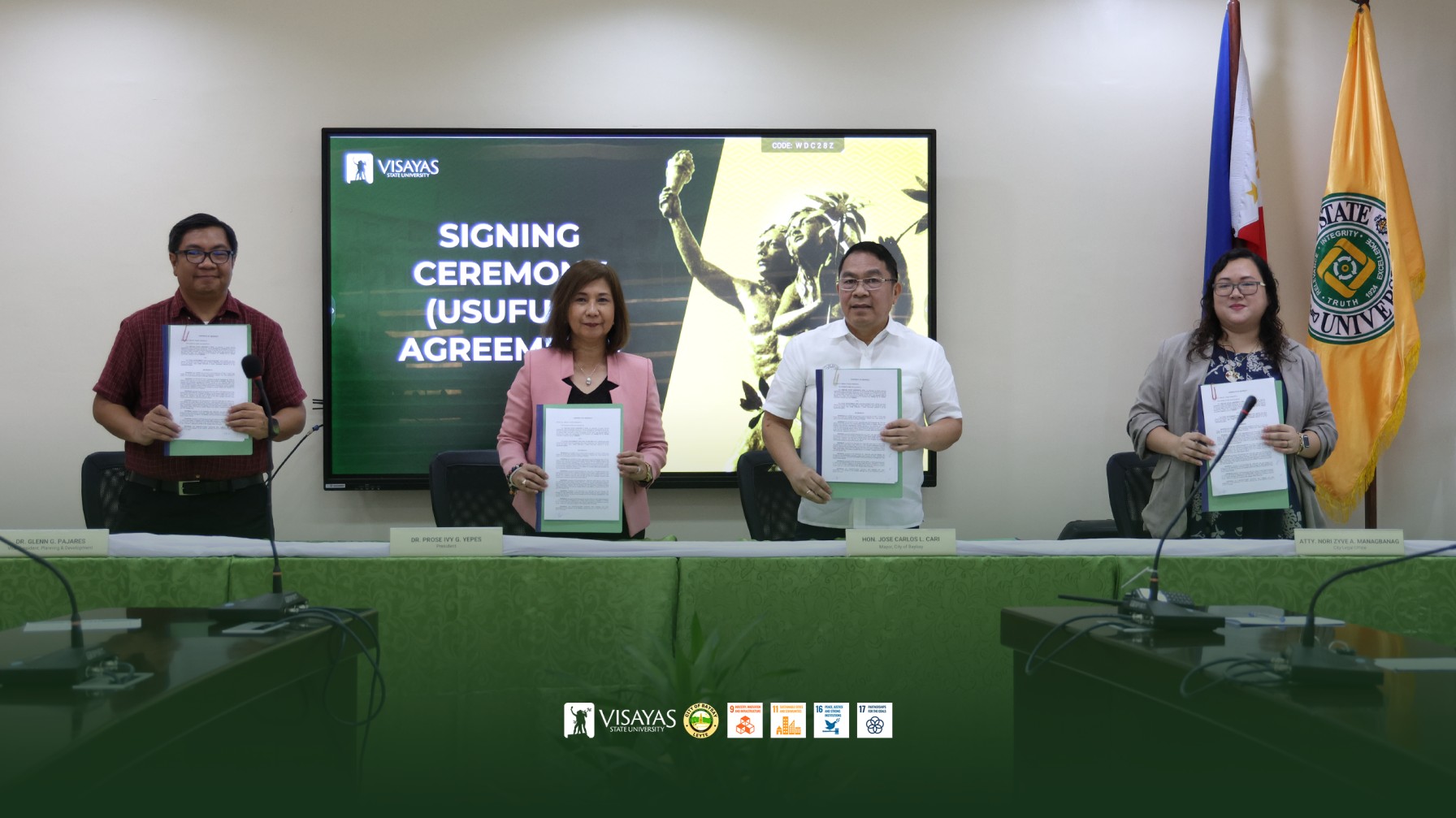
Visayas State University (VSU) and the Local Government Unit (LGU) of Baybay City, Leyte, formally entered into a usufruct agreement to establish a centralized hub for satellite government offices focusing on public safety, emergency response, and local transit.
This agreement allows the LGU Baybay to use and enjoy the benefits of occupying the property of VSU for a specific period without owning it, provided it is maintained and not altered destructively.
Under this deal, which was approved by the VSU Board of Regents (BOR) through BOR Resolution No. 203, series of 2025, the prime lot measuring 1,000 square meters at the VISCA market will be utilized for the establishment of stations of the Disaster Risk Reduction Management (DRRM), Bureau of Fire Protection (BFP), Philippine National Police (PNP) Baybay City, and a dedicated public utility vehicle (PUV) transport terminal.
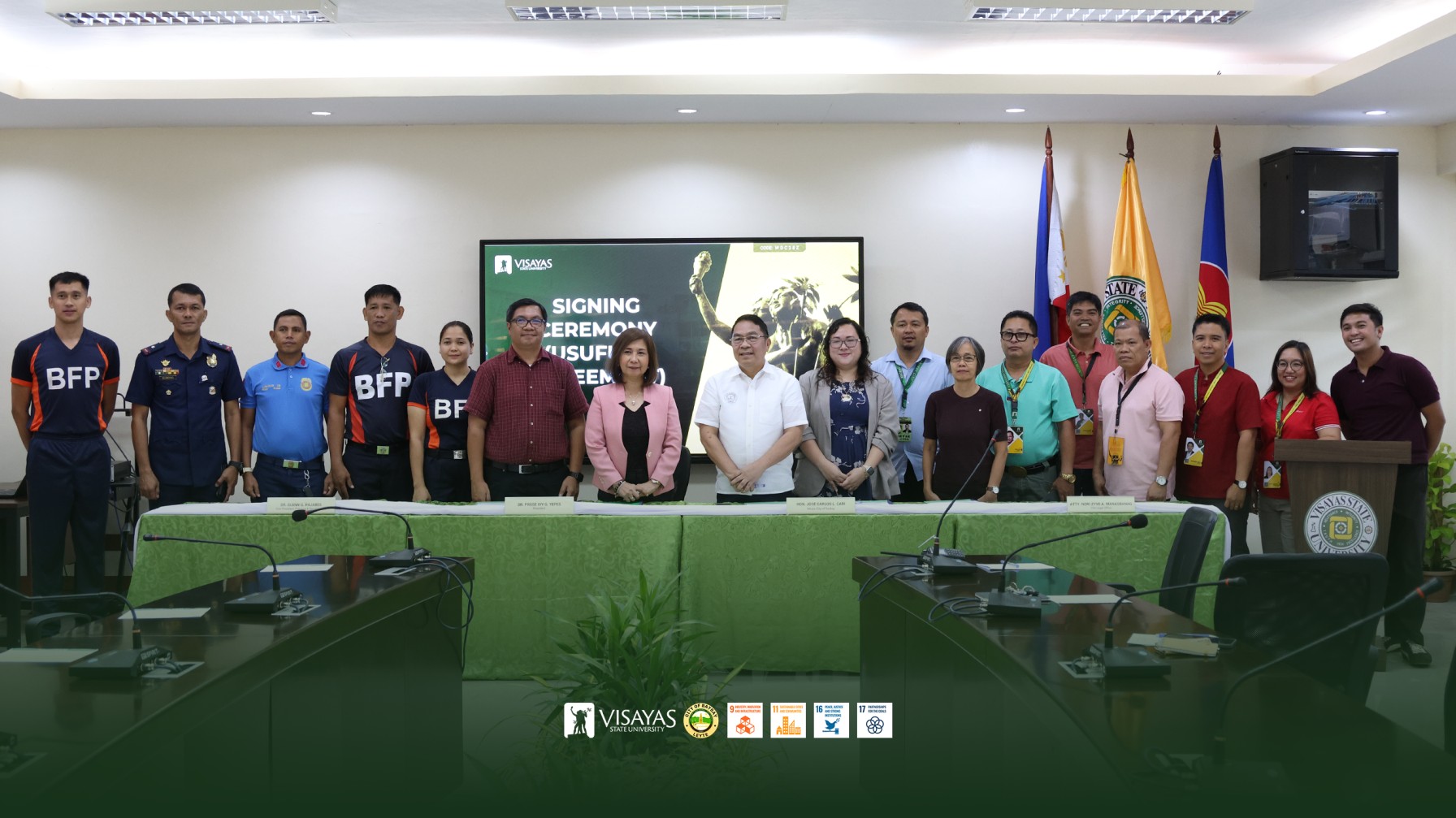
The contract was signed by VSU President, Dr. Prose Ivy G. Yepes, and City Vice Mayor, Atty. Ernesto M. Butawan, representing Baybay City Mayor Hon. Jose Carlos L. Cari, as the usufructuary.
Safer, shared infrastructure
LGU Baybay originally requested only a 500-square-meter lot for the establishment of disaster response and law enforcement satellite facilities.
However, after the PNP Sub-station was built, followed by the transport terminal which covered 600 square meters, the city government requested an additional 500 square meters.
This addition brings the total area to 1,000-square-meters to fully accommodate the integrated emergency, safety, and transportation infrastructure.
For VSU, this project would help ensure the safety, security and well-being of employees, students and residents on campus.
The proximity of frontline emergency services to the campus ensures a preventive shield from security threats and rapid mobilization on the campus in case of disasters.
According to Planning Director, Mr. Toni Marc L. Dargantes, the establishment of a centralized public safety and transit hub is aligned with the broader mandate of the university as a pillar of development in Leyte.
"Transforming university land into a centralized public safety and transit hub extends the university’s role beyond instruction and research into direct community service, regional development, and public welfare. It aligns with our commitment to the region through the Regional Development Plan and the country through the Philippine Development Plan by promoting sustainable infrastructure, enhancing public service delivery, supporting socio-economic development, strengthening disaster resilience, and fostering community-centered innovation for the people of Leyte and Eastern Visayas," he added.
Operational Guidelines and Key Terms
This 20-year usufruct agreement stipulates that VSU retains full title and ownership of the land.
The LGU would introduce, construct, and maintain all necessary infrastructure on site such as the roads, electricity, telecommunication, and water facilities in each office.
They must also build a full concrete fence around the 1,000-square-meter perimeter, which will likewise protect the university’s remaining properties.
The LGU will also be responsible for the structural integrity of the facilities as stipulated by the Building Code of the Philippines and any incident that is caused by the use of the facilities.
In an emergency situation, the LGU will consider the interests and safety of the VSU community first.
In addition, the LGU will ensure that the university can use the DRRM, BFP, and PNP satellite facilities for emergency functions without paying operational fees.
In exchange for smooth coordination in relation to academic operations, the LGU will temporarily return the use of these facilities upon request.
The university will also communicate an emergency schedule change (if it occurs) at least one week prior to the start of the school year.
Lastly, the LGU is responsible for all the utilities, such as water and electricity, and is responsible for maintaining the cleanliness, peace, and order of the hub and its surroundings.
Ownership of the permanent disaster risk facility and built structures shall be determined upon the expiration or termination of the 20-year term, subject to the provisions of Article 448 of the New Civil Code of the Philippines, or any provisions in this agreement to the contrary.
This shared-space solidifies the robust and long-standing institutional relationship between VSU and its host city.
“The transport terminal will provide students and the wider community with improved access to reliable transportation, making tertiary education more attainable. At the same time, the police and fire substations will enhance disaster response capabilities and strengthen public safety within the VSU campus and surrounding areas,” Dr. Glenn G. Pajares, Vice President for Planning and Development said.
The use of strategic university assets allows VSU to provide a safer environment for their own community and to actively engage in the greater regional public safety and civil defense network.
The integration of law enforcement, fire protection, disaster response, and public transportation within a single easily accessed center reduces the response time for emergencies across the entire northern part of Baybay City.
“This partnership reflects our shared commitment to building a safe, secure, and accessible environment for learning. It is only in an atmosphere of peace and prosperity that knowledge, through science and the arts, can truly flourish,” Dr. Pajares concluded.
This article is aligned with the United Nations Sustainable Development Goal (SDG) No. 9: Industry, Innovation and Infrastructure; SDG No. 11: Sustainable Cities and Communities; SDG No. 16: Peace, Justice and Strong Institutions, and; SDG No. 17: Partnerships for the Goals.