
VSU, DSWD-FO VIII ink MOA to strengthen Sustainable Livelihood Program in EV
- Details
- Written by Claudette Meli Hoff E. Garduce and Riza Mae L. Maningo
-
Published: 08 June 2026
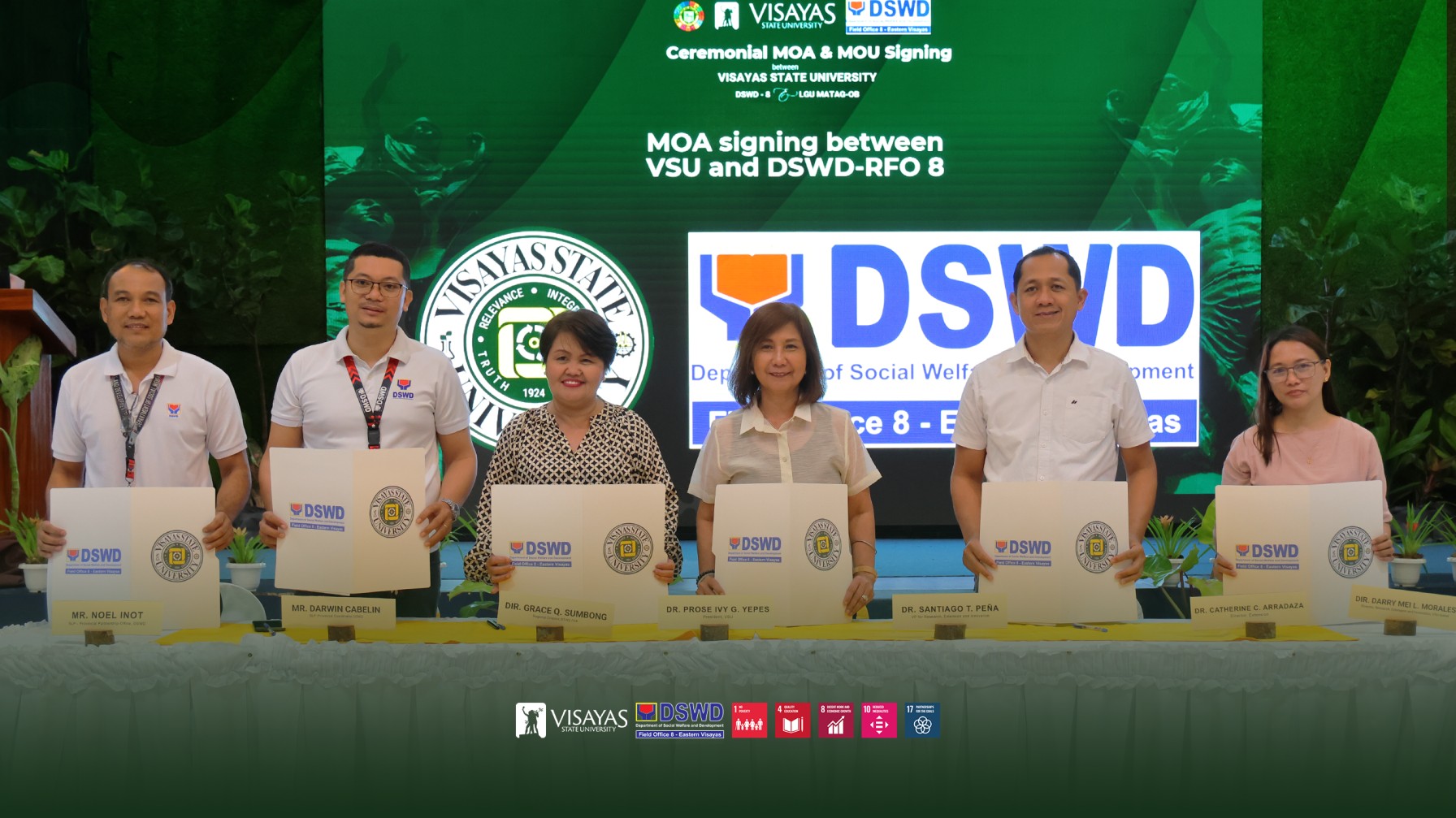
In a shared effort towards reducing poverty and improving economic empowerment, Visayas State University (VSU) together with the Department of Social Welfare and Development-Field Office VIII (DSWD-FO VIII) formally entered into a Memorandum of Agreement (MOA) on April 28, 2026 at the VSU RDE Hall.
The agreement, led by VSU President Dr. Prose Ivy G. Yepes and DSWD-FO VIII Regional Director Grace Q. Subong, reinforces and expands this collaboration in implementing the Sustainable Livelihood Program (SLP) across Eastern Visayas.
The signing marks a milestone in a partnership that began in 2024, when VSU and DSWD-FO VIII first formalized their partnership through a Memorandum of Understanding (MOU) to jointly implement SLP initiatives in the region. Since then, both institutions have worked toward strengthening community-based interventions by combining DSWD’s social development programs with VSU’s expertise in agriculture, entrepreneurship, research, innovation, extension, management, and tourism.
An offshoot of this previous agreement, the newly signed five-year MOA maximizes the implementation of the SLP by leveraging VSU’s research, instruction, and extension capabilities to help vulnerable households transition from socioeconomically marginalized conditions into self-reliant micro-entrepreneurs.
For DSWD-FO VIII, the teamwork highlights the importance of institutional partnerships in achieving sustainable and measurable community outcomes.
“We cannot implement a program alone. We need partners. That is why we tapped Visayas State University, as we recognize that it has substantial resources, particularly in technical expertise, which DSWD does not have,” said Regional Director Grace Q. Subong.
Empowering regional communities through extension services
The Sustainable Livelihood Program (SLP) is a capability-building initiative of DSWD that supports both micro-enterprise development and employment facilitation for disadvantaged sectors. At the core of the program is its mission to improve the socioeconomic condition of participants by equipping them with the knowledge, skills, and resources needed to sustain viable sources of income.
Under the earlier 2024 partnership, VSU committed to assisting DSWD in organizing and implementing SLP through technical assistance and capacity-building interventions. Joint initiatives included identifying target communities, conducting knowledge-sharing activities, facilitating livelihood support, strengthening market linkages, and forming composite action teams for program monitoring and evaluation.
The 2026 MOA further establishes these efforts by setting measurable targets and clearer implementation mechanisms to ensure long-term program sustainability.
Recognizing that sustainable development is heavily dependent on technical skills and knowledge transfer, both agencies deploy joint extension services to uplift the families and individuals throughout the region.
Emphasizing the strategic value of the said partnership, VSU Extension Director Dr. Catherine C. Arradaza, expressed the university's operational readiness.
“This agreement strengthens VSU’s ongoing partnership with DSWD under the Sustainable Livelihood Program (SLP). By leveraging VSU's pool of experts and innovative technologies, we will deliver targeted capacity-building directly to LGU-based beneficiaries. This collaboration reinforces VSU's role as a key driver of community empowerment, translating university research into sustainable, real-world livelihoods,” she said.
The signed MOA outlines shared clear goals for the partnership with measurable outcomes.
It intends to create a partnership to effectively deliver extension programs and services that are implemented through extension activities namely; training, mentoring, activity reports, attendance sheets, photo documentation, joint project implementation schedules, and progress reports.
Moreover, both agencies also encourage capacity building, livelihood, educational and health programs.
This component aims to ensure that at least 85% of members in the Sustainable Livelihood Program Association (SLPA) are trained in sustainable livelihood skills, development and dissemination of training modules and manuals, and Information, Education, and Communication (IEC) materials on sustainable livelihood and enterprise development, and achieve a satisfaction level of at least 85% in the post-training evaluation.
The partnership will also promote knowledge sharing and sustainable practices for community development.
This will be done through learning sessions, mentoring, or coaching activities, evidence of adopted or replicated practices at the community and/or local government unit level, and through monitoring and evaluation reports which demonstrate improved outcomes or sustainability measures.
Delineation of roles and institutional safeguards
Under the agreement, DSWD-FO VIII will be responsible for community profiling, identification of participants, coordination with key local stakeholders, and the provision of Seed Capital Funds for proposed micro-enterprises.
Meanwhile, VSU will provide technical support and deploy qualified resource persons for the requested extension services. The university will also designate a technical focal person who will regularly visit implementation sites to monitor, evaluate, and troubleshoot activities as necessary.
VSU will also provide counterpart assistance for venues, facilities, and materials needed for capacity-building activities conducted within the university premises. Subject to available funds, the university will also support travel-related needs of VSU extension personnel and resource persons involved in the program implementation.
Through this comprehensive partnership, VSU can further its objective of translating university research and academic excellence into impactful community engagement. By doing so, the institution actively tackles regional poverty and helps establish a stable economic base for the entire Eastern Visayas.
This article is aligned with the Sustainable Development Goals (SDG) No. 1: No Poverty; SDG 4: Quality Education; SDG 8: Decent Work and Economic Growth; SDG 10: Reduced Inequalities, and; SDG 17: Partnership for the Goals.