
#VSUGrad2026 | Cluster 2 Commencement Address of Mr. Glenn B. Quiro
- Details
- Written by Mr. Glenn B. Quiro
-
Published: 30 July 2026
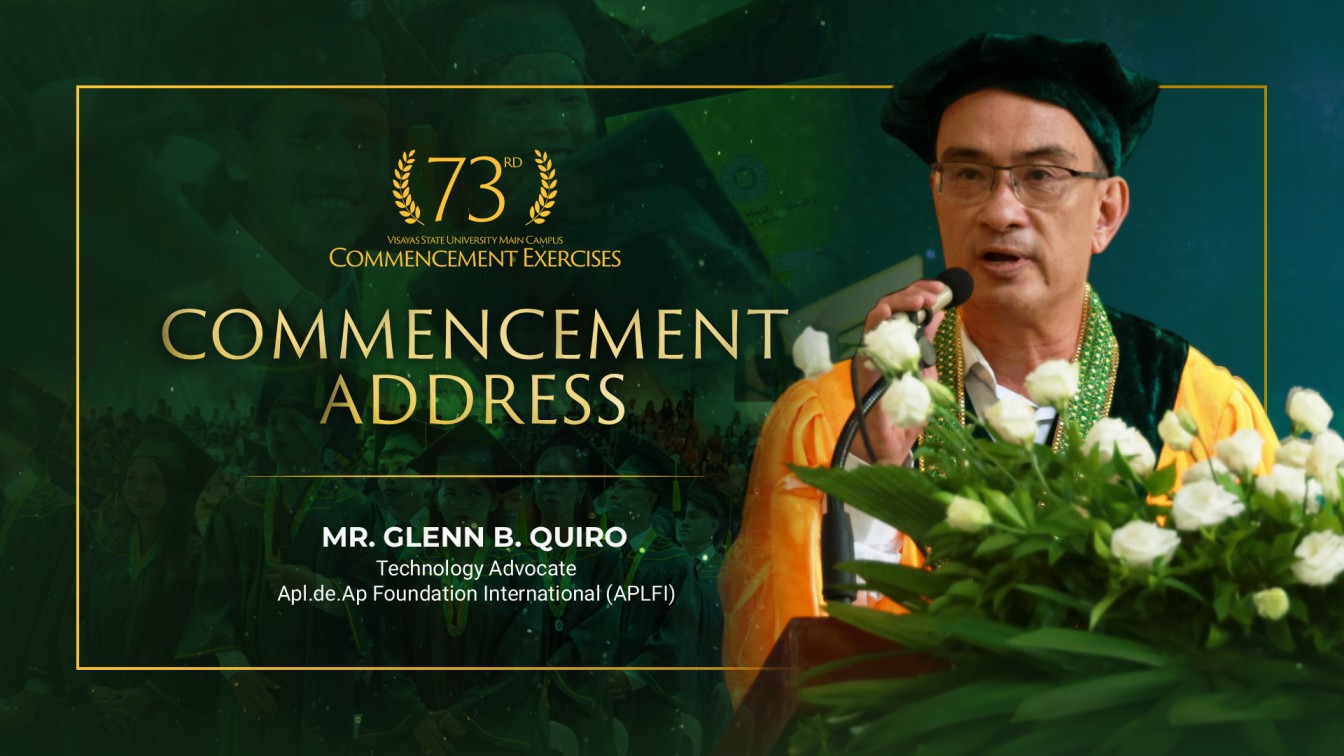
To the university leadership, faculty, parents, families, friends, and most especially, to the graduates.
Today is a day of celebration.
It is a day to celebrate years of study, sacrifice, discipline, and perseverance.
It is a day to celebrate your families, your professors, and the people who helped you reach this moment.
But it is also a day of transition.
For many years, you have lived within the structure of a university.
You had schedules, examinations, requirements, deadlines, professors, classmates, and a defined path.
Today, that structure begins to change.
The next chapter will be less certain.
There will be no syllabus telling you exactly what to study.
No professor will always be there to tell you whether you are on the right track.
You will have to make decisions with incomplete information.
You will sometimes have to move forward without knowing exactly where the road will lead.
And that is why I want to begin with a simple idea: There is a quiet moment that happens before history changes.
It does not look dramatic. There are no headlines. No applause. No audience.
It often looks like one person deciding whether to continue. That moment will come to you.
Perhaps when your first business fails. Perhaps when you are rejected for a job.
Perhaps when a project you believed in does not work. Perhaps when your carefully designed plan for life suddenly changes.
When that moment comes, remember this: Your life is not defined only by what happens to you. It is defined by what you decide to do next. You do not need to know your entire future.
I was born in the Philippines. Like many of you, I began my journey with dreams, but not with a complete map of where those dreams would take me.
I studied Electronics Engineering and Computer Science at UCLA.
At that age, I knew I was interested in technology. I knew I wanted to understand how things work. But I certainly did not know the full path ahead.
I did not know that I would have the opportunity to work at NASA's Jet Propulsion Laboratory as a systems engineer.
I did not know that I would later work in the semiconductor industry. I did not know that I would eventually join Intel and lead operations in China.
I did not know that I would one day lead organizations involving more than 3,000 people and be responsible for a business representing approximately $12.8 billion in revenue.
I did not know that I would later work with the World Bank and the Asian Development Bank on technology, semiconductors, electronics, supply chains, and economic development.
And I certainly did not know that I would eventually find myself working on opportunities to help build the future of the Philippines.
The path became clear only as I walked it. One opportunity led to another. One challenge prepared me for the next. One mentor opened a door.
One difficult experience taught me something I did not know I needed to learn.
I remember being a young engineer and finding myself in rooms with people who had far more experience than I did. I had a choice.
I could pretend that I knew everything. Or I could ask questions.
I learned very early that asking a good question is not a sign of weakness. It is often the beginning of learning.
And sometimes, even after you have prepared as much as you can, you simply have to take the next step. I learned that lesson in a rather unexpected place.
I was skiing down a slope with my skiing partner, who happened to be my boss at the time—an Israeli who had previously served in special forces.
At one point, I found myself looking down the slope and thinking: “I am not quite sure I can do this.” I was also not entirely sure where my skiing partner was.
Then I saw him. He looked at me. And he smiled.
It was a very simple look and a very simple smile. But somehow, the message was clear: Sometimes, you just have to believe.
That look took away some of my fear. I continued down the slope. And I learned something that has stayed with me: You can prepare. You can train. You can seek advice.
You can find mentors. But eventually, life will bring you to a slope you have never skied before. At that moment, you will not have complete certainty.
You will have to believe in your preparation. Believe in the people who have helped you. Believe in your ability to learn.
And sometimes, simply believe that you can take the next turn. You do not need to know exactly where your life will take you.
You need to remain willing to learn, willing to adapt, and willing to keep moving forward.
You Come from a Region that Understands Resilience
You come from the Visayas. This is a region that understands both the power and the unpredictability of nature.
The Visayas has known storms. Earthquakes. Distance. Hardship. Loss. But it has also demonstrated extraordinary resilience, creativity, generosity, and strength.
You come from communities that have repeatedly faced adversity—and rebuilt. That is an important lesson for your generation.
The future will bring challenges that none of us can fully predict. Some will be technological. Some will be economic. Some will be environmental.
Some will be social. But the question is not whether challenges will come.
The question is: Will you be prepared to build despite uncertainty?
Visayas State University has a particularly important role in that future. The future of the Philippines will not be built only in Manila.
It will not be built only in Silicon Valley, Shenzhen, Tokyo, or Singapore. It will also be built in the regions. It will be built in communities like those you know.
It will be built by people who understand agriculture, food security, technology, the environment, business, and the realities of everyday life.
That is one of the great strengths of this university.
You are graduating from an institution connected to science, technology, agriculture, natural resources, communities, and the real challenges of development.
The engineer who designs resilient infrastructure. The computer scientist who develops intelligent systems. The economist who understands incentives and markets.
The manager who brings people and resources together. The scientist who solves problems in agriculture and the environment. These are not separate challenges.
They are connected. And the future will increasingly belong to people who understand those connections.
Discover the Potential God Has Given You
We are often taught to compete. Be better than the person beside you. Get a higher grade. Earn more money. Have a better title.
Build a bigger company. And competition has its place.
But if you spend your entire life only trying to be better than other people, you may never discover how good you could have become.
When I was a student, I was not trying to compete with everyone in the world. I was trying to understand what I could do. What I could learn.
What problems I could solve. And where my abilities could be useful.
The greatest competition is not always with the person beside you. Sometimes, the real competition is between the person you are today and the person you have the potential to become.
God has given each of you different abilities. Different interests. Different experiences. Different ways of thinking.
Do not spend your life trying to become a copy of someone else. You need to discover who you are capable of becoming.
Perhaps your greatest contribution will come through engineering. Perhaps through computer science. Perhaps through business.
Perhaps through economics. Perhaps through agriculture, education, healthcare, entrepreneurship, public service, or an area that has not yet been invented.
Look deeply inside yourself. What are you naturally curious about?
What problems disturb you enough that you want to solve them? What abilities do others see in you that you may not yet recognize in yourself?
Your task is not simply to compete with the world. Your task is to maximize the potential God has placed within you.
Find Mentors, Build with Others
One of the most important lessons of my life is that I did not succeed alone. I had teachers. I had colleagues. I had leaders who gave me opportunities.
I had people who challenged me. I had people who believed in me before I fully believed in myself.
As my career developed, I worked with people who had built technologies, companies, organizations, and industries long before I arrived.
I learned from their successes. But I also learned from their failures.
That is why I strongly encourage you: Find mentors. Find people who have already walked through the terrain you are about to enter.
Find people who have made mistakes, led organizations, made difficult decisions, experienced success, and learned from failure.
A mentor can tell you things that no textbook can teach you. They can say: “I made that mistake before.” “Be careful with this opportunity.” “Here is what I wish I had known at your age.”
Artificial intelligence can provide information. But a mentor can provide judgment. AI can give you answers. A mentor can help you ask the right questions.
When you find mentors, listen. Ask questions. Be humble. And do not approach mentors only asking: “What can you do for me?”
Ask also: “What can I learn from you?” And eventually: “How can I help someone else using what you taught me?” Because the greatest form of mentorship is not a chain.
It is a circle. Someone helped you. You help someone else. They help another person. And the impact continues.
Choose Abundance
During my career, I had the opportunity to work with people from many countries and cultures.
I learned that talent exists everywhere. But opportunities are not always distributed equally.
And this is where mindset matters.
A scarcity mindset says: “There are not enough opportunities.” “If someone else succeeds, there is less opportunity for me.”
An abundance mindset says: “New opportunities can be created.” “I can succeed while helping others succeed.”
“Knowledge grows when it is shared.” When I look at the Philippines, I do not see a country without talent. I see enormous talent.
What we need is to create more opportunities for that talent to develop, connect, and contribute.
The world does not need only people who can compete for existing opportunities. It needs people who can create new opportunities.
A programmer can help an entrepreneur build a company. That company can create jobs. Those jobs can support families.
Those families can educate children. Those children can create something new. One person's success can become the beginning of another person's opportunity.
So do not ask only: “How can I get my share of what already exists?” Ask: “What can I create that makes the world bigger, more prosperous, and more hopeful for others?”
And remember: Helping other people is not the opposite of helping yourself. When you teach someone, you deepen your own knowledge.
When you mentor someone, you strengthen your own understanding. When you open a door for someone else, you become part of a larger network of opportunity.
Chase your dreams with the help of others. And help others chase theirs. That is not a weakness. That is how great things are built.
The greatest opportunity of AI may be human connection
I have spent much of my career working across countries, cultures, and languages. I have seen the extraordinary power of international cooperation.
I have also seen how much time, effort, and misunderstanding can result when people cannot communicate easily.
That is why I believe one of the most important developments in artificial intelligence may not simply be the ability of machines to calculate faster or produce more information.
It may be the ability of people to understand one another better.
Imagine a student in Leyte speaking naturally with a researcher in Japan. Imagine a Filipino entrepreneur speaking with a potential partner in Brazil.
Imagine a doctor and a patient communicating across languages without the language barrier standing between them.
Imagine a student in a remote community learning directly from a teacher on the other side of the world. For thousands of years, language has connected humanity.
But language has also divided us. A brilliant idea may remain unheard because it is expressed in a language another person cannot understand.
A business opportunity may never happen because two entrepreneurs cannot communicate effectively.
A student may be unable to learn from the world's best teachers because of language barriers.
Real-time AI translation has the potential to change this. It can help students learn from one another.
It can help researchers collaborate. It can help businesses enter new markets. It can help workers participate in the global economy.
It can help families separated by geography communicate more easily. And perhaps most importantly: It can help people understand one another better.
The greatest achievement of AI may not be that machines become more intelligent. It may be that human beings can understand one another better.
When people understand one another, they can learn from one another. When they learn from one another, they can cooperate.
When they cooperate, they can create things that no individual or country could create alone.
This is where your generation has an extraordinary opportunity. You can use AI not merely to make machines more powerful.
You can use AI to make human beings more connected.
The best technology does not simply make the world smaller. It makes the world more connected—and perhaps, ultimately, more understanding.
The future will be built across disciplines
Connection is not only about language. It is also about disciplines. The most important problems rarely belong to one field.
A great technology product requires engineers. It also requires software, finance, operations, supply chains, management, customers, and markets.
Technology alone is never enough. The same is true for the challenges you will face. Engineers cannot solve every problem alone.
Computer scientists cannot solve every problem alone. Economists cannot solve every problem alone.
Managers cannot solve every problem alone.
The future will be built where these disciplines intersect.
An engineer may design a technology. A computer scientist may build artificial intelligence.
An economist may understand the incentives that make the solution sustainable. A manager may organize the people and resources required to scale it.
Together, they may solve a problem that none of them could have solved alone.
So do not become trapped inside the boundaries of your degree. Learn beyond your discipline.
Understand how other people think. Learn to work with people who do not think like you. Innovation often happens where different ideas meet.
Failure is a teacher
My career was not a straight line.
There were opportunities that did not work out.
There were decisions that could have been better. There were challenges that seemed overwhelming at the time.
And you will experience the same. You will make wrong decisions.
You will choose the wrong job. You will trust the wrong person. You will launch something that does not work.
You will sometimes fail. And that is all right. Mistakes are teachers. But they are expensive teachers.
So learn quickly. When something does not work, ask: What happened? What did I misunderstand? What can I learn?
Then adapt. And keep going. The people who succeed are not those who never fail.
They are those who learn from failure, adapt, and continue moving forward.
The world will change. Your industry will change. The technology you use will change.
You must be willing to change as well. Adaptation is not abandoning your principles. It is finding a better way to pursue them.
Do not be afraid to begin again. Sometimes, beginning again is not going backward. It is moving forward with more wisdom.
Build depth, protect your character
Today, information is everywhere. Artificial intelligence can summarize books. Write code.
Analyze data. Produce presentations. Generate ideas.
But information is not the same as understanding. And having access to answers is not the same as knowing which questions to ask.
In an AI-driven world, superficial knowledge will become increasingly common. Deep understanding will become increasingly valuable.
Choose something. A field. A discipline. A problem. A craft. And go deeper than most people are willing to go.
As engineers and computer scientists, understand not only how technology works, but why it matters.
As managers and economists, understand not only numbers and markets, but the human beings behind them.
Develop judgment. Develop curiosity. Develop the ability to think independently.
And remember: Technology can make you faster. Education can make you more knowledgeable.
Money can give you more options. But character determines what you do with all of them.
Your reputation matters. Your integrity matters. How you treat people matters. Whether you keep your word matters.
Success without integrity is fragile. So pursue success. But define success properly.
Success is not merely what you accumulate. It is also what you contribute. It is the problem you solve.
The lives you improve. The people you help. The people who become better because they knew you.
Your next five years
Over the next five years: Build discipline. Do the things you say you will do. Develop a globally competitive skill. It may be AI, software, engineering, finance, entrepreneurship, or leadership.
Become excellent at something valuable. Learn continuously. Your graduation is not the end of your education.
From now on, life becomes your classroom. Find mentors. Learn from people who have already walked the path.
Take intelligent risks. Do not live your entire life choosing only what is safe.
Protect your relationships. Your family and true friends will matter more than you realize.
Build an abundance mindset. Create opportunities. Share knowledge. Help others rise.
Use AI as your ally—not your master. Let technology amplify your capabilities. But never surrender your judgment, your values, your creativity, or your humanity. And finally: Do not be afraid to fail.
Learn. Adapt. Keep moving.
To the class of 2026, you are graduating into a world that is being rebuilt. The technologies you will use are changing.
The industries you will enter are changing. The skills that will be valuable are changing.
That creates uncertainty. But it also creates opportunity.
I have seen companies and technologies that once seemed impossible become ordinary. I have seen entire industries change.
I have seen people who were once unknown become leaders.
And I have learned that the future is rarely built by people who wait until everything is certain.
It is built by people who are willing to learn, take risks, work with others, and keep moving.
The world does not need graduates who simply wait for perfect conditions. It needs people who can build despite uncertainty. People who can solve problems.
Create businesses. Develop technologies. Manage organizations. Understand economies. Bring people together. See opportunity where others see only difficulty.
And the Philippines needs you. The Visayas needs you. Your communities need you.
You do not have to leave your home or your community to make an impact. You can build something here.
You can create opportunities here. You can serve here.
You can become globally competitive while remaining deeply connected to the people and communities that shaped you.
The future of the Philippines will not be built only in Manila or in global technology centers.
It will also be built in the regions. It will be built by people who understand agriculture and food security. Technology and business. The environment.
The realities of communities.
People who understand that development must ultimately improve the lives of real people. Many of you are uniquely prepared to do exactly that. The world is now more connected than ever.
Your ideas can travel globally. Your businesses can serve global markets. Your knowledge can reach people anywhere.
And with technologies like AI-powered translation, people who once could not easily understand one another can increasingly learn, cooperate, and build together.
You are entering a world where geography is becoming less of a limitation. But your values will matter more than ever.
Years from now, you may find yourself in that quiet moment. A business may be failing. A project may have failed. A job application may have been rejected.
A dream may be delayed. You may be uncertain about what to do next. There may be no applause. No audience.
No one to tell you what to do. Only you—and a decision.
When that moment comes, remember this day. Remember the people who believed in you. Remember your family. Remember your teachers. Remember your mentors.
Remember the challenges you have already overcome. And remember that you do not need to know your entire future today. I certainly did not know mine.
I did not know where an education in engineering and computer science would take me. I did not know that it would lead me to NASA's Jet Propulsion Laboratory.
I did not know that it would lead me into the semiconductor industry.
I did not know that it would take me across the world and into leadership in Asia. I did not know that I would one day work with international institutions on technology and economic development.
I did not know that my journey would eventually bring me back to opportunities to help build the future of the Philippines. The path revealed itself one step at a time. And yours will too.
So chase your dreams—but do not be afraid to ask for help. Find people who can guide you.
Learn from those who have gone before you. Help others along the way. Because when you help others, you are not taking away from your own future.
You are building a larger future for everyone.
Do not live with a mentality of scarcity. Choose abundance. Do not be afraid of mistakes.
Let them teach you. Do not be afraid of change. Learn to adapt. Do not spend your life trying only to defeat others. Look inside yourself.
Discover the potential God has given you. And then work—patiently, courageously, and relentlessly—to maximize it. You have been given knowledge.
You have been given opportunities. You have been given talents. You have been given people who believe in you.
Now you must decide what you will do with them. So, Class of 2026, dream boldly.
Learn continuously. Find mentors. Help others. Build with courage. Lead with integrity. Use technology to connect people, not divide them.
Choose abundance over scarcity. Learn from failure. Adapt and keep going.
And never forget: The world does not need you to become somebody else.
It needs you to become the best version of the person God created you to be. So go forward.
Build something meaningful. Create opportunities. Serve others. Lift people as you rise.
And when history looks back at the Class of 2026, let it say: They did not wait for a better world. They helped build one.
Congratulations, graduates.
May God bless you, your families, Visayas State University, the Visayas, and the communities and nation you will serve.
Mabuhay ang Class of 2026! Mabuhay ang VSU! Mabuhay ang Pilipinas!