

When drying palay becomes a problem: How a #ProudViscan turned an age-old farm challenge into a winning innovation
- Details
- Written by Riza Mae L. Maningo
-
Published: 29 September 2026
A harvest is never just a harvest.
For Filipino farmers, it is the product of months of hard work, an investment of scarce resources, and often, a family’s best hope for income. But when the time comes to dry the grains, many small farmers still face a problem as old as the harvest itself: how to dry a small volume of palay safely, efficiently, and affordably.
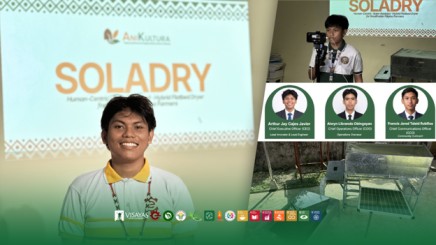
For #ProudViscan agriculture student Arthur Jay Cajes Javier, that challenge became an invitation to rethink how agricultural technology could work for the people who need it most.
His answer—AniKultura, a VSU agri-enterprise built around human-centered agricultural innovation—has earned the distinction of Regional Champion in the Digital Agriculture category of the 2026 Young Farmers Challenge (YFC) of the Department of Agriculture Regional Field Office VIII (DA-RFO 8).
The win, announced in August 2026 following the regional evaluation, comes with a ₱250,000 start-up grant and the opportunity to represent Eastern Visayas at the National Young Farmers Challenge in February 2027.
For Javier and his team, however, the victory is bigger than the competition.
It is a validation of an idea rooted in a simple question: What if agricultural technology were designed around the realities of small farmers—not the other way around?
Re-engineering the culture of harvest
AniKultura carries the motto, “Culture of Harvest, Re-Engineered for Human-Centricity.”
That philosophy is embodied in its flagship innovation, SolaDry: Human-Centric · Solar-Assisted · Hybrid Flatbed Dryer for Smallholder Filipino Farmers.
The idea addresses a persistent post-harvest challenge in Philippine agriculture: grain drying.
In Eastern Visayas, commercial drying facilities may require large batch volumes, creating a difficult gap for smallholders whose harvests may amount to only a few sacks. With limited options, farmers may resort to drying palay along roadsides and other unsuitable spaces—leaving their produce vulnerable to contamination, weather disruptions, and safety risks.
AniKultura sought to close that gap by creating a dryer sized not for the largest farms, but for the smallholder farmer.
Designed, fabricated, assembled, and tested at the VSU Renewable Energy Research Center (RERC), SolaDry is a compact, modular 1.2-meter by 0.7-meter flatbed dryer capable of handling 50 to 100 kilograms per batch cycle.
The project was developed with support from the Department of Agricultural and Biosystems Engineering (DABE) and the VSU Technology Business Incubator (TBI) through Project LIYAB, with technical guidance from RERC mentors, Engr. Jucel Marie T. Guatlo and Engr. Feliciano L. Sinon Jr., and support from DABE Department Head, Engr. Nilo Leorna.
Rather than relying on a single energy source, the system combines direct sunlight, a UV-plastic greenhouse enclosure, and solar thermal forced air. Its ESP32-based smart automation system monitors drying conditions, maintains a 50°C food-grade thermal ceiling, and detects moisture endpoints to help determine when the grain has reached the desired condition.
In other words, SolaDry does not simply attempt to make drying faster.
It attempts to make modern drying fit the scale, resources, and realities of the Filipino smallholder.
“We didn't design just for efficiency; we designed directly for the Filipino farmers who will use it,” Javier said during his online defense before the regional panel.
Engineering and entrepreneurship
The innovation did not stop at the machine itself.
Recognizing that even an affordable agricultural technology can remain inaccessible when its upfront cost is beyond a farmer’s means, AniKultura developed two ways for farmers to use SolaDry.
The first is a turnkey machine priced at ₱40,000.
The second is a Drying-as-a-Service (DaaS) model, charging ₱50 per 50-kilogram sack.
The approach gives farmers the option to access modern drying technology without immediately shouldering the full cost of owning a machine.
It is this combination of engineering, entrepreneurship, and farmer-centered thinking that shaped AniKultura’s regional YFC entry.
During the regional defense, Javier presented the enterprise’s technical design, financial model, and operational strategy to the evaluation panel, demonstrating not only how SolaDry works but also how the innovation could function as a viable agricultural enterprise.
Viscan Ingenuity
SolaDry was not built in isolation.
It was designed, fabricated, assembled, and tested at RERC, where the team gained access to fabrication space, research facilities, and technical guidance throughout the development of the prototype.
Meanwhile, Project LIYAB provided the initial funding that enabled the students to build SolaDry and move their concept beyond paper and into an actual working system.
For AniKultura, however, institutional support did not mean that the students simply handed their concept over to university experts.
They built it themselves.
The students supplied the initiative, technical work, and entrepreneurial vision; VSU provided the research environment in which that initiative could be developed, tested, and strengthened.
This collaboration illustrates the kind of innovation ecosystem that the university seeks to cultivate—one where students can bring classroom knowledge into research facilities, work alongside academic experts, access specialized equipment, and receive institutional support to transform ideas into technologies with potential community impact.
Beyond the competition, AniKultura is also taking steps to formally protect and potentially advance the technology. The team plans to file its computer-aided design (CAD) drawings and Invention Disclosure Form with the university, with the VSU Intellectual Property and Technology Support Office handling the succeeding intellectual property process.
In this way, SolaDry becomes more than an award-winning student project. It becomes part of a continuing university innovation pathway—from research and prototyping to intellectual property, enterprise development, and eventual field application.
From research center to the field
Following its regional victory, the team plans to use the ₱250,000 start-up grant to fabricate six operational SolaDry units in collaboration with RERC while gathering field data from pilot applications across Leyte.
Initial validation has been secured in partnership with the Murado Farmer's Integrated Association in Baybay City, providing an important bridge between university-based innovation and actual farming communities.
This field-based approach reflects a larger principle in agricultural innovation: technologies become meaningful not simply when they work in a laboratory, but when they prove useful where farmers actually live and work.
And for VSU, this is where instruction, research, innovation, extension, and entrepreneurship converge.
A student idea can begin in the classroom, take shape inside a research center, receive support through an innovation and business incubation program, undergo testing and validation, and eventually reach the communities it was designed to serve.
That pathway gives AniKultura’s achievement significance beyond the YFC competition. The championship recognizes the students’ innovation, while the journey behind it demonstrates how a university research and innovation ecosystem can help move an idea from student concept to tested technology with potential community application.
Taking an idea to the national stage
Javier’s journey with AniKultura demonstrates what can happen when a student looks beyond the classroom and sees agriculture not only as a field of study, but as a field of possibilities.
His team’s regional championship places their innovation on the national stage, but the more enduring achievement may lie in the question AniKultura is asking Philippine agriculture:
Can technology become more accessible when we begin by designing around the farmer?
For a university committed to advancing agriculture and developing graduates capable of responding to national and global challenges, that question matters.
As Javier and AniKultura prepare to represent Eastern Visayas at the National Young Farmers Challenge in February 2027, their journey carries with it more than the distinction of a regional championship.
It carries a harvest of another kind—a growing generation of young agricultural innovators willing to re-engineer old systems, challenge conventional solutions, and build technologies with Filipino farmers at the center.
From a small batch of palay to a national stage, AniKultura is showing that transforming agriculture can begin with something deceptively simple: seeing the farmer’s problem from a different perspective.
This article is aligned with Sustainable Development Goal (SDG) No. 2: Zero Hunger; SDG No. 4: Quality Education; SDG No. 8: Decent Work and Economic Growth; SDG No. 9: Industry, Innovation and Infrastructure; SDG No. 12: Responsible Consumption and Production; SDG No. 13: Climate Action; and SDG No. 17: Partnerships for the Goals.