
Who are you waking for? And when is enough, enough?
- Details
- Written by Santiago T. Peña, Jr.
-
Published: 01 October 2026
Good morning, everyone.
First of all, thank you very much to our HRMDO for giving me this privilege to speak before you today.
And I really mean privilege, because I have to tell you, this is quite a difficult assignment.
If you asked me to present a project proposal, perhaps I could work with that more comfortably.
But I was tasked to inspire our faculty and staff.
And I thought, “Aguy… Am I supposed to give a sermon? A lecture? A motivational talk?” And to make the assignment even more difficult, our President is here. Madam President, I hope I say the right things. But seriously, I am grateful for this opportunity.
Not because I think I have all the answers, but perhaps the best thing I can do is simply share a few experiences and questions that have made me think about what public service really means.
My warm greetings to our beloved President, Dr. Prose Ivy G. Yepes, our Vice Presidents, other VSU officials, our colleagues in government service, and all our faculty and staff here today.
Before I go any further, I think we should acknowledge something that we sometimes forget precisely because we see it every day.
Don't you think we are fortunate to work here at VSU?
Look around us. We have this beautiful campus, the mountains, the trees, the open spaces. We wake up to fresh air. We don't have to sit in traffic for an hour just to get from home to the office. We can walk. We can breathe. It is generally peaceful. It is safe.
Because we're here every day, we may stop noticing how fortunate we are. But recognizing that is already a reason to feel inspired—and grateful.
And that brings me to the question I was asked to speak about today.
We had the opportunity to interview quite a number of candidates for the ROSS II positions recently.
One of the questions raised by a member of the panel was: “Para kanino ka ba bumabangon?” Who are you waking up for? What makes you get up every morning and do the things that you need to do? The answers were different.
For some, it was their family, their children, their parents, their work, their responsibility—”sustento sa panimalay.”
And I thought that was a very good question—one with legitimate answers.
Because when work becomes difficult—and we all have those days—you need to know why you are doing it.
But there is another Ms. Universe question that I think is equally important.
Considering how involved many of us are here in VSU—research, extension, teaching, administration, committees, projects, meetings, reports, activities, and everything else that seems to find its way into our job. When is enough, enough? Kanus-a man ang igo, igo na? At what point do we say, “Okay na, tama na.”
And the candidates gave different answers. Some said it was when they felt their health was already being affected. Others said when their family needed them, or when they reached a legal or ethical boundary. Some simply acknowledged that they could not do everything.
And I think that is important.
Because public service does not mean that we have to destroy ourselves in the process. But that question—when is enough, enough?—made me think about something deeper. What do we really mean when we say public service?
Let’s take a look at the 2024 Outstanding Government Workers recognized through the Civil Service Commission's Honor Awards Program. As I ran through the list, something struck me.
When we hear “Presidential Lingkod Bayan Award,” perhaps we naturally imagine people who have done something extraordinary.
People with big positions. Big accomplishments. People whose names are widely known. But across the different award categories, you also find people doing very ordinary work.
The Dangal ng Bayan Semi-finalists included a plumber, a nursing attendant, a utility worker, a clerk, a teacher. For the Presidential Lingkod Bayan, there is an Undersecretary, but there were also a social welfare officer, a medical specialist, and a scientist.
People whose jobs may not seem particularly glamorous. And yet they were recognized for their contributions to public service. That made me think: Maybe public service is not always about doing extraordinary things. Maybe sometimes it is simply about doing ordinary things faithfully.
And when I thought about that, I realized that we don't have to look very far. We have them here at VSU.
I remember a time when I was still deeply immersed in research work.
There were experiments that needed to be monitored, and there were occasions when I had to stay overnight at Vet Med.
For those who know Vet Med, you know where it is.
Hilltop. At night, you can hear the insects. You hear the wind. It is very quiet—very quiet, and dark.
Our mentors used to joke about a “lady without a face” who supposedly appeared there.
So imagine staying there alone at night after somebody had already told you stories like that. One early morning, around four o’clock, I really needed to use the toilet.
And I remember telling myself: “Kaihi-on na lagi ko! Bahala na!” So I went out.
And then I heard some noise coming from the toilet.
At four in the morning… I thought, “Aguy…”
But when I got there, I realized it wasn't a ghost. It was one of our utility workers. He was cleaning the toilet. At four in the morning. And somehow, that stayed with me.
Here I was, staying overnight because I had research work to do. And there he was, also working at four in the morning. I was thinking about my experiment. He was doing his job.
And probably nobody would ever know that he had been there that night, cleaning the toilet at four in the morning.
In fact, the whole point of doing his job well was that the next morning, we would simply find a clean toilet.
Nobody would ask who cleaned it.
Nobody would applaud. It was just done.
And I think that is the nature of so much of the work that keeps an institution running. We see the result, but we don't always see the people behind it.
Think about our security guards.
There is somebody at the gate when we arrive. Somebody was there before we came.
Somebody will still be there after we leave.
Their shifts change. They work through the night. And when the rain is pouring, they are still at their post.
We go home. They stay. We have shelter. They are outside. And then there are our research assistants.
Some of them have been here for years. Some were already working when I was still a student. They maintain our research plots and demonstration areas. They plant. They monitor. They maintain.
When we tell a farmer or a stakeholder, “We have a demonstration site there,” somebody had to make sure that site was actually there.
We often see the output. We don't always see the person who made it possible. And it is not only our staff.
It is our faculty.
Our teachers who stay late for students.
Our researchers who balance teaching, research, reports, proposals, and administration. Our extension workers travel to communities that are not always easy to reach. Our administrators who sometimes have to make difficult decisions, including decisions that may not make everyone happy.
Because public service is not always about making everyone happy. Sometimes it is simply about doing what is right.
And then there are our students. Many of us started here as students.
I remember, as a student, walking from Zea Mays Men's Hall near the beach, all the way up to Vet Med on the hilltop. I did that walk almost every day for six years.
Looking back now, I don't remember thinking of it as a sacrifice. It was simply the way we got to class.
But when I think about it now, that walk was part of our journey.
We walked in the heat, in the rain, sometimes tired, sometimes in a hurry, but we kept going because there was somewhere we needed to be.
And perhaps that is also how service works. Not every day is extraordinary. Sometimes it is simply taking the next step, walking the distance in front of you, and showing up again the next day.
And this brings me to another thought.
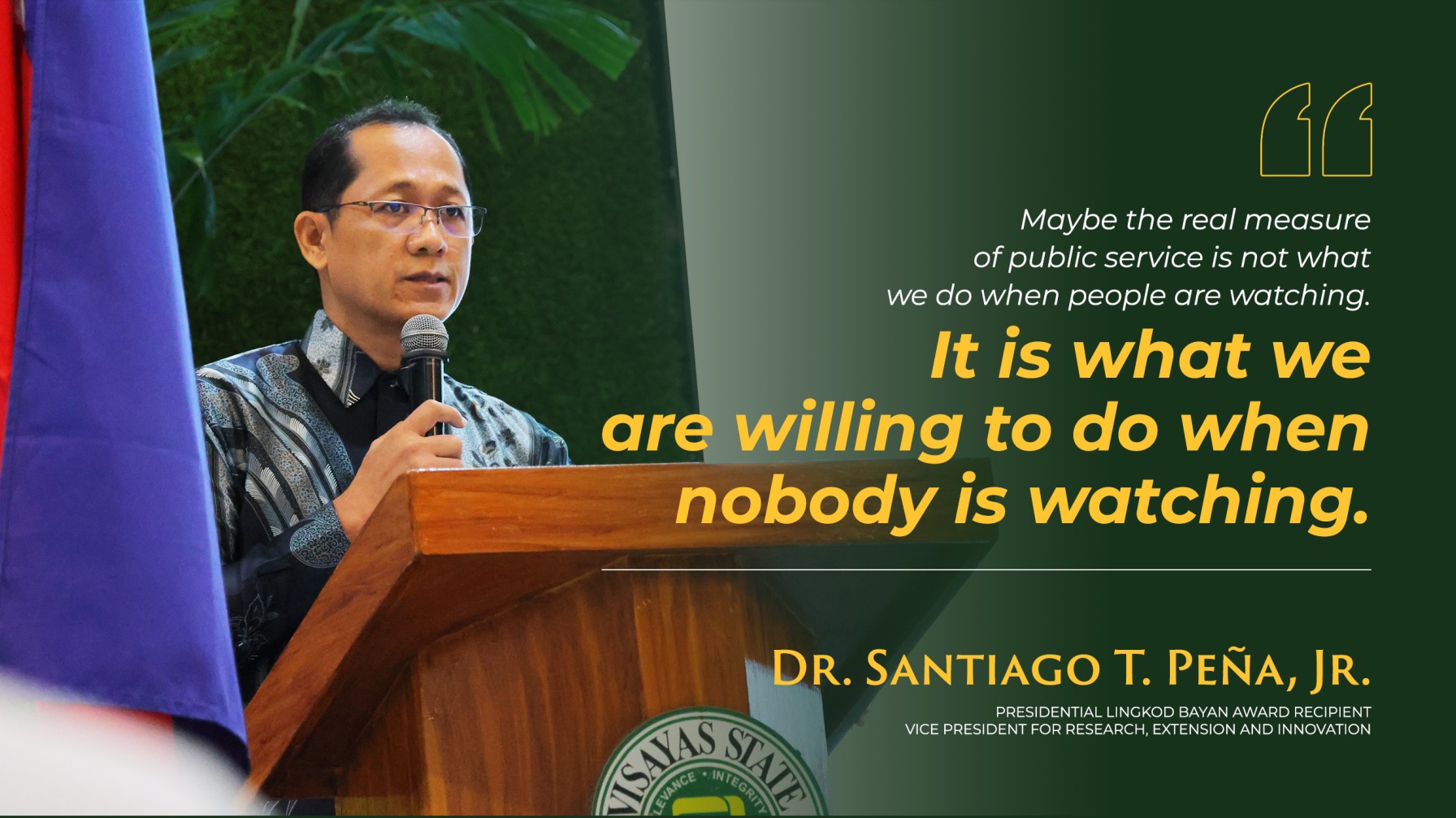
Maybe the real measure of public service is not what we do when people are watching.
It is what we are willing to do when nobody is watching. When there is no recognition. No photograph. No certificate. No one to congratulate us. Just the work.
And for those of us who believe in God, we know that even when nobody else sees, God sees. That, for me, gives ordinary work a different meaning.
Because perhaps the real test is not whether somebody will notice what we did. Perhaps the question is whether we can still do it properly even if nobody ever does.
And one thing public service teaches you, especially as the years go by, is that positions are temporary.
Today, you may be the one signing the document. Tomorrow, somebody else will be signing it.
Today, people come to your office. Tomorrow, you may be the one knocking on somebody else's door.
Today, you may be the person making the decision. Eventually, you will hand that responsibility to someone else.
So we should be careful not to confuse the position we occupy with the person we are. Because ultimately, our worth does not come from our designation.
Our position may be given to us by an institution, but our identity is much bigger than our position.
And I think that is an important thing to remember in public service. Because titles come and go. Positions come and go. But how we treat people, how honestly we work, how faithfully we carry our responsibilities—that is something that stays with us.
There is a phrase I have seen around VSU for a very long time. In fact, it is right there inside the Administration Building. I'm sure many of you have seen it too:
“Public Office is a Public Trust.”
-Article XI, Section 1, 1987 Philippine Constitution
We see those words so often that sometimes they become part of the background. But the longer you stay in public service, the more those words mean.
A public office is not really ours. The position is not ours. The authority and resources are not ours. We are entrusted with them for a period of time.
Eventually, we leave. Someone else will sit in that chair. Someone else will occupy that office. Someone else will take responsibility.
And hopefully, we leave something a little better than what we inherited.
Of course, no institution is perfect. VSU is not perfect, and neither are we. We make mistakes, we have shortcomings, and sometimes things do not go the way we want them to.
And if you ask me, I can say that from experience. I have also experienced being reported. Can you imagine? Whatever the reason, of course I felt bad. Nevertheless, life must go on. I learned from it. I moved on. And life went on.
Because being entrusted with something does not mean being perfect. It means being accountable for what has been entrusted to us, being willing to learn when we fall short, and continuing to do our best.
Perhaps that is also part of stewardship. We will make mistakes. We will have shortcomings. But what matters is how we respond, how we learn, and what we leave behind.
We are entrusted with something. And for those of us who believe, that sense of stewardship ultimately points us back to God.
And when our time comes to leave, perhaps we can look back and say: I made mistakes. I could have done some things better. But I showed up. I tried. I did my part.
And hopefully, because we were here, something became a little better.
There is another thing that I think happens when our work becomes complicated. We can become so focused on doing the work that we forget whom the work is for.
We talk about research outputs. Extension activities. Projects. Reports. KPIs. Deliverables.
All of these are important. But sometimes, with the complexity of university work, we become so focused on the project that we forget the person behind it.
We see the report, the KPI, the memorandum, the transaction—but behind each of these is a person.
The farmer is not just a beneficiary. The student is not just a name on a class list. The colleague is not just another office to coordinate with. There is a person behind the work we do.
And perhaps one of the simplest ways to serve is simply to remember that.
So when we ask, “Para kanino ka ba bumabangon?,” perhaps the answer is closer than we think.
There is someone on the other end of our work.
And there is one thing I cannot leave out today, because if I do, I would be leaving out an important part of who I am: my faith.
There is a verse in the Bible that has become particularly meaningful to me:
“So whether you eat or drink, or whatever you do, do it all for the glory of God.”
— 1 Corinthians 10:31
I like this verse because of how simple it is.
Paul could have said, whether you lead, whether you teach, whether you accomplish something great. But he said: whether you eat or drink. Something as ordinary as eating, as drinking. And then: “Whatever you do.”
I think there is something very powerful in that.
Sometimes we think that if we want to glorify God, we have to do something big. Something extraordinary. Something that people will notice. But perhaps that is not the point.
If even eating and drinking can be done for the glory of God, then surely the ordinary things we do every day can be done that way too. Cleaning a room. Guarding a gate. Maintaining a research field. Teaching a class. Preparing a report. Processing a document. Helping a student. Going to the field. Doing research. Making a difficult decision.
Even something as simple as showing up and doing your work properly. For a person of faith, these things can have a meaning beyond the task itself.
But faith does not necessarily mean work until you collapse. I don't think God is asking us to prove our faith by destroying ourselves in the process. We have families. We have health. We need rest. We need to know our limits.
Sometimes saying “I cannot do this” is not a failure of commitment. Sometimes it is simply recognizing that we are human. We are stewards not only of the work entrusted to us, but also of the life God has entrusted to us.
So perhaps “when is enough, enough?” does not always mean, “When do I stop serving?” Sometimes it means: “When is enough, enough, and when is it time to rest so we can serve again tomorrow?”
And that brings me back to the first question. Para kanino ka ba bumabangon? Who are you getting up for? Maybe it is your family. Maybe your students. Maybe your colleagues. Maybe the farmers and communities we serve. Maybe the university. But for those of us who believe, there is also another answer.
Ultimately, we serve God through the people and responsibilities He has placed before us. And that is where the verse becomes very real: “Whatever you do, do it all for the glory of God.”
So when I received the Presidential Lingkod Bayan Award, I did not really see it as a story about me.
Because the more I think about it, the more people I see behind it.
I remember receiving a notice from the VSU administration informing me that I had been recommended for the award and that I needed to prepare my documents. That was actually while I was still in Iloilo City for the long-awaited accreditation interview for my
professorship. I was focused on the big day—the accreditation interview.
A few days later, when I got back to VSU, thank God, I was still able to finish my so-called accomplishment story.
But it turned out that the ten-page document I submitted was only the beginning.
I had to go through an interview with someone that felt like an endless questionnaire—it went on for a few hours.
Then there were also interviews with people who knew me and had worked with me—including my colleagues, supervisors, and even my neighbor!
And that was when I realized: an award like this cannot really be established by one person's papers.
You can write your own accomplishment story. You can prepare ten pages of documents. But you cannot write the story of what other people have experienced working with you.
That story is written by the people around you.
And when I look back, I see my mentors, my colleagues, the staff from my beloved FVM, my research assistants, students, farmers, and partners. People who helped me, worked with me, challenged or criticized me, supported me, and sometimes simply made the work possible.
And that is probably why I feel more humbled than proud when I talk about the award. Because an award may carry one person's name, but the work behind it rarely belongs to one person. There are always many people behind it.
And perhaps that is what I would like to leave with you today.
Most of us will never receive a Presidential Lingkod Bayan Award. And that's perfectly fine. We don't have to. We don't have to do something extraordinary every day. We just have to remember that what we do matters. That somebody depends on our work. That the position we hold is entrusted to us. That the small things we do can make the institution work. And, for those of us who believe, that even those small things can be offered to God.
So I began this morning by saying I wasn't sure how to inspire you. I'm still not sure that I can. But perhaps I don't need to. Because when I look around VSU, I realize that we are already surrounded by people who quietly show us what service looks like.
The utility worker at four in the morning. The guard standing in the rain. The research assistant in the field. The teacher in the classroom. The administrator making a difficult decision. The student walking across campus. People doing ordinary things, day after day.
And perhaps that is where I find the connection between the human and the heavenly. We do our work here, in very ordinary circumstances. But for those of us who believe, God sees the ordinary things. And perhaps that is enough reason to do them well. So, to everyone here, thank you.
Thank you for the work people see.
And perhaps even more, thank you for the work people don't see. Because all of these are part of keeping this university moving.
And while we are here, may we continue to serve faithfully—not because we expect recognition, but because we have been entrusted with something.
And when we wake up tomorrow morning and ask ourselves again, “Para kanino ba ako bumabangon? When is enough enough?,” may we remember the people we serve, the responsibility we have been given, and ultimately, the God whom we seek to honor through the work of our hands.
“Whether you eat or drink, or whatever you do, do it all for the glory of God.” Thank you very much.
And happy 126th Philippine Civil Service Anniversary to all of us.
Mabuhay ang lingkod bayan!