
Beyond the seed: How AAACU changed one #ProudViscan’s view of agriculture
- Details
- Written by Riza Mae L. Maningo
-
Published: 01 October 2026
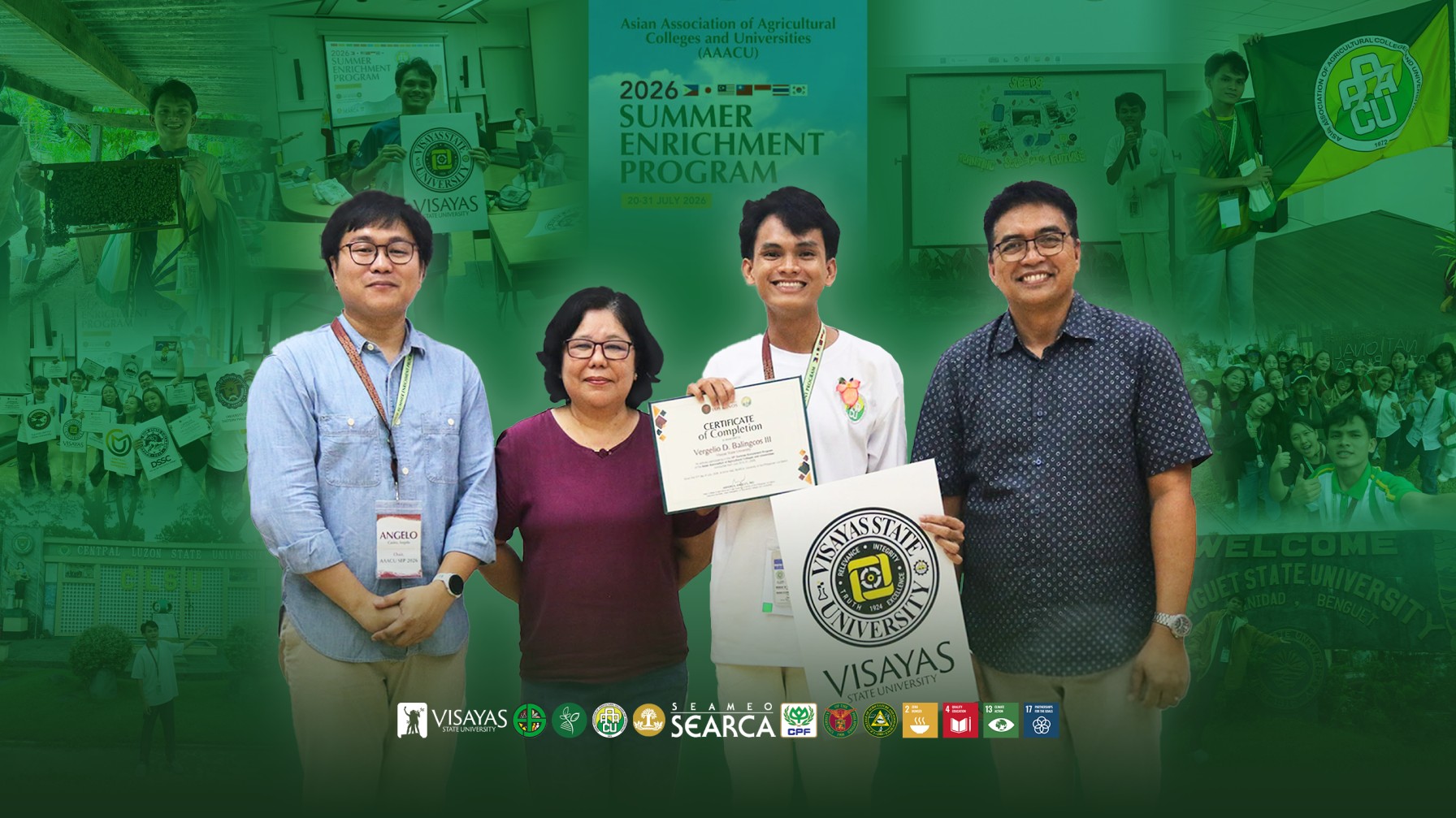
For Vergelio VJ D. Balingcos III, agriculture once seemed to begin with a seed.
As a graduating Bachelor of Science in Agriculture, major in Plant Breeding and Genetics in at Visayas State University, much of his academic world has revolved around seed varieties, plant traits, genetic diversity, and the science behind developing crops that are more productive and resilient.
He understood agriculture through the laboratory, the field, and the classroom.
Then came the Asian Association of Agricultural Colleges and Universities (AAACU) Student Enrichment Program (SEP) 2026.
The two-week program, which ended on August 1, brought together 36 young agriculturists, including Balingcos as VSU’s student representative, for an immersive learning journey across six universities and 17 research institutions in Luzon.
Together, the delegates encountered different approaches to agricultural education, research, technology, policy, extension, community engagement, and collaboration.
For Balingcos, the experience did more than expand his knowledge of agriculture.
It changed the way he understood it.
From plant traits to the bigger agricultural system
The AAACU SEP challenged Balingcos to look beyond the boundaries of Plant Breeding and Genetics and see agriculture as a discipline deeply connected to people, institutions, communities, and the larger issues facing society.
At the University of the Philippines Los Baños, Cavite State University, Southern Luzon State University, Central Luzon State University, Mariano Marcos State University, and Benguet State University, he encountered agricultural systems shaped by different environments, communities, institutional strengths, and local realities.
Each stop offered a different perspective.
Some demonstrated how research can address emerging agricultural problems. Others highlighted technologies developed to respond to specific needs. Still others showed the importance of policy, extension, education, community engagement, and institutional collaboration in bringing knowledge beyond the university.
“What stood out to me was that, despite the differences in geography, culture, and agricultural systems, many of the challenges we face are all just interconnected,” Balingcos reflected.
Food security. Climate change. Agricultural productivity. Rural development. And the challenge of encouraging the next generation to pursue agriculture.
These are not problems confined to one discipline, one institution, or even one country.
And for a student whose specialization centers on improving crops, the experience offered an important realization: building a resilient food system requires more than producing better plants. It requires understanding the environments in which they grow, the people who cultivate them, and the systems that allow innovations to reach them.
The perspective closely mirrors the direction VSU itself is pursuing.
When climate resilience becomes more than a concept
For a university whose roots are deeply intertwined with agriculture and natural-resource science, climate resilience is not simply an emerging academic buzzword. It is increasingly a practical imperative.
The severe El Niño experienced by the Philippines in 2024 offered a stark reminder of this reality, with VSU AgroMet Station, recognizing the effects of extreme heat and changing weather conditions on agriculture, health, energy, and human productivity.
The university’s research, extension, and innovation efforts have since continued to pursue questions that sit at the heart of Balingcos’ AAACU experience: How can agriculture remain productive when the climate is becoming less predictable? How can scientific knowledge reach farmers? And how can innovations strengthen both food security and the livelihoods that depend on it?
One particularly timely example is VSU’s partnership with the Louisiana State University (LSU) AgCenter through the Visayas Socio-Economic Research and Data Analytics Center (ViSERDAC).
The project, titled "Strengthening climate resilience in leveraging US Agricultural Research and Extension strategies for advancing climate smart agriculture adoption among Filipino rice producers,” brings together research, capacity building, and field engagement to advance climate-resilient rice production among Filipino farmers.
Its work has already reached rice farming communities in Leyte, where researchers examined the adoption of climate-resilient practices and explored ways to translate agricultural research interventions appropriate to Philippine farming realities.
For Balingcos, this is precisely the kind of connection that made the AAACU journey meaningful.
Research cannot stop at the laboratory.
It has to travel–from the research center to the field, from the university to the farming community, from scientific findings to decisions that can help a farmer withstand a difficult production season.
From resilient crops to resilient food systems
VSU’s climate agenda also extends to the way agricultural resources themselves are managed.
Last year, the university partnered with Verde Carbon Capture, Inc. for a large-scale initiative on low-emission rice production in Leyte and Bohol. The project promotes Alternate Wetting and Drying (AWD), a climate-smart water management strategy that alternates flooding and draining in rice paddles rather than keeping fields continuously submerged.
The approach seeks to reduce methane emissions while conserving irrigation water and maintaining rice yields–demonstrating how climate action can simultaneously address environmental sustainability, resource efficiency, and agricultural productivity.
The university’s research also looks closely at the climate realities of its own communities.
A study published in the Annals of Tropical Research, “Irregularity and time-series trend analysis of rainfall in Baybay City, Leyte, Philippines,” examined rainfall patterns from 1911 to 2020 and highlighted the importance of adaptive measures in water-resource management, agriculture, and infrastructure amid rainfall variability and extreme weather events.
Beyond farms and water systems, VSU is also examining resilience at the ecosystem level. Its 2026 forest research project, “Assessing Biodiversity and Ecosystem Functioning of Permanent Forest Dynamics Plots in Mt. Nacolod, Southern Leyte for Climate Resilience and Vulnerability,” explores how forest ecosystems can remain resilient amid environmental pressures.
Taken together, these efforts paint a larger picture.
Climate-resilient agriculture is not simply about finding a crop that can survive heat or drought.
It is about understanding water, soils, ecosystems, technologies, livelihoods, communities, and the policies and institutions that connect them.
And this was precisely the bigger picture that Balingcos began to see during the AAACU SEP.
When research leaves the laboratory
As a student specializing in plant breeding, Balingcos was particularly drawn to the research programs and innovations presented throughout the program.
The research institutions gave him a glimpse of what happens when scientific concepts move beyond papers, laboratories, and experimental plots and begin addressing actual problems faced by farmers and communities.
For him, this was among the most important lessons of the journey.
Research, he realized, is not meaningful simply because it produces new knowledge. Its deeper value is felt when that knowledge becomes actually responsive towards the needs of the people for whom it is intended.
“AAACU made me realize to see the science of agriculture not only as something to study, but as something meant to create impact,” he said.
That realization resonates with the direction VSU is taking in its research, extension, innovation, and instruction efforts.
The university’s current institutional agenda emphasizes the integration of climate resilience, sustainable resource management, digital innovation, community-centered learning, and experiential education, while preparing graduates who are adaptive, innovative, and globally relevant. VSU has likewise identified the acceleration of climate-resilient agriculture and fisheries systems as an important direction for regional science, technology, and innovation.
For Balingcos, this means seeing his specialization not as an isolated field, but as one piece of a much larger agricultural system.
A better variety matters.
But so does the farmer who will grow it.
So does the soil in which it will be planted, the water available to sustain it, the climate it must withstand, the technology that will support its production, the extension worker who will help communities adopt it, and the institution that will bring the innovation from research to the tangible reality.
Learning through people
Beyond the universities and research institutions, the people Balingcos encountered became an equally important part of his AAACU journey.
Interacting with fellow delegates from different universities and neighboring countries exposed him to perspectives shaped by different cultures, agricultural systems, and personal experiences.
The diversity of the group reinforced another lesson: agricultural challenges cannot be solved by science alone.
They require people who are willing to communicate, collaborate, listen, and work across disciplines and borders.
“Being with them throughout the experience reminded me that agriculture is not something that can be solved by science alone, but rather, as something that should be worked on by people through collaboration,” he said.
For Balingcos, this broadened his understanding of what it means to be a young Filipino agriculturist.
His role, he realized, should not end with understanding scientific principles.
It should also involve learning how to translate that knowledge, connect it with communities, and help create meaningful change.
An education that travels—and comes home
In many ways, the AAACU SEP became an extension of what Balingcos had already been learning at VSU.
The university's laboratories and classrooms taught him the science of agriculture.
Its research and extension programs showed how that science can respond to real-world problems.
The AAACU experience allowed him to see how other institutions and countries were confronting many of the same challenges—and how much can be learned when agricultural communities share knowledge across boundaries.
This convergence is particularly significant at a time when food security and climate change are increasingly inseparable.
A warming planet, unpredictable rainfall, water constraints, extreme weather, declining natural resources, and growing food demand are forcing agriculture to rethink how food is produced and how agricultural knowledge is shared.
For VSU, the response is not limited to producing research outputs.
It is also about producing scholars capable of acting on what they learn.
The university's vision for its graduates increasingly calls for professionals who are not only technically competent but also sustainability-oriented, innovation-driven, community-centered, and prepared to work in an interconnected world.
Balingcos' journey offers a glimpse of what that education can look like in practice.
He left VSU as a plant breeding student.
He returned from AAACU as a young agriculturist beginning to see the entire food system–from a global perspective.
Bringing the lessons home
Returning to VSU, Balingcos brought home more than photographs, memories, and new friendships.
He returned with a broader perspective of his field—and a deeper appreciation of the role VSU plays in preparing students to contribute to Philippine agriculture.
The experience encouraged him to look at his future profession with a greater sense of purpose.
For him, being a young agriculturist means being willing to learn, collaborate, communicate, and contribute beyond the boundaries of one's specialization.
And perhaps that is the most valuable lesson the AAACU SEP gave him.
“AAACU did not give me all the answers, but it gave me better questions to carry forward,” he said.
Those questions now extend far beyond the boundaries of plant breeding.
How can science help farmers adapt to a changing climate?
How can research become more responsive to the realities of farming communities?
How can innovations developed in universities reach the people who need them most?
And how can young agriculturists help build a food system capable of feeding a growing population while remaining resilient to climate and environmental pressures?
These are not questions Balingcos is expected to answer alone.
But they are questions he is now better prepared to address.
From VSU to the future of Philippine agriculture
Balingcos' AAACU journey ultimately brings him back to where he began: the seed.
Except that he now sees it differently.
A seed carries genetic potential.
But realizing that potential requires an entire system of science, people, institutions, resources, and communities working together.
The same may be said of an agriculturist.
Education provides the foundation. Research provides knowledge. Extension connects that knowledge to communities. International engagement widens perspective. And collaboration turns individual expertise into collective action.
That is the kind of agriculturist Balingcos hopes to become.
And it is also the kind of graduate VSU seeks to develop—one who can move confidently between the laboratory and the field, between local realities and global conversations, and between knowledge and action.
His AAACU experience therefore becomes more than a story of one student's international exposure.
It becomes a reflection of an educational mission: to prepare young Filipinos who can recognize that the challenges of food security and climate resilience are global, while understanding that meaningful solutions must remain grounded in the needs of communities.
For Balingcos, the journey has only begun.
“This journey would not have been possible without the people and institutions who supported me along the way,” he said, expressing his gratitude to VSU and its administration; the Faculty of Agriculture and Food Science, particularly Dean Dr. Suzette B. Lina; the FAFS-Student Supreme Council led by Hon. Arjon John Gamez; the Department of Plant Breeding and Genetics, particularly its head, Dr. Ma. Gweneth Abit; and the AAACU and its partner institutions.
He also thanked the faculty members, mentors, organizers, fellow delegates, and everyone who welcomed the participants throughout the program.
As he prepares to leave VSU and enter the next chapter of his life, Balingcos carries with him not only the lessons he gained from the AAACU SEP, but also a responsibility—to share those lessons, apply them, and contribute to the future of Philippine agriculture.
And if agriculture once began for him with a seed, the journey has taught him that its possibilities reach much farther.
Beyond the seed are the people. Beyond the laboratory are the communities. And beyond science is the responsibility to make a real impact.
This article is aligned with Sustainable Development Goal (SDG) No. 2: Zero Hunger; SDG No. 4: Quality Education; SDG No. 13: Climate Action; and SDG No. 17: Partnerships for the Goals.