

#DiscoverWithVSU: AI Model detects Cacao Black Pod Disease with 99% accuracy
- Details
- Written by Mike Laurence V. Lumen
-
Published: 19 June 2026
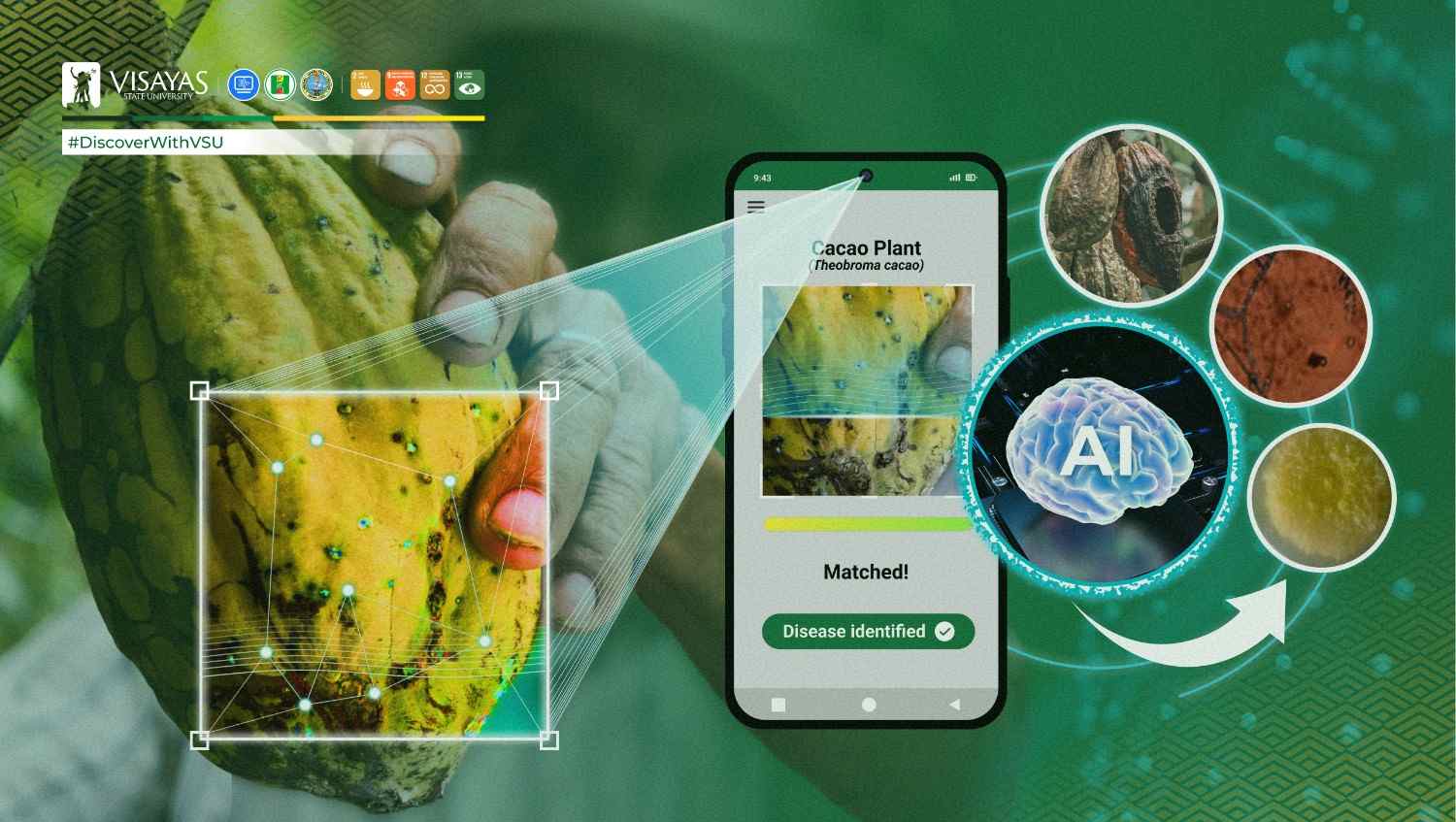
Every year, many cacao farmers lose a large part of their harvest because of black pod disease, one of the most destructive diseases affecting cacao farms. Once the infection spreads, entire pods rot, harvests decrease, and farmers lose both time and income.
A study conducted by researchers from Visayas State University (VSU) and Abuyog Community College (ACC) explored how artificial intelligence (AI) can help farmers detect the disease earlier using simple photos of cacao pods.
Their study, titled “Convolutional Neural Network Model for Cacao Phytophthora Palmivora Disease Recognition,” was published in the International Journal of Advanced Computer Science and Applications (IJACSA).
The research was conducted by Jude B. Rola, Jomari Joseph A. Barrera, Maricel V. Calhoun, Jonah Flor Oraño-Maaghop, Magdalene C. Unajan, Joshua Mhel Boncalon, and Joy S. Espinosa from the VSU-Department of Computer Science and Technology (VSU-DCST), together with Elizabeth M. Sebios from the Department of Information Technology Education of ACC.
Black pod disease is caused by Phytophthora palmivora, an oomycete (water mold) plant pathogen that infects cacao pods and can reduce yields by as much as 90% during severe outbreaks. Farmers usually identify infected pods through manual inspection or by consulting agricultural experts. However, for many farming communities, especially those in remote areas, access to specialists is not always easy or affordable.
To help address this problem, the researchers collected 2,000 images of cacao pods from cacao farms within VSU. The dataset included healthy and infected cacao pods from commonly grown varieties such as Criollo, Forastero, and Trinitario. The images were captured using a smartphone camera under controlled conditions and were checked and classified by a cacao expert from VSU Department of Horticulture (VSU-DOH).
The team tested six different machine learning models to determine which one could best identify diseased pods from images. Among all the systems tested, the Convolutional Neural Network or CNN model achieved the highest accuracy at 99%.
According to the researchers, the system studies the color, texture, and appearance of cacao pods to determine whether the pod is healthy or infected.
With earlier detection, farmers may be able to respond faster before the disease spreads throughout the plantation. This may help reduce crop losses, protect harvests, and improve cacao production.
The researchers also recommended developing the system into a mobile application that farmers and agricultural workers may eventually use directly in the field using smartphones.
As farming continues to face challenges from pests and diseases, studies like this show how technology can be used in practical ways to support farmers, protect crops, and help strengthen local agricultural production.
This article is aligned with the Sustainable Development Goal (SDG) 2: Zero Hunger, SDG 9: Industry, Innovation, and Infrastructure; SDG 12: Responsible Consumption and Production, and; SDG 13: Climate Action.