
VSU College of Medicine secures CHED approval, welcomes pioneer batch for AY 2026–2027
- Details
- Written by Riza Mae L. Maningo
-
Published: 24 June 2026
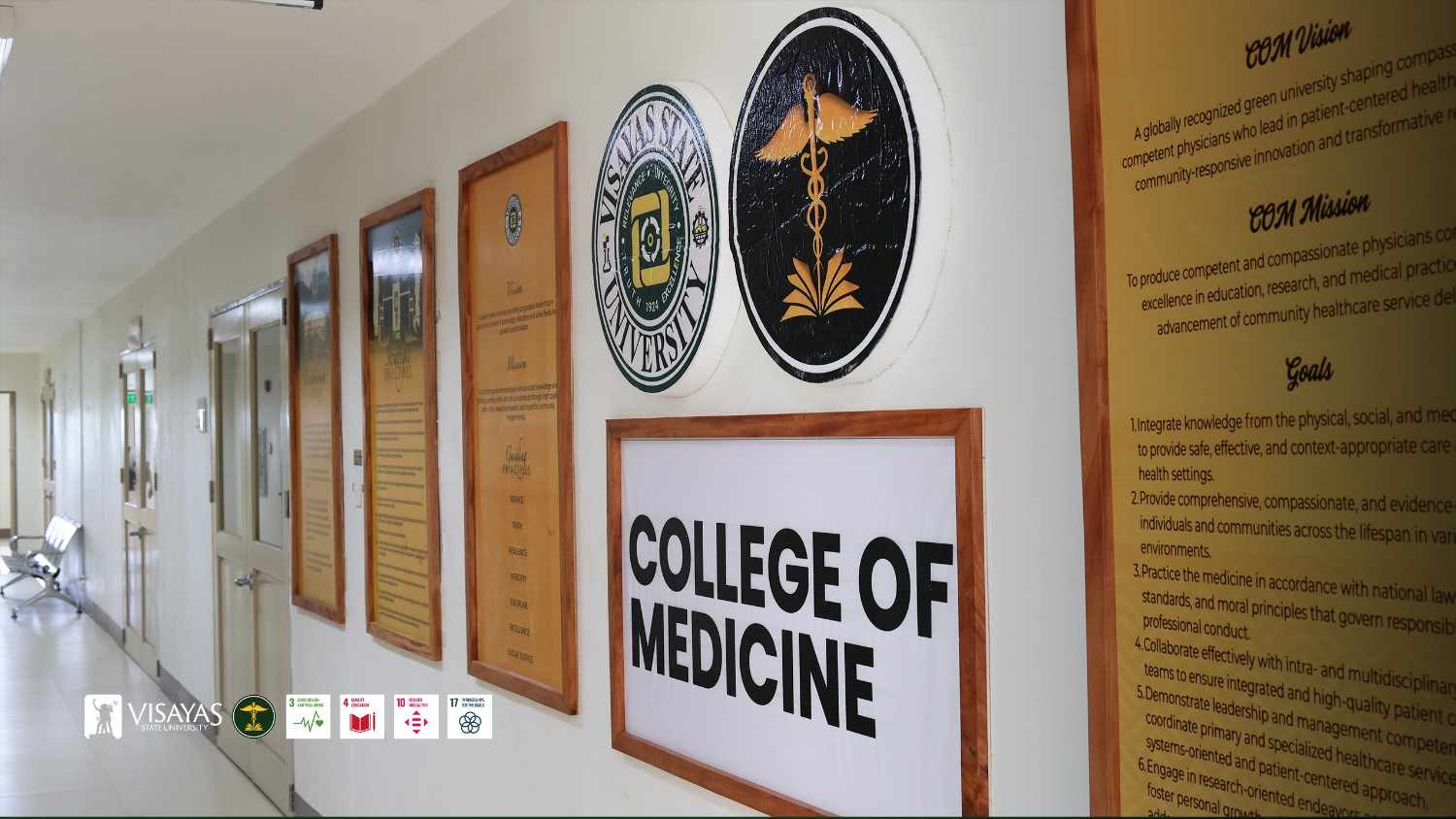
The Commission on Higher Education (CHED) has approved the Doctor of Medicine program, paving the way for the Visayas State University to welcome its first batch of medical students beginning Academic Year 2026–2027. Granted through the Office of Programs and Standards Development (OPSD) and the Technical Panel for Medical Education, the approval covers the first- and second-year levels.
Secured on June 17, 2026, the approval caps years of planning, facility development, faculty recruitment, and partnership-building. It affirms the university's readiness to deliver quality medical education and reflects the collective efforts of administrators, faculty members, healthcare partners, legislators, and supporters who helped bring the vision to life.
VSU joins other institutions in Eastern Visayas in expanding access to medical education, making the path to becoming a doctor more attainable for students in the region while helping address persistent shortages in the healthcare workforce.
The approval marks a new chapter for the university as it prepares to welcome its pioneering batch of medical students—future physicians who are expected to serve not only Eastern Visayas but also communities across the country.
Following a rigorous evaluation and deliberation process, CHED found VSU fully compliant with the requirements of CHED Memorandum Order No. 18, series of 2016, which sets the standards for Doctor of Medicine programs in the country.
What aspiring VSU medical students need to know
With CHED approval now in place, VSU has officially opened applications for the pioneer batch of students who will comprise the first Doctor of Medicine class of the VSU College of Medicine.
The online application period runs from June 24 to July 10, 2026. Applicants may register and complete their application through the online admissions portal at https://med-apply.vsu.edu.ph/.
Who may apply?
The VSU College of Medicine welcomes applicants who meet the following qualifications:
- Filipino citizenship
Must be a natural-born or naturalized Filipino citizen at the time of application. - Strong academic background
Must hold a bachelor's degree from a CHED-recognized college or university with a General Weighted Average (GWA) of at least 2.0 or 85%. Graduates of pre-med programs are preferred. - NMAT requirement
Must have obtained a minimum NMAT score of 40th percentile rank, with results issued within the last two years. - Good moral character
Must present proof of good moral standing, supported by recommendations from two college professors. - Commitment to return service
Must demonstrate commitment to undergo a return service program after completing medical training. - Preference for Eastern Visayas applicants
Priority may be given to applicants from Region VIII who are committed to serving local communities. - Priority for applicants from low-income families
In line with VSU's commitment to accessible medical education, applicants from economically disadvantaged households will be prioritized. - Transferees
Applicants transferring from another institution must submit transfer credentials and may only be admitted as first-year medical students.
How does the admissions process work?
Admission to the VSU College of Medicine involves five stages:
- Online Application
Applicants must register and complete the online application form through the admissions portal: https://med-apply.vsu.edu.ph/. - Document Evaluation
The College of Medicine Admissions Committee will verify the authenticity and completeness of all submitted documents. - Interview Scheduling
Applicants who pass the initial screening will receive an Applicant Control Number (ACN) and an interview schedule via email. - Panel Interview
Qualified applicants will undergo an interview conducted by the VSU COM Admissions Committee. Beyond academic performance, the panel will assess motivation to pursue medicine, social awareness, integrity, resilience, and commitment to service. - Final Evaluation and Selection
Successful admission will be based on overall ranking, interview performance, and the results of physical and psychometric examinations.
Documentary requirements
Applicants are required to submit the following documents:
- Letter of Intent addressed to the COM Dean and signed by both the applicant and parent or guardian, indicating willingness to render return service, preferably within Eastern Visayas;
DR. ROXANNE JAYME-BONGON
Dean
College of Medicine
Visayas State University
- Recommendation Letter addressed to the COM Dean, signed by the applicant's previous school (Department Head or Dean);
- Duly accomplished COM Admission Application Form;
- Clear machine copy of NMAT results;
- Certified True Copy of Transcript of Records;
- Certified True Copy of Diploma or Certificate of Graduation;
- General Weighted Average (GWA) Certificate;
- Transfer Credentials (for transferees only);
- PSA-issued Birth Certificate;
- Barangay- or DSWD-issued Certificate of Indigency (for underprivileged/indigent families only);
- Latest Income Tax Return (ITR) of parents or Certificate of Tax Exemption from BIR for non-working parents;
- Any valid government-issued ID;
- Two recent colored 2x2 ID photos taken within the last six months
Through this process, VSU seeks future physicians who not only possess the academic capability to succeed in medicine but also embody the values of service, compassion, leadership, and social accountability that define the university's vision for its graduates.
From a community need to a medical school
The opening of admissions for the VSU College of Medicine marks the culmination of years of planning, collaboration, and commitment to improving healthcare access in Eastern Visayas.
While the program officially begins accepting its pioneer batch this A.Y. 2026-2027, the prospect of offering a Doctor of Medicine degree at VSU was first formally shared by former VSU President Edgardo E. Tulin during his state of the university address on November 21, 2022.
With the official endorsement from CHED, the College of Medicine represents a commitment that goes far beyond a mere academic addition to VSU's offerings. It is a response to the region's long-standing need for more physicians and healthcare professionals, particularly in underserved communities. The vision is to train #ProudViscan doctors who are not only competent in their profession but also compassionate and deeply committed to serving the communities where they are needed most.
Looking back, the need became apparent during the COVID-19 pandemic, which highlighted the challenges faced by local healthcare systems and the continuing shortage of medical manpower. As a provincial component city that serves not only its residents but also neighboring municipalities in Western Leyte, Baybay City recognized the importance of investing in a sustainable pipeline of future physicians who understand the realities of local healthcare delivery.
Momentum toward establishing a medical school at VSU gained ground in February 2023 when Leyte Fifth District Representative Carl Nicolas C. Cari announced the approval at the House Committee level of proposed legislation creating a College of Medicine in the university. As principal author of House Bill No. 4553, Congressman Cari championed the measure as a strategic investment in the region's healthcare future.
The proposal advanced further in May 2023 following the approval of the Senate Committee on Higher, Technical, and Vocational Education. A major breakthrough came on December 20, 2023 when President Ferdinand R. Marcos Jr. signed Republic Act No. 11974 into law, officially establishing the VSU College of Medicine in Baybay City. The law, which took effect on January 4, 2024, mandated the university to offer both a Doctor of Medicine program and an Integrated Liberal Arts and Medicine program.
With the legal foundation in place, VSU immediately began laying the groundwork for the college. Throughout 2024 and 2025, the university worked hard on curriculum development, faculty recruitment, infrastructure preparation, and institutional partnerships necessary to meet national standards for medical education.
A key congressional meeting held on August 28, 2024 brought together university officials and Congressman Cari to advance the implementation of Republic Act No. 11974 while awaiting budget appropriations. During this period, a specialized VSU task force crafted an evidence-based curriculum while drawing lessons from some of the country's leading medical schools. More importantly, the program was designed to go beyond simply offering a medical degree. University President Prose Ivy G. Yepes emphasized that the VSU COM would be anchored on community-based healthcare, equipping aspiring physicians with the knowledge, skills, and social awareness needed to serve rural and underserved communities across Eastern Visayas, and even beyond.
Recognizing that medical education extends beyond classrooms and laboratories, VSU also established strategic partnerships with healthcare institutions across the region. In March 2025, the university designated VisayasMed Hospital as its base hospital through a Memorandum of Agreement (MOA). Additional partnerships followed with Gatchalian Medical Center, Ormoc Doctors' Hospital, and OSPA-Farmers' Medical Center in Ormoc City, as well as Baybay City Immaculate Conception Hospital, the Baybay City Super Health Center, and the City Medical Diagnostic and Dialysis Center.
Together, these partnerships provide future medical students with diverse clinical training opportunities while strengthening healthcare services throughout Eastern Visayas—bringing VSU one step closer to its vision of producing physicians who are equipped to serve both the region and the nation.
Assembling the pioneer medical faculty
Alongside facility upgrades and institutional partnerships, VSU invested in building a strong academic and professional foundation for the program.
In January of last year, Dr. Roxanne S. Jayme-Bongon officially joined the university as consultant for the establishment of the College of Medicine and led preparations for its operationalization.
On September 8, 2025, VSU COM formally welcomed its pioneer faculty members who were tasked with developing the curriculum and preparing the institution for its first student intake.
Leading the college is Dr. Jayme-Bongon, who transitioned from consultant to become the first Dean of VSU COM.
She is joined by Dr. Silverio B. Arcamo, Jr., Dr. Judith P. Sanico, and Dr. Karina P. Lapinid, whose combined expertise spans surgery, pulmonology, internal medicine, diabetology, occupational health, and medical research.
What began with a core group of four pioneer physician-educators has since grown into a team of 20 faculty members who are now prepared to teach, mentor, and guide the college's first batch of medical students in Academic Year 2026–2027. The expansion of the faculty reflects VSU's continued commitment to meeting national standards for medical education while ensuring that students receive quality instruction from experienced healthcare professionals across various medical disciplines.
Here’s the full list of faculty members and their respective specializations:
VSU COM FACULTY
| NAME | SPECIALIZATION |
|---|---|
| 1. DR. ROXANNE J. BONGON | FAMILY MEDICINE |
| 2. DR. JUDITH P. SANICO | INTERNAL MEDICINE - PULMONOLOGY |
| 3. DR. KARINA P. LAPINID | INTERNAL MEDICINE - DIABETOLOGY |
| 4. DR. SILVERIO B. ARCAMO, JR. | SURGERY |
| 5. DR. JOHNNY KENNETH F. ROJAS | INTERNAL MEDICINE |
| 6. DR. RANDOLPH M. LIBRES | PATHOLOGY |
| 7. DR. JERONE ANTHONY D. NAVALES | INTERNAL MEDICINE |
| 8. DR. NIÑO JESSIELITO N. DOYDORA | INTERNAL MEDICINE - PULMONOLOGY |
| 9. DR. NORLITA P. ARCAMO | PSYCHIATRY |
| 10. DR. GLEEN A. MANAGBANAG | AESTHETICS |
| 11. DR. CORAZON D. DIORICO | OBSTETRICS – GYNECOLOGY |
| 12. DR. JOVANN FREDERICK F. RABOR | INTERNAL MEDICINE – NEUROLOGY |
| 13. DR. RHODETTE E. AREVALO | INTERNAL MEDICINE – CARDIOLOGY |
| 14. DR. SOFIA SALOME O. APARECE-SOLIS | INTERNAL MEDICINE - PULMONOLOGY |
| 15. DR. MARIA ANDONE L. TAN | OBSTETRICS – GYNECOLOGY |
| 16. DR. MA. FLOR ANNE E. QUIANZON | RADIOLOGY |
| 17. DR. RICARDO L. KHO, JR. | PEDIATRICS |
| 18. DR. CHRISTIAN S. DIORICO | INTERNAL MEDICINE - PULMONOLOGY |
| 19. DR. FRANCISTONI G. SERAFICA | INTERVENTIONAL RADIOLOGY |
| 20. DR. BRIGETTE NIÑA S. ABELLA | REHABILITATION MEDICINE |
| 21. DR. MICHELLE ONG CHU | INTERNAL MEDICINE – GASTROENTEROLOGY |
| 22. DR. RODRIGO CAPAHI | INTERNAL MEDICINE – NEPHROLOGY |
| 23. DR. EDWIN CAÑETE | INTERNAL MEDICINE – ENDOCRINOLOGY, DIABETES & METABOLISM |
| 24. DR. PATRICK DYCOCO | INTERNAL MEDICINE |
| 25. DR. NELSON CHU | INTERNAL MEDICINE - PULMONOLOGY |
| 26. DR. ABIGAIL CHU | INTERNAL MEDICINE – NEPHROLOGY |
| 27. DR. ELWIN JAY YU (AFFILIATE) | PUBLIC HEALTH |
| 28. DR. MERRY CHRIST'L GUINOCOR (AFFILIATE) | PEDIATRICS |
| 29. DR. CATHERINE CAMUIGING | INTERNAL MEDICINE - PULMONOLOGY |
| 30. ASST. PROF. DARIUS NOEL C. MIÑOZA (AFFILIATE) | GENETICS |
| 31. ATTY. RYSAN C. GUINOCOR (AFFILIATE) | DATA PROTECTION OFFICER |
| 32. ATTY. JEREMIAH REYNALDO | GENERAL LAW |
From a shared vision to a lasting legacy of service
The establishment of VSU COM represents more than just a milestone for the university; it is the university’s heartfelt commitment to the development of individuals and the welfare of local communities.
Reflecting on the approval, Dr. Roxanne S. Jayme-Bongon described the milestone as both a blessing and a responsibility shared by everyone who helped transform the vision into reality.
She acknowledged the collective efforts of the Technical Working Group, faculty members, staff, university leaders, legislators, and healthcare partners whose dedication laid the foundation for the program. She emphasized that the mission of the college goes beyond producing licensed physicians.
“Our goal is to form future physicians who are competent in practice, compassionate in service, and committed to the communities they serve,” Dr. Bongon said, stressing the community-oriented philosophy that will guide academic and clinical training.
Guided by the principles of Community-Oriented Medical Education (C.O.M.E.), the college seeks to cultivate a generation of medical professionals whose expertise is matched by a deep sense of social accountability and service.
What began as a proposal in Congress has now become a fully approved medical program ready to welcome its first students. Today, the VSU College of Medicine stands as a symbol of opportunity, service, and hope—bringing quality medical education closer to aspiring doctors and quality healthcare closer to the communities that need it most.
As Dean Bongon aptly puts it, “Let us all C.O.M.E. to VSU through Community-Oriented Medical Education, and together, let us learn, serve, and grow in pursuit of excellence and social accountability.”
This article is aligned with Sustainable Development Goal (SDG) No. 3: Good Health and Well-being; SDG No. 4: Quality Education; SDG No. 10: Reduced Inequalities; and SDG No. 17: Partnerships for the Goals.