
VICARP-VSU launches Visayas-wide GALING PCAARRD Kontra Krisis Projects
- Details
- Written by Elmera Y. Bañoc
-
Published: 26 June 2026
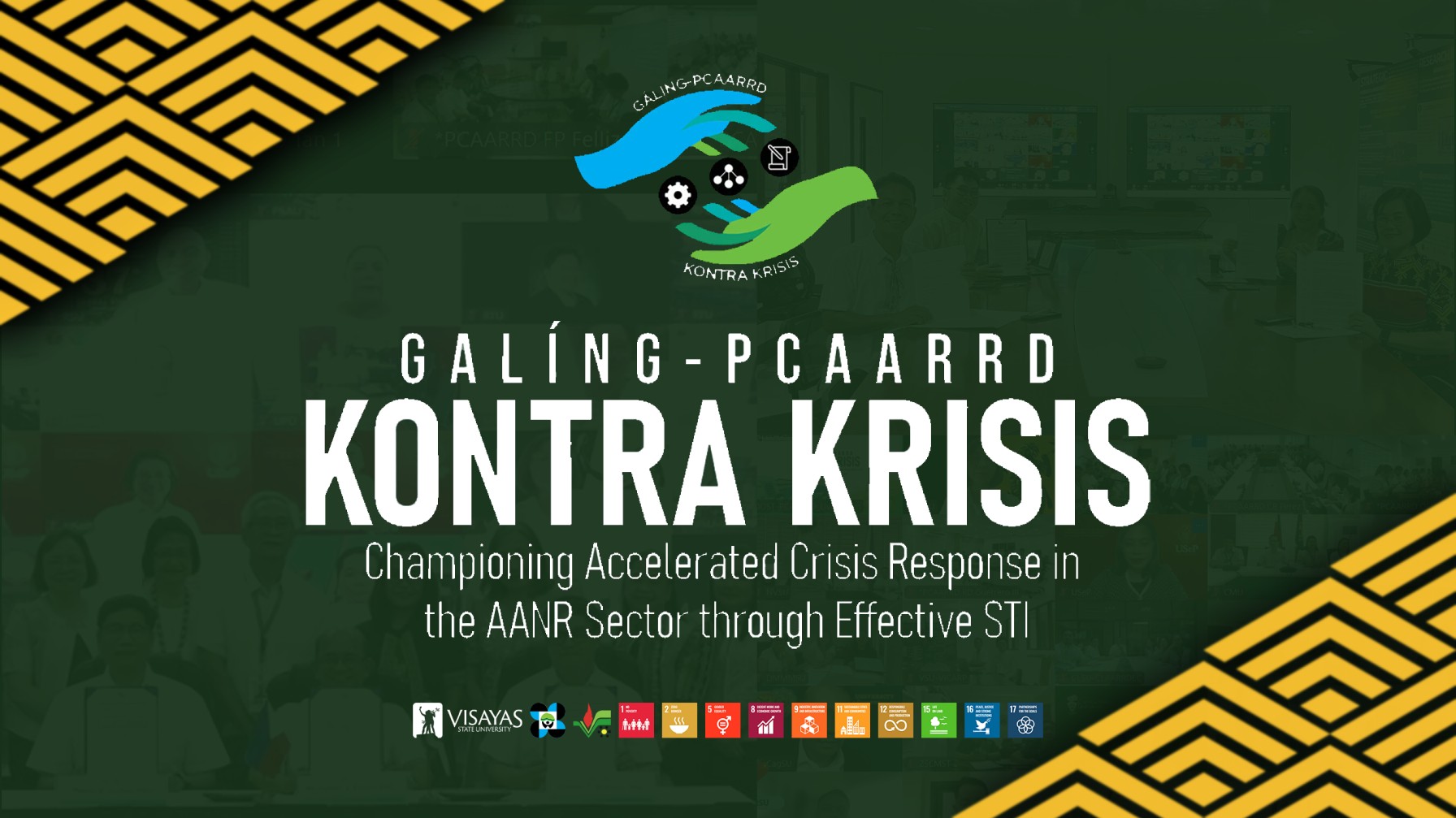
Of the sixty-three (63) Good Agri-Aqua Livelihood Initiatives towards National Goals (GALING) PCAARRD Kontra Krisis Projects (GPKK) approved for funding by the Department of Science and Technology–Philippine Council for Agriculture, Aquatic, and Natural Resources Research and Development (DOST-PCAARRD) nationwide, five projects will be implemented in the Visayas under the leadership of the Visayas Consortium for Agriculture, Aquatic and Natural Resources Research and Development (ViCARP) hosted by Visayas State University (VSU).
These projects were formally launched as one of the highlights of DOST-PCAARRD's 15th Founding Anniversary last June 22, 2026, marking fifteen years since the merging of the former PCARRD and PCAMRD in 2011.
The GALING PCAARRD Kontra Krisis (GPKK) Program addresses the impacts of economic, environmental, and energy-related challenges by promoting innovative agricultural and livelihood solutions that improve food security, generate income opportunities, and strengthen community resilience.
Strategic Projects
Leading the implementation of the program in the Visayas, ViCARP-VSU will oversee five strategic projects designed to benefit farmers, households, local government units, and community organizations.
Among the projects launched is “Deployment of Root Crop Planting Materials to Mitigate the Impacts of the Energy Crisis on Household Food Security and Livelihoods,” a Php. 5-million initiative aimed at increasing access to quality root crop planting materials to support household food production and livelihood generation with Prof. Marlon M. Tambis as project leader.
Complementing this effort is the project, “Leveraging Root Crop Food Products for Energy Crisis Response and Food Security through Distribution and Demonstration,” with Php. 4 million in funding. This project promotes the utilization of root crops as nutritious and sustainable food alternatives through community demonstrations and product distribution activities also headed by Prof. Marlon M. Tambis.
Another initiative, “ALALAY VSU: Agri-based Livelihood Assistance for Local Agricultural Yield,” implemented under the MATATAG ViCARP Framework, seeks to enhance agricultural productivity and provide livelihood support to vulnerable communities through science-based agricultural interventions. With Php. 4.8 million in funding, the project is headed by Dr. Santiago T. Peña, Jr.
To further expand technology adoption and capacity building, ViCARP-VSU will also implement the “Training of Trainers (ToT) on Community-Based Charcoal Briquetting Technology for Sustainable Fuel and Livelihood, Enriched Potting Preparation (EPP) Technology, and Training Management in Visayas.” The project aims to equip extension workers, local leaders, and partner organizations with technologies that promote sustainable fuel alternatives, improved crop production, and effective training management. With funding pegged at Php. 3.1 million, the project is headed by Engr. Feliciano L. Sinon, Jr.
Meanwhile, the “GALING AGHAM (Angkop na Gabay Hatid ng Agham at Teknolohiya): Strategic Communication Support to the GALING PCAARRD Kontra Krisis Program in Visayas” has a budget allocation of Php. 3 million. Headed by Ms. Elmera Y. Bañoc, this project will strengthen communication and knowledge-sharing efforts to ensure that the program's technologies, innovations, success stories, and impacts reach a wider audience.
Statement of Cooperation
A significant highlight of the event was the signing of the Statement of Cooperation, symbolizing the collective commitment of DOST-PCAARRD, Visayas State University, and partner institutions toward the implementation, scalability, and sustainability of the GALING PCAARRD Kontra Krisis Program which will run from July 2026 to December 2027.
Participating institutions, through this agreement, pledged to work together in strengthening the resilience and sustainability of the agriculture, aquatic, and natural resources (AANR) sector through science, technology, and innovation.
The partnership seeks to accelerate the deployment of climate-resilient and energy-smart technologies, strengthen innovation ecosystems and agri-enterprise development, and institutionalize science-based resilience mechanisms that will contribute to long-term food security, livelihood improvement, and environmental sustainability.
The agreement likewise stresses the importance of multi-stakeholder collaboration in promoting innovative and sustainable solutions for communities across the country amid various challenges.
Dr. Prose Ivy G. Yepes, VSU President and Chairperson of ViCARP-RRDCC, extended her full commitment to carry out these initiatives.
“The true value of research is realized when it reaches the communities that need it most. Through these GALING PCAARRD Kontra Krisis Projects, we are not only deploying technologies. We are creating opportunities, strengthening livelihoods, and empowering communities to become more resilient in the face of emerging challenges," Dr. Yepes said.
From Knowledge to Solutions
As DOST-PCAARRD celebrates fifteen years of advancing research and innovation for the agriculture, aquatic, and natural resources sector, the launch of the GALING PCAARRD Kontra Krisis Projects and the signing of the Statement of Cooperation stand as strong manifestations of a collective commitment to transform scientific knowledge into practical solutions that improve lives.
With ViCARP-VSU at the forefront of implementation in the Visayas, these initiatives are poised to strengthen food security, enhance livelihoods, and contribute to a more resilient, innovative, and sustainable future for Filipino communities.
This article is aligned with the Sustainable Development Goal (SDG) 1: No Poverty; SDG 2: Zero Hunger; SDG 5: Gender Equality; SDG 8: Decent Work and Economic Growth; SDG 9: Industry, Innovation, and Infrastructure; SDG 11: Sustainable Cities and Communities; SDG 12: Responsible Consumption and Production; SDG 15: Life on Land; SDG 16: Peace, Justice and Strong Institution; SDG 17: Partnership for the Goals.