
#GlobalGreen: VSU installs hybrid solar power system to strengthen ICT resilience
- Details
- Written by Victor Neri and Jessamine Ecleo
-
Published: 30 June 2026
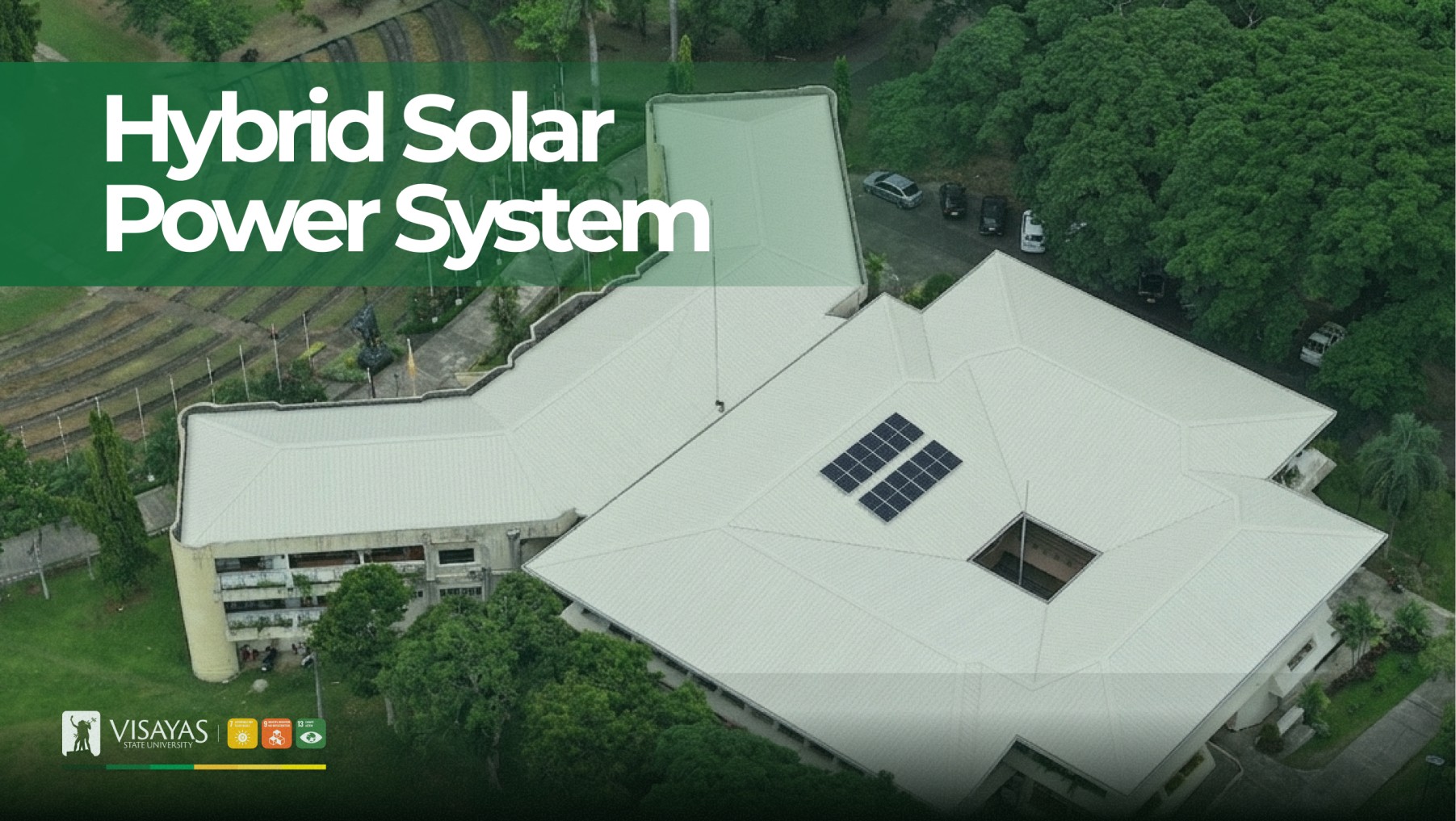
As one of the top performing State Universities and Colleges (SUC) in the 2026 Times Higher Education (THE) Sustainability Impact Ranking, Visayas State University (VSU) remains at the forefront of clean and renewable energy usage in the region, having recently installed a hybrid solar power system that provides energy for essential information and communications technology (ICT) infrastructure.
The project, amounting to a total of 33.6 million pesos funded under the General Appropriations Act (GAA) 2025 Capital Outlay, aims to enhance the University Management Information System (UMIS).
Included in this project is the installment of the hybrid solar power generator with a total cost of 1,499,200 pesos, which supports VSU’s green power management initiative in its ICT operations and helps ensure uninterrupted digital services.
Through this investment, the university continues to integrate sustainable technologies into its campus operations.
The project not only promotes the use of renewable energy but also improves the reliability of university services, strengthens operational continuity, and enhances preparedness during power interruptions and other emergencies.
Mr. Norman O. Villas, Head of the Management Information System (MIS) Unit, said that having a strong ICT setup is more important than ever.
"Reliable ICT services enable the University to continuously communicate with students, faculty, staff, and other stakeholders, making sure that important announcements, academic services, and administrative operations stay accessible," Villas said.
He also said that a strong ICT setup helps reduce service interruptions and keeps key services running, even during disasters. This was highlighted in a recent Public Service Continuity Workshop, where ICT was identified as a key part in keeping public services working.
Powering critical ICT infrastructure
The Hybrid Solar Power System mainly provides electricity to important network equipment that keeps the VSU’s internet and digital operations running.
Right now, two of VSU’s main network sites are already using the hybrid solar energy system. The system uses solar panels to produce clean electricity during the day and stores extra energy in batteries for use at night or when the power goes out.
"At night during power outages, these batteries automatically provide electricity to the network nodes, letting them continue operating without interruption," Villas explained. "This enables us to maintain 24/7 operations using green energy while greatly improving the reliability and the sustainability of our ICT infrastructure."
In the Administration Building, several solar panels are already operational, which supplies power to network devices that provide connectivity to various offices.
During power outages, the system can keep internet services running for up to four hours, allowing employees to remain connected using battery-powered laptops and mobile devices.
At present, about 95 percent of the remaining network devices in the Administration Building have been integrated into the hybrid solar power system, further improving its reliability and expanding its coverage.
Improving sustainability and operational continuity
Beyond ensuring uninterrupted ICT services, the hybrid solar power system has also contributed to lower energy consumption.
According to Engr. Sean O. Villagonzalo, Director of the University Information and Communication Services (UICTS), initial assessments indicate that it reduces electricity use by approximately 36 kilowatt-hours (kWh) each day, helping the university lower operating costs while reducing its carbon emissions.
The system currently powers the university's Data Center and Administration Building, with plans to extend its capacity to support the entire ICT network in the future.
"Our extended vision is to power not only our Data Center and Administration Building but also the University's entire ICT network using hybrid solar technology. This will significantly strengthen the strength of our digital infrastructure and reduce our dependence on the commercial power grid,” Engr. Villagonzalo said.
He also said that VSU’s ICT network has stayed strong during several typhoons because the university’s underground fiber-optic lines are less likely to be damaged by bad weather. Adding hybrid solar power helps solve the last challenge of keeping a steady power supply during long outages.
Expanding resilient and green campus operations
The office is closely working with the Office of the President and the electrical team to bring hybrid solar technology to more important facilities.
These include the Registrar’s Office, Cash Division, Accounting Office, Finance Office, research labs, and other key academic and administrative work areas.
The project enhances the university's ability to maintain essential operations during emergencies while strengthening its overall disaster preparedness. It also reflects the institution's commitment to building a more sustainable #GlobalGreen campus and helps ensure the continuous delivery of dependable public services.
This article is aligned with United Nation’s Sustainable Development Goals (SDGs) 7: Affordable and Clean Energy, SDG 9: Industry, Innovation and Infrastructure; and, SDG 13: Climate Action.