

VSU forwards food security, zero hunger agenda through 2026 Nutrition Month
- Details
- Written by Riza Mae L. Maningo and Josephus Cabuncal
-
Published: 10 July 2026
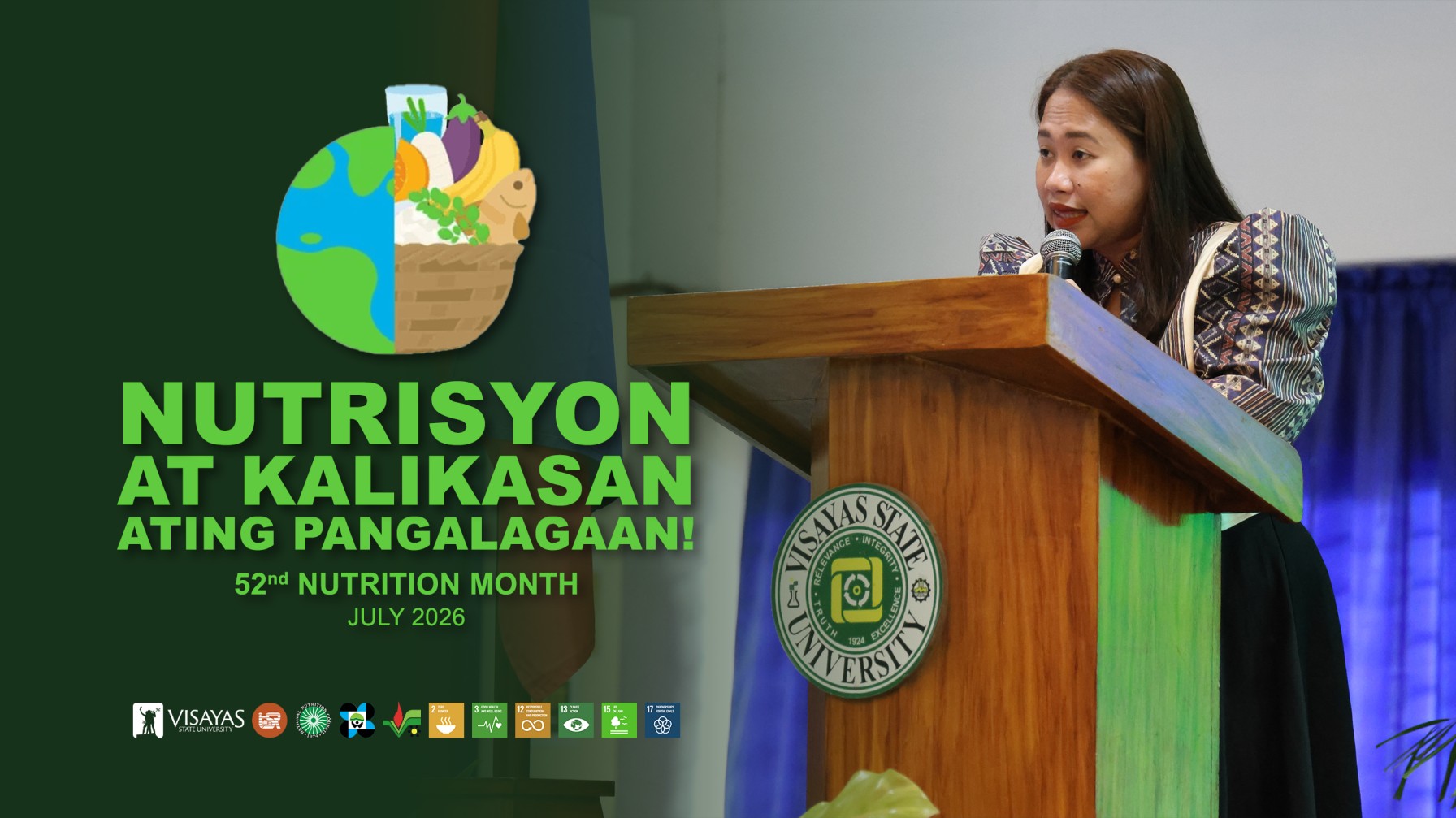
As the university officially launched its 2026 Nutrition Month celebration, VSU reaffirmed its commitment to advancing food security and nutrition by empowering communities to make healthier, more sustainable food choices while protecting the natural resources that sustain life. Anchored on the National Nutrition Council's (NNC) sub-theme, "Nutrisyon at Kalikasan, Ating Pangalagaan!,” the celebration reinforces the goals of the Philippine Plan of Action for Nutrition (PPAN) 2023–2028, recognizing that achieving Zero Hunger requires collective action to safeguard both people and the environment.
Spearheaded by the Institute of Strategic Research and Development Studies (ISRDS) through the VSU Barangay Integrated Development Approach for Nutrition Improvement (BiDANI) Extension Program, the celebration highlights the university's continuing role in promoting science-based nutrition education and sustainable community development.
Representing the BiDANI Extension Program under Project Leader, Assoc. Prof. Ma. Aurora Teresita W. Tabada, Mx. Letty Jane Lor affirmed that nutrition is not merely a personal health concern but a shared responsibility that demands collaboration among institutions, communities, and families.
Strengthening food systems through environmental stewardship
Pursuant to Presidential Decree No. 491 or the Nutrition Act of the Philippines, VSU has lined up activities that encourage the Viscan community to become active partners in building healthier and more resilient food systems.
This year's celebration also complements National Disaster Resilience Month, recognizing the growing impact of climate change on agriculture, food production, and household nutrition. By integrating nutrition advocacy with environmental protection and disaster resilience, the university underscores that food security cannot be achieved without healthy ecosystems capable of sustaining agricultural productivity.
"Everything we eat begins with nature," Mx. Lor reminded participants. "Our rice, vegetables, fruits, fish, meat, and clean water all come from healthy ecosystems. When forests are degraded, oceans are polluted, or farms are damaged by droughts, floods, and stronger typhoons, our food supply is affected."
She explained that climate-related disruptions continue to threaten food availability and disproportionately affect children, pregnant women, older adults, and economically vulnerable households. Likewise, unsustainable food production and excessive food waste contribute to environmental degradation, making responsible consumption and sustainable food systems essential to improving nutrition outcomes.
Beyond encouraging healthy eating, VSU's Nutrition Month advocacy promotes conscious food choices, reduced food waste, support for local agriculture, and environmental stewardship as practical pathways toward achieving food security for present and future generations.
Every Viscan, an advocate for Zero Hunger
Nutrition Month also serves as a call for collective action. Mx. Lor encouraged university employees to continue supporting programs that promote public health, nutrition, and environmental sustainability through dedicated public service. She likewise urged families to cultivate healthy eating habits and responsible consumption at home, while inspiring communities to reduce food waste, support local producers, and protect the natural resources that sustain food production.
Concluding her message, she reminded the university community that meaningful change begins with everyday choices. As she noted, every healthy choice nourishes a life, every sustainable action protects the planet, and every Filipino who chooses to care for the food supply, their families, and the environment helps to build a healthier, greener, and more resilient Philippines.
Transforming science into food security
VSU's commitment to Zero Hunger is reflected not only in its Nutrition Month celebration but also in its year-round initiatives that strengthen food systems and improve community resilience.
Through the Visayas Consortium for Agriculture, Aquatic and Natural Resources Research and Development (ViCARP), which the university hosts, VSU is leading the implementation of five GALING PCAARRD Kontra Krisis Projects funded by the Department of Science and Technology–Philippine Council for Agriculture, Aquatic, and Natural Resources Research and Development (DOST-PCAARRD).
These initiatives expand access to quality planting materials, promote nutritious root crop-based food products, support sustainable livelihoods, and deploy science-based technologies that help communities withstand economic and climate-related challenges while improving household food security.
Complementing these efforts is VSU's expanding partnership with local government units, including Project BALSAH with the Municipality of Matag-ob, Leyte, where the university provides technical expertise in sustainable agriculture, research, extension, climate resilience, and rural development.
Together, these initiatives demonstrate that VSU's pursuit of Zero Hunger extends far beyond a month-long campaign. By integrating nutrition advocacy with scientific innovation, sustainable agriculture, and community empowerment, the university continues to build resilient food systems that nourish lives, strengthen livelihoods, and contribute to a healthier and more food-secure Philippines
This article is aligned with the Sustainable Development Goal (SDG) 2: Zero Hunger; SDG 3: Good Health and Well-being; SDG 12: Responsible Consumption and Production; SDG 13: Climate Action; SDG 15: Life on Land; and SDG 17: Partnerships for the Goals.