Approved-Policy
Policy on Stray Animal Management, Responsible Ownership, and the Raising and Sale of Animals at Visayas State University (BOR Resolution No. 100, s. 2025)
Policy on Stray Animal Management, Responsible Ownership, and the Raising and Sale of Animals at Visayas State University
(BOR Resolution No. 100, s. 2025)
Summary
This policy being proposed aims to address primarily the increasing challenges of stray dogs in the Visayas State University (VSU) campus. This also takes into consideration the raising of livestock (or food-producing) and other animals. Essentially, it seeks to promote public safety, animal welfare, responsible pet ownership and ecological sustainability. This policy integrates relevant legislations, including Republic Act 9482 (Anti-Rabies Act of 2007), Republic Act 10631 (Animal Welfare Act of 2013), Republic Act 9147 (Wildlife Resources Conservation and Protection Act) and relevant materials which emphasize animal welfare and public safety.
Rationale
The Visayas State University (VSU), the main campus, is often regarded as one of the most scenic and picturesque university campuses in the Philippines (Quacquarelli Symonds, n.d.). As a green university, it strives to maintain an environment that supports biodiversity, public health, and campus life. In recent years, however, the growing population of stray animals on campus, particularly dogs, has posed increasing challenges, including risks of zoonotic disease transmission (e.g., rabies), threats to human safety, and potential disruptions to ecological balance. At the least, unmanaged stray dog populations can interfere with community activities and the peaceful functioning of the university, underscoring the need for humane and science-based interventions.
To address these concerns, this policy is proposed. This is grounded on existing national legislation and international standards. Republic Act No. 9482, or the Anti-Rabies Act of 2007, mandates responsible pet ownership, mass rabies vaccination, and humane stray animal control, positioning rabies prevention as a national public health priority. According to the World Organisation for Animal Health (WOAH, 2018), effective stray dog population control requires a multi-faceted strategy, including mass rabies vaccination, sterilization, humane euthanasia where necessary, and sustained community engagement. Rabies is a preventable disease yet it continues to claim lives in the Philippines due to gaps in dog vaccination coverage, public awareness, and coordinated response (Smith et al., 2024). Their call to action highlights the crucial role that academic institutions must play—not only in education and research—but also in demonstrating leadership in local rabies prevention and animal control efforts.In a study of the University of São Paulo, Dias et al. (2013) reported that feeding practices within university campuses significantly influence the size, behavior, and spatial distribution of stray dog populations. Specifically, food availability, often provided by well-meaning individuals, contributed to the concentration and persistence of strays, highlighting the need for universities to regulate such practices to avoid unintended consequences.
Beyond the issue of stray dogs, VSU also recognizes the need to regulate the raising and keeping of wildlife species, such as snakes and tarantulas, within the university premises. Under Republic Act No. 9147, or the Wildlife Resources Conservation and Protection Act of 2001, the keeping, breeding, or trade of wildlife, whether for personal, educational, or commercial purposes, requires appropriate permits from the Department of Environment andNatural Resources (DENR) or the Department of Agriculture (DA), depending on jurisdiction. Wildlife kept without valid documentation may pose risks to campus safety, public health, and biodiversity conservation.
In addition, the raising of animals for sale, such as rabbits or other species bred in home-based or small-scale facilities, must adhere to the regulations outlined in Republic Act No. 8485, as amended by RA 10631 or the Animal Welfare Act of 2013. These laws require individuals or establishments engaged in animal breeding for sale to secure a Certificate of Registration from the Bureau of Animal Industry (BAI), and to maintain humane, sanitary, and adequate facilities to ensure animal welfare. Unregulated breeding and sale of animals may contribute to overpopulation, poor animal health, and public nuisance, particularly in a densely populated academic environment like VSU.
This proposed policy therefore, draws upon these legal frameworks and scientific findings to establish a comprehensive and proactive approach to managing stray animals, regulating the keeping and raising of wildlife, and ensuring that any form of animal breeding and sale on campus adheres to national welfare standards. It prioritizes public safety, animal welfare, and ecological sustainability, aiming to foster a campus environment where humans, animals, and nature can coexist responsibly.
Coverage
These policies apply to all faculty, staff, residents, students and visitors who bring or keep animals on any part of the VSU premises.
Definition of terms
Animal Breeding and Sale: Refers to the practice of raising animals (e.g., rabbits) for sale or trade. Per RA 8485 (as amended by RA 10631), any person or entity engaged in animal breeding for sale must first secure a Certificate of Registration from the Bureau of Animal Industry (BAI) and ensure the facility is clean, adequate, and does not cause animal suffering. The certificate must be renewed annually and may be revoked for non-compliance.
Stray Dog: Refers to dogs that are not registered, are unleashed and roaming, and are no longer under the effective control of their owner (adapted from RA 9485). This includes: (a) free-roaming owned dogs not under direct control or restriction at a particular time, and (b) free-roaming dogs with no identified owner (WOAH, 2018).
Wildlife: Refers to wild forms and varieties of flora and fauna, in all developmental stages, including those in captivity or bred/propagated. This includes native and non-native species kept for personal, scientific, conservation, educational, or commercial purposes (RA 9147, Section 5x). Examples include snakes, tarantulas, monitor lizards, civet cats, and other non-domesticated animals.
Wildlife Information: Refers to the best available scientific data or verified information used to determine whether any activity involving wildlife—such as the keeping, trade, or breeding of species like snakes or tarantulas—is detrimental to their survival or habitat. Per Section 6 of RA 9147, such activities must be evaluated and authorized by the DENR or DA, and the responsible authorities are mandated to regularly update wildlife information through research.
Guidelines
In accordance with state and other appropriate regulations, the following responsibilities shall apply to the VSU community including all pet dog owners and other animal owners residing, studying, or working (i.e., employees, vendors, concessionaires, or tenants) within the Visayas State University (VSU) campus, and individuals who regularly bring their pets into campus or enter VSU as visitors.
- Submit their dogs and other animals for mandatory registration. All pets residing in on-campus housing or frequently brought to campus must be registered with the Housing Committee. For dog registration, this shall include the pet's photos/s, vaccination record, owner's contact details, and proof of rabies vaccination. Toward this end, pet owners shall await further instructions from the VSU Housing Committee. Regular pet inventories will be conducted henceforth by the Housing Committee.
- For transient visitors, those who come to VSU on a short-term or infrequent basis, and bring pet dogs or cats with them, the Security and Safety Services Office (SSSO) shall request the presentation of the animal’s rabies vaccination card upon entry.
- If the owner indicates that they are visiting the university for the purpose of having their pet vaccinated at the Faculty of Veterinary Medicine (FVM), the SSSO must verify the updated vaccination card before the pet leaves the campus.
To ensure proper verification, the FVM shall conduct a training session for SSSO personnel on how to evaluate the details and authenticity of rabies vaccination cards.
B. Have their dog/s regularly vaccinated against rabies and maintain a registration card which shall contain all vaccinations conducted on their dog, for accurate record purposes. To this end, pet owners may coordinate with the Faculty of Veterinary Medicine (FVM) for anti-rabies vaccination services and the issuance or updating of the official vaccination card. The FVM is tasked to provide services for the regular vaccination against rabies.
C. Be a responsible owner by providing their dog with proper grooming, adequate food and clean shelter. Pet owners must ensure that their animals are properly groomed, adequately fed, and kept in safe, clean, and humane living conditions. Any sick or injured animal must be reported promptly to the Faculty of Veterinary Medicine (FVM) or a licensed veterinary clinic. When necessary, the Security and Safety Services Office (SSSO) may conduct inspections to verify compliance. Oversight of these responsibilities shall be led by the Housing Committee, in coordination with the Faculty of Veterinary Medicine and the Faculty of Computing.
D. Maintain control over their dog and not allow it to roam the streets or any public place without a leash. Pet owners must always keep their pets leashed or (caged or in an appropriate enclosure) in public spaces and must muzzle their dogs when necessary, particularly those dogs with a history of aggression or anxiety in crowds.
To this end, unless permitted, dogs shall not be brought into or allowed to enter the following areas:
- Laboratories
- Classrooms
- University Library
- Market areas
- Guest house, pavilions, fast food outlets, canteens, and food preparation areas
- UHS and medical facilities
- Offices
E. The VSU community is encouraged to report to the SSSO sightings of stray dogs especially those that are exhibiting abnormal demeanor.
F. The SSSO of VSU is tasked for the monthly humane capture of stray dogs. The protocol for this should be submitted to the TWG for review and feedback.
G. LUDIP in coordination with FVM, shall identify an area for the shelter facility for impounded dogs. The FVM is tasked to submit a plan to OVPAF, in relation to the establishment and management of the shelter facility. In addition, the Faculty of Computing in coordination with the FVM is tasked to create a database to determine the population dynamics of stray animals within VSU and assess the stray dog population to plan and monitor effective interventions. The SSSO is tasked to input into this database.
H. Within twenty-four (24) hours, report immediately any dog biting incident to the SSSO for appropriate action (i.e., for the capture of the dog) such as, but not limited to, the capture or isolation of the animal. Simultaneously, all bite or scratch incidents must also be reported to the University Health Services (UHS) for proper medical treatment and official documentation. The UHS is tasked with developing and disseminating a standard protocol for responding to such incidents.
The SSSO shall immediately notify the Faculty of Veterinary Medicine (FVM) if an impounded dog exhibits changes in demeanor that may indicate rabies or other serious health risks. The FVM shall be responsible for securing and maintaining the necessary materials and equipment for the safe handling and observation of suspected rabies cases.
I. Assist the dog bite victim immediately and shoulder the medical expenses incurred and other incidental expenses relative to the victim’s injuries.
Pet owners shall fully assist bite victims and cover all medical and related expenses. The same responsibility applies in cases where a pet causes vehicular accidents due to roaming or aggressive behavior. Failure to comply may result in disciplinary or legal action.
J. Attend seminars on responsible pet ownership and other seminars related to the implementation of this policy that will be announced by the FVM, the UHS or the Housing Committee. Pet owners must attend awareness campaigns about responsible pet ownership, the risks associated with stray dogs, and the importance of humane treatment of animals, and relevant activities that will be announced by the Housing Committee.
K. Prevent pets from damaging university property.
Pets must not be allowed to damage gardens, buildings, or other campus structures, and must not harm or chase wildlife, especially in ecotourism or protected areas.
L. Ensure proper disposal of pet waste and maintain cleanliness of the campus.
Pet owners must immediately clean up after their pets and dispose of waste properly, including in beach areas. Waste may be buried in designated grounds. Failure to comply may result in penalties or revocation of pet privileges.
M. Ensure pets do not cause noise disturbances.
Pet owners must ensure that their dogs and other animals do not create excessive or persistent noise, particularly in residential and academic areas where it may disrupt classes, work, or rest. Incidents of constant or disruptive animal noise should be reported to the Housing Committee, which shall take appropriate action in coordination with relevant university offices.
N. Report and manage aggressive pet behavior.
Any aggressive or dangerous behavior must be reported immediately to the SSSO. Repeated aggressive incidents may result in the pet being restricted or banned from campus.
O. Comply with rules on raising wildlife
Under Section 5 (letter x) and Section 6 of RA 9147 (Wildlife Resources Conservation and Protection Act), wildlife, including but not limited to snakes and tarantulas, whether in captivity or bred in homes, may only be kept if the owner obtains a valid Certificate of Wildlife Registration (CWR) from the DENR. The keeping or breeding of wildlife within the campus without proper documentation and clearance is strictly prohibited.
P. Comply with rules on raising animals for sale.
In accordance with Sections 2 and 3 of RA 8485 (The Animal Welfare Act of 1998, as amended by RA 10631), any person intending to breed or raise animals (e.g., rabbits, dogs) for sale must first secure a Certificate of Registration from the Bureau of Animal Industry (BAI). The facility must be clean, adequate, and not cause suffering to the animals. Any such activity on campus is subject to university approval and inspection, and unauthorized animal trade or backyard breeding is prohibited.
Q. Avoid unauthorized feeding
The feeding of stray dogs and other animals within the Visayas State University (VSU) campus by students, employees, vendors, or visitors is strictly prohibited.
Enforcement and Penalties
- The VSU-Security and Safety Services, in coordination with the Housing Committee and Admin, shall enforce these policies.
- Violations may result in: Call-out the pet owners
- Written warnings
- Community service or clean-up duties
- Fines or administrative sanctions in accordance with existing state regulations
- Revocation of campus pet privileges
Institutional Support
VSU supports initiatives like:
- Free or subsidized anti-rabies vaccination campaigns
- Information drives on responsible pet care in coordination with Faculty of Veterinary Medicine by clusters, and digital outlets
- Partnerships with veterinary clinics for campus outreach
- Microchipping and other ID methods
Final Provisions
- These policies are subject to periodic review and revision by the VSU Administration in consultation with key stakeholders.
- All members of the VSU community are enjoined to foster a responsible, compassionate, and sustainable approach to animal care.
Revised Scholarship Policy for VSU Administrative Staff (BOR Resolution No. 55-A, s. 2025)
Revised Scholarship Policy for VSU Administrative Staff
(BOR Resolution No. 55-A, s. 2025)
RATIONALE
The scholarship policy for administrative staff plays a crucial role in fostering a supportive and equitable workplace environment in VSU. However, there are current trends, certain gaps and inconsistencies within the current policy on Scholarship program for administrative staff prescribed in the CSC-approved VSU Revised Merit System for Administrative Staff (per 2018 ORAOHRA) that may hinder their professional development and engagement. Promoting equal opportunity in scholarship access for both administrative staff and faculty is crucial in building a fair and supportive academic environment. The university will be able to foster a culture of inclusive and equitable staff development that benefits everyone. This commitment will not only benefit administrative staff but also contribute to the overall equity and effectiveness of the university community.
Hence, the following are the proposed amendments of the existing scholarship policy for administrative staff for approval.
|
Existing Provisions on Scholarship Program in the Revised |
Proposed Revision on the VSU Scholarship Policy for Administrative Staff |
Justification |
|
1.0. Introduction Visayas State University (VSU) envisions to be a global green university providing progressive leadership in agriculture, science and technology, education, and allied fields for societal transformation. To uphold this standard of excellence and to realize the vision of the university, it is crucial to provide excellent support services. There is a need to upgrade the capability of administrative staff through provision of advance training and education. In response to this need, the proposed Administrative Staff Development Policy aims to establish a structured framework for continuous professional development. It seeks to provide opportunities for career advancement and the development of administrative staff, enabling them to take on greater responsibilities within a growing institution. The goal is to equip administrative staff with the knowledge, skills, and competencies necessary for effectively delivering their respective functions and contributing to VSU's pursuit of excellence, quality service, and creating impacts. |
To clearly communicate the significance of the proposal and to provide a brief overview. |
|
|
2.0. Purpose The proposed changes of the Administrative Staff Scholarship aim to harmonize and update the existing scholarship policy. The policy is issued to widely disseminate the amended Revised Merit System for Administrative Staff to ensure uniform policy interpretation, and effective and efficient implementation thereof. |
To identify the objective of the policy. |
|
|
3.0. Coverage This policy shall apply to VSU administrative staff on permanent status of employment only. |
To identify who are qualified for the scholarship grant maximizing the benefits of the funding and ensuring that it serves its intended purpose effectively. |
|
|
4.0. Exclusions The following administrative staff are excluded from the coverage of the policy: 4.1. Casual employees 4.2. Co-terminus employees 4.3. Contractual employees 4.4. Contract of Service/Job Order staff |
To clarify the scope and limitations of the policy |
|
|
5.0. General Guidelines for Degree Program Scholarship This provides opportunities for academic training leading to either undergraduate or graduate degree (masteral and doctoral). A maximum of three (3) scholars in the Main campus and 1 scholar for each component campus will be sent at any time. However, additional scholars may be allowed if there is an external scholarship. The following are the general guidelines for degree program scholarship on undergraduate, masteral and doctoral degrees: 5.1. Source of Scholarship Grant 5.1.1. VSU Scholarship - With full support - Thesis/Dissertation Support Only: Available for administrative staff pursuing graduate studies on their own, with a previously approved program of study. 5.1.2. Scholarship from External agencies/ institutions/ individual - With VSU support on salary - Endorsements may be granted upon request by the recipient staff. - Requests for alternative work arrangements such as flexiplace and flexitime can be approved with a maximum of six units during working hours. However, more than six units of study load can be requested subject to justification and its approval. |
To provide framework for understanding and clarify for stakeholders involved. |
|
|
Duration of the Program
|
5.2. Duration of the Scholarship 5.2.1. VSU Scholarship/Financial Assistance will be based on a maximum number of years for the undergraduate, masteral or doctoral degree as determined by the Delivering Higher Education Institution (DHEI). This also covers staff pursuing a straight doctoral program. 5.2.2. One (1) semester extension of study leave with full benefits is possible, provided it is recommended by the Adviser/Chairperson of the Graduate Advisory Committee and the Department/Unit/Office Head. |
To become consistent with the duration of the programs offered by DHEI. To give chance for the administrative staff to finish his/her degree. |
|
Criteria for selecting Applicants to the Scholarship and Financial Assistance Grant:
2. For the undergraduate scholarship program:
3. For graduate degree:
a.1. Must be at least a baccalaureate degree holder at the time of application. a.2. Must have an average grade of 85 or 2.0 or better. a.3. If presently working for a graduate degree, the applicant must have a weighted average grade of 2.00 (or its equivalent) or better during the semester preceding the application. a.4. Must have served VSU for at least five (5) years at the time of application on permanent status a.5. Must have the potential to undergo formal study
b.1. Must be at least a masteral degree holder at the time of application. b.2. Must have an average grade of 85 or 2.0 (or its equivalent) or better. b.3. If presently working for a doctorate degree, the applicant must have a weighted average grade of 2.00 (or its equivalent) or better during the semester preceding the application. b.4. Must have served VSU on permanent status for at least five (5) years at the time of application. b.5. Must have the potential to undergo formal study. |
5.3. Criteria for Selection Administrative staff will be granted VSU Scholarship or Financial Assistance upon meeting the following conditions: 5.3.1. General Criteria: 5.3.1.1. Must have a regular item in any university unit/office/ center. 5.3.1.2. Must have served the university for at least two (2) years in a permanent status at the time of application. 5.3.1.3. Must not have pending criminal or administrative cases. 5.3.1.4. Must be physically fit to pursue an intensive academic program 5.3.1.5. Must demonstrate potential for academic success based on grades and performance. 5.3.1.6. Not older than 40 for a masters degree and 45 for doctoral. Candidates over these age limits may be considered if they have completed at least 50% of their course requirements, with justifications required for older applicants. 5.3.1.7. Must not have any current foreign or local scholarship grant. 5.3.1.8. The administrative staff has obtained at least a Very Satisfactory rating in the last two (2) evaluation periods, as indicated in her/his Individual Performance Commitment Review (IPCR) accomplished form. 5.3.1.9. Grantees will enroll in CHED-recognized DHEI approved by the VASC. 5.3.1.10. Priority for scholarship shall be given to applicants for masteral and doctoral degrees who occupy supervisory positions as well as potential to finish a graduate degree and assume greater responsibilities upon completion of the degree. 5.3.2. Undergraduate scholarship: 5.3.2.1. No revision 5.3.2.2. No revision 5.3.2.3. No revision 5.3.2.4. No revision 5.3.3. For Graduate Degree scholarship: 5.3.3.1 Masteral Degree a. Must be at least a baccalaureate degree holder at the time of application. b. No revision c. No revision d. Must have served VSU for at least two (2) years at the time of application on permanent status. e. No revision 5.3.3.2 Doctoral Degree: a. No revision b. No revision c. No revision d. Must have served VSU on permanent status for at least two (2) years at the time of application. e. No revision |
To promote inclusive scholarship program. To enhance educational opportunities. To promote an inclusive and equitable workplace culture. To promote accountability. To effectively promote rewards for very satisfactory to outstanding performance. To promote value on quality and excellence. For prioritization purposes and promote To enhance educational opportunities and address specific needs within the workforce. To enhance educational opportunities and address specific needs within the workforce. |
|
Nature of Support a. Degree Program a.1. Scholarship a.1.1. Graduate degree a.1.1.1. School fees a.1.1.2. Book allowance on reimbursement basis not to exceed P5,000.00 per semester, not to exceed 4 semesters for Master’s degree and three years for doctoral degrees a.1.1.3.Thesis allowance of P25,000.00 for Master’s degree or P40,000 for doctoral degrees a.1.1.4. Salary for the duration of the scholarship grant a.1.1.5. Stipend of P7,500.00 per month for Master’s degree and P10,000.00 for doctoral degrees a.1.1.6. One round trip transportation for the whole duration of the scholarship grant. a.1.2.Undergraduate degree: a.1.2.1. School fees a.1.2.2. Book allowance on reimbursement basis not to exceed P2,000.00 per semester a.1.2.3.Thesis allowance of P5,000.00 to be given during the terminal year a.1.2.4. Salary for the duration of the scholarship grant a.1.2.5. One round trip transportation for the whole duration of the a.2. Financial assistance: a.2.1. Doctoral Degree to be pursued during week ends a.2.1.1. School fees a.2.1.2. Book allowance for P5,000.00 per semester a.2.1.3.Thesis assistance of P40,000.00 a.2.2. Master’s degree a.2.2.1. School fees a.2.2.2. Book allowance for P5,000.00 per semester a.2.2.3.Thesis assistance of P20,000.00 a.2.3.Undergraduate degree (rendering service to VSU while taking the degree) a.2.3.1. School fees a.2.3.2. Book allowance of P2,000.00 per semester a.2.3.3. Thesis assistance of P5,000.00 a.2.3.4. Transportation and incidental expenses of P1,000 per month for those enrolled outside VSU for a minimum of six (6) units a.2.4. Staff with external scholarship: a.2.4.1. Salary |
5.4. Privileges 5.4.1. VSU Scholarship 5.4.1.1. Graduate Degree
5.4.1.2. Undergraduate Degree
5.4.2. With Scholarship from External Agencies/ Institutions/ and Individual For administrative staff who obtained external scholarship grant, VSU will provide the following Financial Assistance:
|
|
|
Conditions of Scholarship
a.1. Grantee shall not accept another scholarship administered by the college or other agency while the program is in effect, unless approved by the university; a.2. Grantee shall enroll during the semester immediately following the award. No deferment shall be allowed except for justifiable reasons and only upon approval of the University President. In cases of pregnancy or prolonged illness which will unduly delay the completion of the degree being sought, the scholarship shall be suspended or cancelled; a.3. Grantee of full scholarship grant shall carry a full academic load per semester (at least 18 units for the undergraduate and 9 units for the graduate program); and, a.4. Grantee will enroll in CHED-recognized DHEI approved by the NAPB.
b.1. Maintain a weighted average grade of 2.5 (or its equivalent) or better for undergraduate and 2.0 (or its equivalent) or better for graduate grantees during any semester; b.2. Pass all subjects taken; b.3. Not subjected to any disciplinary action involving more than three months suspension from classes; and, b.4. Not transfer from to another course unless with prior permission from the University President upon the recommendation of the NAPB. Obligations of Grantee to the College c.1. Scholars: two (2) years of service to the university for every year of study or a fraction of more than two (2) months thereof. Availment for a period of two months or less shall be served for one (1) year; c.2.Financial assistance grantees: one year of service to the university for every academic year of study or a fraction of more than two (2) months thereof. Availment for a period of two (2) months or less shall be served for half the rate; c.3. Grantees of special assignment shall submit a copy of their outputs to the university, conduct seminars to other administrative staff who will benefit from their work and serve the university for a period of time equivalent to the length of the sabbatical assignment; c.4. Grantees who fail to comply with the service requirement will reimburse in full all expenses spent by the government in connection with the award plus interest prevailing at the time of the grant. No proportionate refund shall be allowed; c.5. Within the duration of the grant, the grantee will not be given overtime pay or travel allowance. |
|
To adopt Item 5.5. of the proposed revision. |
|
5.5. Responsibilities of the Grantee Grantee of graduate and undergraduate scholarship or financial assistance must comply the following: 5.5.1.Submit clearance and settle all obligations before the study leave. 5.5.2. Must sign a contract with VSU. 5.5.3. Must conduct himself/ herself in a manner not to bring disgrace or dishonor to himself/ herself and/or the country and University 5.5.4. Must take full academic load every semester based on the approved Study Plan/Plan of Course Work without changing his/her degree or the field of specialization without prior clearance from the GRANTOR. If unable to enroll in a particular semester, he/she must temporarily return to work at VSU for him/her to continue receiving his/her salary and other benefits. 5.5.5. Submit to the HRMD proof of enrolment every semester/trimester to ensure continuance of salary, Stipend, Tuition Fee & Book Allowance. If the Grantee is enrolled during Summer or Midyear Term, the Grantee must submit a copy of the approved Plan of Course Work/Plan of Study, and proof of enrollment to ensure payment of salary, tuition fee & stipend, book allowance, and thesis/dissertation support. Dropping/filing of leave of absence within a semester is only allowed if reasons are based on ailment or any health condition wherein treatment or rest is needed for the whole semester or school year as certified by a physician and confirmed by the University Physician. After dropping/filing a leave of absence, the Grantee must submit to the HRMO the following:
Failure to reinstate shall result to the following:
5.5.6. Must not accept any kind of employment while enjoying the scholarship/fellowship. 5.5.7. Accept no other kind of a scholarship grant without clearance from VSU. If the grantee can avail of another scholarship grant, he/she shall refund the amount availed from VSU starting from the date of effectivity of the other scholarship. 5.5.8. Must maintain a semester grade point average acceptable to the graduate school. 5.5.9. Must submit a semestral progress report to the head of the unit and furnish a copy to the Chairperson of the VSU Administrative Scholarship Committee as basis for the continuance of the grant 5.5.10. Submit Special Power Attorney (SPA) stating that if she fails to successfully complete the course program or failed to fulfill the conditions stipulated in his/her scholarship contract, the VSU is authorized to automatically deduct from her salary the mid-year bonus received by the grantee as a result of non-compliance with the terms and conditions that was stipulated in the contract and the DBM Circular No. 2019-4 5.5.11. Must submit 3 hard copies of approved dissertation distributed to: a) one (1) VSU Library, b) one (1) College Library, and c) one (1) to the AACCUP Center, upon return from study leave. One (1) electronic copy must also be submitted to the VSU Library. 5.5.12. Must complete his/her graduate studies. Return to VSU immediately at the end of the semester when his studies or course under the grant is completed. Should the grantee fail to return to service after the end of the semester/trimester/ summer when he completed the degree, he will be considered absent and shall be without pay the following term unless the Grantee has leave or service credits where his absences will be charged. 5.5.13. The grantee shall commence the render of return to service obligation after the completion of the degree. In case of health reasons and other justifiable causes, return to service may be temporarily allowed upon recommendation of the adviser and the Dean of Graduate School where the Grantee is studying, said service, however, shall not be considered as partial compliance of the Grantee's service obligation. Should the grantee fail to return to service at the end of the semester when he completed the degree, he will be considered absent and shall be without pay the following term unless the Grantee has leave or service credits where his absences will be charged. 5.5.14. Serve VSU for a period at the rate of two (2) years for every year or a fraction of more than two (2) months thereof of enjoyment of the Grant within the Philippines or outside the Philippines. Availment of the grant for a period of two (2) months or less shall be served for half the rate. Provided, that failure to comply with the provisions of this contract or willful abandonment of the grant resulting to the non-completion of the degree pursued shall obligate the GRANTEE to reimburse to VSU the full amount of expenses spent by the university, including transportation, salaries, stipends, bonuses, and other expenses related thereto, in which case shall not be less than P5,000, plus a non-compounding interest of 6% per annum of the principal amount. The reckoning period of collection shall take effect after issuance by the university of a demand letter to the concerned staff, concerning his contractual obligation as a result of breach of revocation. A mutually agreed terms of payment of the collectible amount may be adopted, without prejudice to the interest of the university or the government. Request for reduced workload to work on his thesis upon reinstatement due to failure to complete the degree pursued on specified time is allowed provided this is for one (1) semester only and to be supported by the program of activities for monitoring purposes. 5.5.15. Return to VSU immediately at the end of the semester when his studies or course under the grant is completed. Should the grantee fail to return to service at the end of the semester when he completed the degree, he will be considered absent and shall be Without Pay the following term unless the Grantee has leave or service credits where his absences will be charged. 5.5.16. Submit a written report on his studies within sixty (60) days after return to duty 5.5.17. Present the results of their thesis to the VSU community upon resumption to duty as part of the re-entry plan. |
The term, “full academic load” is dependent on the DHEI. To assess the reason/s on dropping from the graduate program and filing of LOA. To promote judicious use of government funds. To monitor closely the scholars. Data will also be used in generating reports for CHED, DBM and other government agencies. In compliance to DBM Circular No. 2019-4 To facilitate scholars’ compliance with her/his financial obligation. To clarify the issue on return service to VSU by scholars who are unable to complete the degree on prescribed period. To ensure that the benefit of education extends beyond the individual to the academic community creating a positive impact. For clarification |
|
|
Criteria for support to Non-Degree Training Program (in order of priority)
|
6.0. General Guidelines for Non-Degree and Specialty Training Program (at least 1 month) This is a short training program of at least one (1) month in specialized fields offered by institutions outside or inside VSU which shall be available to a maximum of five (5) administrative personnel yearly. Participation can contribute to the improvement of the participant’s expertise in line with the performance of her/his work. Highly relevant short-term training sponsored by either local or foreign professional organizations can be availed by a permanent administrative staff with prior invitations as paper presenters, moderators and/or other important roles. Such attendance must be duly endorsed by offices concerned. 6.1. Criteria 6.1.1. Must have served VSU for at least two (2) years at the time of application on permanent/ casual/ contractual status. 6.1.2. The need for the field of training must be certified by the department/unit/ center head. 6.1.3. No Revision 6.1.4. No Revision 6.2. Privileges 6.2.1. VSU Financial Assistantship
6.2.2. With External Sponsor of training course This includes short-term training sponsored by professional organizations held either locally or abroad. An invitation and endorsement by appropriate offices is required.
6.3. Responsibility of the Grantee 6.3.1. Must sign a contract with VSU. 6.3.2. Must not accept any kind of employment while undergoing the training 6.3.3. Must not accept any kind of scholarship without clearance from VSU 6.3.4. Must submit a Re-entry Action Plan before the training and a narrative report upon his return. 6.3.5. Must serve VSU at the rate of one (1) year for every year or a fraction thereof or half the rate for one (1) month up to two (2) months of enjoyment of the grant.
|
To provide framework for understanding and clarify for stakeholders involved. |
|
7.0. Procedure for Availment 7.1. The department/unit concerned prepares its staff development plan, including the needed trainings/seminar/ workshops. This will be submitted to the VSU Administrative Scholarship Committee (VASC). 7.2. The VASC reviews the proposed staff development plan and recommends approval by the University President. The VASC ensures that the staff recommended to go on scholarship will pursue the degree in a reputable university and the field is relevant to the functions of the office where the staff is connected, b) the training conference/workshop is relevant to the staff’s functions. If in order, the VASC recommends approval of the request to the University President. 7.3. The President reviews and acts on the VASC recommendation. 7.4. Upon receipt of the President’s approval of minutes of the VASC meeting, the VASC Secretary prepares and provides the recommendee with the excerpt of the action of the President on the VASC recommendation. 7.5. For approved study leave, HRMD- Learning and Development Office prepares the scholarship contract between the staff concerned and the university. 7.6. The HRMD-LDO organizes an orientation on the provision of the contract especially her/his responsibilities. 7.7. When the staff is oriented and amenable to the terms and conditions of the contract, she affixes her/his signature therein. 7.8. The HRMD Director and VP for Administration and Finance likewise signs as witnesses to the contract. 7.9. The President signs as one of the contracting parties to the contract. 7.10. The staff concerned secures the services of a notary public to notarize the contract and returns the contract to HRMD Office. 7.11. HRMD distributes copy of the contract. The procedure shall be subject to continual improvement through regular review and enhancing the process to ensure it remains effective, efficient, and aligned with VSU goals and best practices.
|
To establish a well-defined procedure to ensure fairness, efficiency, and effectiveness in the award process, ultimately contributing to the overall success and integrity of the scholarship program |
|
|
8.0. Separability Clause If any provisions of this policy or part hereof is held valid or unconstitutional, the remainder of the provisions not otherwise affected shall remain valid and subsisting. |
To address the situation where one or more provisions of the document may be found to be invalid, unenforceable, or illegal. |
|
|
9.0. Repealing Clause All orders, rules and regulations, and other issuances, or part thereof inconsistent with this policy are hereby repealed, modified, or amended accordingly. |
To explicitly revoke previous policy that are no longer applicable. |
|
|
10.0. Effectivity The implementation of the amended Scholarship policy for administrative staff shall be effective after the Board of Regents approval. These provisions apply to all VSU staff-scholars with active or ongoing scholarship contract. |
To specify when the revised policy will become effective. This is also in response to the request of the “VSU scholars with active and ongoing scholarship contract” to alleviate their situation. |
Security and Safety Protocols: Standard Operating Procedure in the Visayas State University
Security and Safety Protocols: Standard Operating Procedure in the Visayas State University
(BOR Resolution No. 53, s. 2025)
THE MAIN GOAL OF SECURITY AND SAFETY SERVICES
The goal of VSU security management is to create and preserve an environment where all employees/staff and university officials, students, visitors, and properties are safe and well-protected at all times.
THE CORE FUNCTIONS
- Access Control
- Incident Response
- Surveillance
- Patrol and Inspections
- Compliance and Risk Management
- Communication and Coordination
- Training and Awareness
- Investigations
- Emergency Preparedness
- Reporting and Analytics
PHYSICAL SECURITY
- Access Control: (Upper and Lower Campuses)
- All duty guards must check the proper identification of students, staff, employees, and visitors. No identification card, no entry to VSU campuses.
- All duty guards must strictly inspect the personal belongings of all persons/visitors entering the VSU campuses, demand identification cards, and then issue pass cards/visitor's ID before allowing them to proceed inside the university.
- All duty guards must conduct physical inspections of all vehicles entering and exiting the VSU campuses.
- All duty guards must conduct patrols and check all buildings under their respective areas of assignment.
- All duty guards must strictly implement the curfew hours from 9:00 p.m. for students and 10:00 p.m. for other stakeholders, except for an important activity related to their course.
- Duty guards of llang-llang post must ensure that the gate is closed at exactly 9:00 pm to avoid the entry of intruders.
- All duty guards must strictly observe the advisory being implemented in the beach area for the safety of the students and visitors
- All duty guards must maintain the data recording of all persons entering the VSU campuses in the duty Log Book. They must also record all significant incidents that transpired during their tour of duty in the Blotter Logbook. Take note of the status and the actions taken.
B. Traffic Control
- All duty guards must maintain traffic supervision and control within the VSU premises.
- All duty guards must strictly adhere to the traffic policies and regulations being implemented within the university.
- All duty guards must oversee the proper parking of all vehicles and observe no parking areas within the VSU premises.
- All duty guards must implement the 20-30 Kph speed limit of all vehicles that enter the campuses.
- All duty guards must advise all students to use the pedestrian lane in crossing and sidewalks in walking.
C. Communication Control
- All duty guards must maintain the proper use of handheld Radio as a means of communication.
- All duty guards must strictly observe the Chain of Command or the Chain of Communication at all times.
- All duty guards must strictly observe the confidentiality of all official communications or information about the operations of VSU.
- The Security Manager, Chief Security and Safety Services, and the VSU President must be informed at all times of all information and observations that might compromise the safety and security of all VSU stakeholders.
D. Beach Area Control
All duty guards must strictly implement the following policies in the beach area:
- Drinking of intoxicating liquor is only allowed a t the Beach Garden Resort
- Grilling of any food is only allowed at the Beach Garden Resort;
- No smoking inside the VSU campus;
- No Littering anywhere inside the campus;
- No swimming at the beach beyond 7:00 PM, since no lifeguard on duty at the beach area;
- Strictly no swimming during inclement weather conditions;
- Refrain from staying at the beach area during night time; B e responsible for the safety of yourself and the security of your personal belongings anytime and anywhere;
- Visitors are required to bring home their own garbage/trash to reduce the volume of VSU garbage collections.
- All duty guards of Post 1 must give or provide a copy of VSU beach area reminders to all visitors.
E. Visitors Control
- The Security Manager must inspect or visit the Hostel, Apartelle, Balay Alumni, and other billeting facilities inside the campuses for proper coordination regarding their previous/present activity bookings for the proper security preparations.
- All managers of the said facilities must strictly follow the security and safety policies being implemented inside the VSU campuses.
F. Bomb Threat Control
- All duty guards must strictly implement the inspection procedures of all bags, knapsacks, boxes, merchandise, etc., that will enter the premises.
- All duty guards must consider that a suspicious-looking package, paper bag, etc., left alone should be cautiously scrutinized as a possible bomb.
- All duty guards when suspected bombs are noted or being reported, must advise the Security Manager and the Chief Security and Safety immediately for their appropriate actions and coordination with the proper authorities.
- All duty guards must be observant o f people roaming around the area doing nothing. Vendors with tricycles/knapsacks/bags should be driven out, as they may be couriers of bombs.
- All duty guards must advise all stakeholders to always observe people leaving behind bags/packages/boxes in the garbage cans/bins within the premises.
- All duty guards must be observant of cars/motorcycles riding individuals who are suspiciously observing VSU premises.
- All duty guards must be cautious in opening envelopes and packages sent by unknown individuals or packages with no return address.
- All duty guards must take note that the greatest safeguard against the effects of bomb threats is to prevent entry of unauthorized persons into certain areas, whenever possible.
- All duty guards must take note that the restricted entry and identification of the staff and visitors can be significant factors i n assessing the seriousness of any given threat.
G. Incident Control
- Upon receipt of the incident report, all duty guards must immediately respond to validate the report.
- Once validated, the duty guards who responded must isolate the scene by cordoning off the area and prohibiting all students from access to the incident scene.
- All duty guards must redirect the safe access or passage of all students affected by the incident.
- All students are prohibited from taking any photographs of the incident scene.
- All students are prohibited from making any false and unverified publication to any social media platform.
H. Construction Site Control
- All duty guards must ensure that the construction site i s isolated and with visible signs that it is a Danger Zone.
- All duty guards must regularly inspect the construction site and ensure that all the safety protocols are being observed and practiced;
- No construction of barracks for resting/sleeping purposes;
- All construction workers must have their proper identification cards when entering the campus;
- All construction workers are not allowed to roam around the university campuses;
- All construction workers must wear the proper PPEs before engaging;
- The concerned contractors must employ their own Safety Officer and Watchman for a safe and secured construction site.
ADDITIONAL INSTRUCTIONS
- All duty guards must be in proper uniform while rendering their tour of duty.
- They must observe the buddy-buddy system at all times.
- Sleeping on a post is strictly prohibited and considered as a grave offense.
- All duty guards must religiously observe and follow the 11 General Orders at all times while on duty.
- They must stay alert, and watchful and be ready to respond to any call of duty or emergencies.
Proposal to Revise the Admission, Retention, and Residency Policies for the Undergraduate Programs in the Faculty of Engineering (BOR Resolution No. 41, s. 2025)
Proposal to Revise the Admission, Retention, and Residency Policies for the Undergraduate Programs
in the Faculty of Engineering
(BOR Resolution No. 41, s. 2025)
RATIONALE
The proposed revision focuses on the admission policy for the Faculty of Engineering (FE) to align with the updated admission guidelines of the university. Currently, the FE admission process mainly follows the university policy guidelines, as stipulated in the existing Policies for Admission, Retention, and Residency Rule for the Undergraduate Degree Programs Under the College of Engineering and Technology (BOR Resolution No. 134, Series 2022). These policies have served as the foundation for admission, retention, and residency rules in the College of Engineering and Technology, specifically for the four engineering programs, BS Computer Science, and BS Meteorology in VSU-Baybay (VSU-B). The admission is based solely on the applicant's performance on the VSU College Admission Test (VSUCAT). Depending on the availability of quotas, applicants who pass the VSUCAT are offered admission to FE programs. However, this approach has led to challenges in ensuring that students admitted to FE programs are sufficiently prepared for the academic challenges and suited to meet the technical requirements of the engineering courses. As a result, the course passing rate of Precalculus of Engineers and other introductory engineering courses taken during the first semester of first-year students has been very low (Appendix A).
With the recent admission policy of the university, allowing faculties or departments to conduct a second layer of admission criteria, FE proposes the Faculty of Engineering Aptitude Test (FEAT) as an additional examination to evaluate the readiness and commitment of applicants more effectively. This enhancement in admission aims to support student success and uphold the commitment of the faculty to educational excellence in producing qualified professionals.
In addition, the revised admission policy aligns with the new organizational structure of VSU, which aims to harmonize programs across the VSU campuses. As such, the policy will also be applied to the engineering programs at VSU-Isabel (VSU-I) to ensure consistency across engineering programs of the university. The proposed revision categorizes applicants to the Faculty of Engineering into the following groups: 1) New Freshman, 2) Transferee, 3) Second-Courser Applicant, and 4) Shiftee Applicant. Each of these categories will follow specific admission criteria tailored to assess their academic background and preparedness to pursue engineering programs.
The proposed revisions shall apply only to incoming undergraduate applicants/students of the Faculty of Engineering, including those at VSU Isabel, starting the First Semester, AY 2026-2027. The programs transferred to other faculties, such as BS Computer Science and BS Meteorology, are not covered by these changes.
| Existing Provisions on Scholarship Program in the Revised |
Proposed Revision on the VSU Scholarship Policy for Administrative Staff | Justification |
|
1.0. Introduction Visayas State University (VSU) envisions to be a global green university providing progressive leadership in agriculture, science and technology, education, and allied fields for societal transformation. To uphold this standard of excellence and to realize the vision of the university, it is crucial to provide excellent support services. There is a need to upgrade the capability of administrative staff through provision of advance training and education. In response to this need, the proposed Administrative Staff Development Policy aims to establish a structured framework for continuous professional development. It seeks to provide opportunities for career advancement and the development of administrative staff, enabling them to take on greater responsibilities within a growing institution. The goal is to equip administrative staff with the knowledge, skills, and competencies necessary for effectively delivering their respective functions and contributing to VSU's pursuit of excellence, quality service, and creating impacts. |
To clearly communicate the significance of the proposal and to provide a brief overview. |
|
|
2.0. Purpose The proposed changes of the Administrative Staff Scholarship aim to harmonize and update the existing scholarship policy. The policy is issued to widely disseminate the amended Revised Merit System for Administrative Staff to ensure uniform policy interpretation, and effective and efficient implementation thereof. |
To identify the objective of the policy. |
|
|
3.0. Coverage This policy shall apply to VSU administrative staff on permanent status of employment only. |
To identify who are qualified for the scholarship grant maximizing the benefits of the funding and ensuring that it serves its intended purpose effectively. |
|
|
4.0. Exclusions The following administrative staff are excluded from the coverage of the policy: 4.1. Casual employees 4.2. Co-terminus employees 4.3. Contractual employees 4.4. Contract of Service/Job Order staff |
To clarify the scope and limitations of the policy |
|
|
5.0. General Guidelines for Degree Program Scholarship This provides opportunities for academic training leading to either undergraduate or graduate degree (masteral and doctoral). A maximum of three (3) scholars in the Main campus and 1 scholar for each component campus will be sent at any time. However, additional scholars may be allowed if there is an external scholarship. The following are the general guidelines for degree program scholarship on undergraduate, masteral and doctoral degrees: 5.1. Source of Scholarship Grant 5.1.1. VSU Scholarship - With full support - Thesis/Dissertation Support Only: Available for administrative staff pursuing graduate studies on their own, with a previously approved program of study. 5.1.2. Scholarship from External agencies/ institutions/ individual - With VSU support on salary - Endorsements may be granted upon request by the recipient staff. - Requests for alternative work arrangements such as flexiplace and flexitime can be approved with a maximum of six units during working hours. However, more than six units of study load can be requested subject to justification and its approval. |
To provide framework for understanding and clarify for stakeholders involved. |
|
|
Duration of the Program
|
5.2. Duration of the Scholarship 5.2.1. VSU Scholarship/Financial Assistance will be based on a maximum number of years for the undergraduate, masteral or doctoral degree as determined by the Delivering Higher Education Institution (DHEI). This also covers staff pursuing a straight doctoral program. Delete 5.2.2. One (1) semester extension of study leave with full benefits is possible, provided it is recommended by the Adviser/Chairperson of the Graduate Advisory Committee and the Department/Unit/Office Head. |
To become consistent with the duration of the programs offered by DHEI. To give chance for the administrative staff to finish his/her degree. |
|
Criteria for selecting Applicants to the Scholarship and Financial Assistance Grant:
2. For the undergraduate scholarship program:
3. For graduate degree:
a.1. Must be at least a baccalaureate degree holder at the time of application. a.2. Must have an average grade of 85 or 2.0 or better. a.3. If presently working for a graduate degree, the applicant must have a weighted average grade of 2.00 (or its equivalent) or better during the semester preceding the application. a.4. Must have served VSU for at least five (5) years at the time of application on permanent status a.5. Must have the potential to undergo formal study
b.1. Must be at least a masteral degree holder at the time of application. b.2. Must have an average grade of 85 or 2.0 (or its equivalent) or better. b.3. If presently working for a doctorate degree, the applicant must have a weighted average grade of 2.00 (or its equivalent) or better during the semester preceding the application. b.4. Must have served VSU on permanent status for at least five (5) years at the time of application. b.5. Must have the potential to undergo formal study. |
5.3. Criteria for Selection Administrative staff will be granted VSU Scholarship or Financial Assistance upon meeting the following conditions: 5.3.1. General Criteria: 5.3.1.1. Must have a regular item in any university unit/office/ center. 5.3.1.2. Must have served the university for at least two (2) years in a permanent status at the time of application. 5.3.1.3. Must not have pending criminal or administrative cases. 5.3.1.4. Must be physically fit to pursue an intensive academic program 5.3.1.5. Must demonstrate potential for academic success based on grades and performance. 5.3.1.6. Not older than 40 for a masters degree and 45 for doctoral. Candidates over these age limits may be considered if they have completed at least 50% of their course requirements, with justifications required for older applicants. 5.3.1.7. Must not have any current foreign or local scholarship grant. 5.3.1.8. The administrative staff has obtained at least a Very Satisfactory rating in the last two (2) evaluation periods, as indicated in her/his Individual Performance Commitment Review (IPCR) accomplished form. 5.3.1.9. Grantees will enroll in CHED-recognized DHEI approved by the VASC. 5.3.1.10. Priority for scholarship shall be given to applicants for masteral and doctoral degrees who occupy supervisory positions as well as potential to finish a graduate degree and assume greater responsibilities upon completion of the degree. 5.3.2. Undergraduate scholarship: 5.3.2.1. No revision 5.3.2.2. No revision 5.3.2.3. No revision 5.3.2.4. No revision 5.3.3. For Graduate Degree scholarship: 5.3.3.1 Masteral Degree a. Must be at least a baccalaureate degree holder at the time of application. b. No revision c. No revision d. Must have served VSU for at least two (2) years at the time of application on permanent status. e. No revision 5.3.3.2 Doctoral Degree: a. No revision b. No revision c. No revision d. Must have served VSU on permanent status for at least two (2) years at the time of application. e. No revision |
To promote inclusive scholarship program. To enhance educational opportunities. To promote an inclusive and equitable workplace culture. To promote accountability. To effectively promote rewards for very satisfactory to outstanding performance. To promote value on quality and excellence. For prioritization purposes and promote To enhance educational opportunities and address specific needs within the workforce. To enhance educational opportunities and address specific needs within the workforce. |
|
Nature of Support a. Degree Program a.1. Scholarship a.1.1. Graduate degree a.1.1.1. School fees a.1.1.2. Book allowance on reimbursement basis not to exceed P5,000.00 per semester, not to exceed 4 semesters for Master’s degree and three years for doctoral degrees a.1.1.3.Thesis allowance of P25,000.00 for Master’s degree or P40,000 for doctoral degrees a.1.1.4. Salary for the duration of the scholarship grant a.1.1.5. Stipend of P7,500.00 per month for Master’s degree and P10,000.00 for doctoral degrees a.1.1.6. One round trip transportation for the whole duration of the scholarship grant. a.1.2.Undergraduate degree: a.1.2.1. School fees a.1.2.2. Book allowance on reimbursement basis not to exceed P2,000.00 per semester a.1.2.3.Thesis allowance of P5,000.00 to be given during the terminal year a.1.2.4. Salary for the duration of the scholarship grant a.1.2.5. One round trip transportation for the whole duration of the a.2. Financial assistance: a.2.1. Doctoral Degree to be pursued during week ends a.2.1.1. School fees a.2.1.2. Book allowance for P5,000.00 per semester a.2.1.3.Thesis assistance of P40,000.00 a.2.2. Master’s degree a.2.2.1. School fees a.2.2.2. Book allowance for P5,000.00 per semester a.2.2.3.Thesis assistance of P20,000.00 a.2.3.Undergraduate degree (rendering service to VSU while taking the degree) a.2.3.1. School fees a.2.3.2. Book allowance of P2,000.00 per semester a.2.3.3. Thesis assistance of P5,000.00 a.2.3.4. Transportation and incidental expenses of P1,000 per month for those enrolled outside VSU for a minimum of six (6) units a.2.4. Staff with external scholarship: a.2.4.1. Salary |
5.4. Privileges 5.4.1. VSU Scholarship 5.4.1.1. Graduate Degree
5.4.1.2. Undergraduate Degree
5.4.2. With Scholarship from External Agencies/ Institutions/ and Individual For administrative staff who obtained external scholarship grant, VSU will provide the following Financial Assistance:
|
|
|
Conditions of Scholarship
a.1. Grantee shall not accept another scholarship administered by the college or other agency while the program is in effect, unless approved by the university; a.2. Grantee shall enroll during the semester immediately following the award. No deferment shall be allowed except for justifiable reasons and only upon approval of the University President. In cases of pregnancy or prolonged illness which will unduly delay the completion of the degree being sought, the scholarship shall be suspended or cancelled; a.3. Grantee of full scholarship grant shall carry a full academic load per semester (at least 18 units for the undergraduate and 9 units for the graduate program); and, a.4. Grantee will enroll in CHED-recognized DHEI approved by the NAPB.
b.1. Maintain a weighted average grade of 2.5 (or its equivalent) or better for undergraduate and 2.0 (or its equivalent) or better for graduate grantees during any semester; b.2. Pass all subjects taken; b.3. Not subjected to any disciplinary action involving more than three months suspension from classes; and, b.4. Not transfer from to another course unless with prior permission from the University President upon the recommendation of the NAPB. Obligations of Grantee to the College c.1. Scholars: two (2) years of service to the university for every year of study or a fraction of more than two (2) months thereof. Availment for a period of two months or less shall be served for one (1) year; c.2.Financial assistance grantees: one year of service to the university for every academic year of study or a fraction of more than two (2) months thereof. Availment for a period of two (2) months or less shall be served for half the rate; c.3. Grantees of special assignment shall submit a copy of their outputs to the university, conduct seminars to other administrative staff who will benefit from their work and serve the university for a period of time equivalent to the length of the sabbatical assignment; c.4. Grantees who fail to comply with the service requirement will reimburse in full all expenses spent by the government in connection with the award plus interest prevailing at the time of the grant. No proportionate refund shall be allowed; c.5. Within the duration of the grant, the grantee will not be given overtime pay or travel allowance. |
|
To adopt Item 5.5. of the proposed revision. |
|
5.5. Responsibilities of the Grantee Grantee of graduate and undergraduate scholarship or financial assistance must comply the following: 5.5.1.Submit clearance and settle all obligations before the study leave. 5.5.2. Must sign a contract with VSU. 5.5.3. Must conduct himself/ herself in a manner not to bring disgrace or dishonor to himself/ herself and/or the country and University 5.5.4. Must take full academic load every semester based on the approved Study Plan/Plan of Course Work without changing his/her degree or the field of specialization without prior clearance from the GRANTOR. If unable to enroll in a particular semester, he/she must temporarily return to work at VSU for him/her to continue receiving his/her salary and other benefits. 5.5.5. Submit to the HRMD proof of enrolment every semester/trimester to ensure continuance of salary, Stipend, Tuition Fee & Book Allowance. If the Grantee is enrolled during Summer or Midyear Term, the Grantee must submit a copy of the approved Plan of Course Work/Plan of Study, and proof of enrollment to ensure payment of salary, tuition fee & stipend, book allowance, and thesis/dissertation support. Dropping/filing of leave of absence within a semester is only allowed if reasons are based on ailment or any health condition wherein treatment or rest is needed for the whole semester or school year as certified by a physician and confirmed by the University Physician. After dropping/filing a leave of absence, the Grantee must submit to the HRMO the following:
Failure to reinstate shall result to the following:
5.5.6. Must not accept any kind of employment while enjoying the scholarship/fellowship. 5.5.7. Accept no other kind of a scholarship grant without clearance from VSU. If the grantee can avail of another scholarship grant, he/she shall refund the amount availed from VSU starting from the date of effectivity of the other scholarship. 5.5.8. Must maintain a semester grade point average acceptable to the graduate school. 5.5.9. Must submit a semestral progress report to the head of the unit and furnish a copy to the Chairperson of the VSU Administrative Scholarship Committee as basis for the continuance of the grant 5.5.10. Submit Special Power Attorney (SPA) stating that if she fails to successfully complete the course program or failed to fulfill the conditions stipulated in his/her scholarship contract, the VSU is authorized to automatically deduct from her salary the mid-year bonus received by the grantee as a result of non-compliance with the terms and conditions that was stipulated in the contract and the DBM Circular No. 2019-4 5.5.11. Must submit 3 hard copies of approved dissertation distributed to: a) one (1) VSU Library, b) one (1) College Library, and c) one (1) to the AACCUP Center, upon return from study leave. One (1) electronic copy must also be submitted to the VSU Library. 5.5.12. Must complete his/her graduate studies. Return to VSU immediately at the end of the semester when his studies or course under the grant is completed. Should the grantee fail to return to service after the end of the semester/trimester/ summer when he completed the degree, he will be considered absent and shall be without pay the following term unless the Grantee has leave or service credits where his absences will be charged. 5.5.13. The grantee shall commence the render of return to service obligation after the completion of the degree. In case of health reasons and other justifiable causes, return to service may be temporarily allowed upon recommendation of the adviser and the Dean of Graduate School where the Grantee is studying, said service, however, shall not be considered as partial compliance of the Grantee's service obligation. Should the grantee fail to return to service at the end of the semester when he completed the degree, he will be considered absent and shall be without pay the following term unless the Grantee has leave or service credits where his absences will be charged. 5.5.14. Serve VSU for a period at the rate of two (2) years for every year or a fraction of more than two (2) months thereof of enjoyment of the Grant within the Philippines or outside the Philippines. Availment of the grant for a period of two (2) months or less shall be served for half the rate. Provided, that failure to comply with the provisions of this contract or willful abandonment of the grant resulting to the non-completion of the degree pursued shall obligate the GRANTEE to reimburse to VSU the full amount of expenses spent by the university, including transportation, salaries, stipends, bonuses, and other expenses related thereto, in which case shall not be less than P5,000, plus a non-compounding interest of 6% per annum of the principal amount. The reckoning period of collection shall take effect after issuance by the university of a demand letter to the concerned staff, concerning his contractual obligation as a result of breach of revocation. A mutually agreed terms of payment of the collectible amount may be adopted, without prejudice to the interest of the university or the government. Request for reduced workload to work on his thesis upon reinstatement due to failure to complete the degree pursued on specified time is allowed provided this is for one (1) semester only and to be supported by the program of activities for monitoring purposes. 5.5.15. Return to VSU immediately at the end of the semester when his studies or course under the grant is completed. Should the grantee fail to return to service at the end of the semester when he completed the degree, he will be considered absent and shall be Without Pay the following term unless the Grantee has leave or service credits where his absences will be charged. 5.5.16. Submit a written report on his studies within sixty (60) days after return to duty 5.5.17. Present the results of their thesis to the VSU community upon resumption to duty as part of the re-entry plan. |
The term, “full academic load” is dependent on the DHEI. To assess the reason/s on dropping from the graduate program and filing of LOA. To promote judicious use of government funds. To monitor closely the scholars. Data will also be used in generating reports for CHED, DBM and other government agencies. In compliance to DBM Circular No. 2019-4 To facilitate scholars’ compliance with her/his financial obligation. To clarify the issue on return service to VSU by scholars who are unable to complete the degree on prescribed period. To ensure that the benefit of education extends beyond the individual to the academic community creating a positive impact. For clarification |
|
|
Criteria for support to Non-Degree Training Program (in order of priority)
|
6.0. General Guidelines for Non-Degree and Specialty Training Program (at least 1 month) This is a short training program of at least one (1) month in specialized fields offered by institutions outside or inside VSU which shall be available to a maximum of five (5) administrative personnel yearly. Participation can contribute to the improvement of the participant’s expertise in line with the performance of her/his work. Highly relevant short-term training sponsored by either local or foreign professional organizations can be availed by a permanent administrative staff with prior invitations as paper presenters, moderators and/or other important roles. Such attendance must be duly endorsed by offices concerned. 6.1. Criteria 6.1.1. Must have served VSU for at least two (2) years at the time of application on permanent/ casual/ contractual status. 6.1.2. The need for the field of training must be certified by the department/unit/ center head. 6.1.3. No Revision 6.1.4. No Revision 6.2. Privileges 6.2.1. VSU Financial Assistantship
6.2.2. With External Sponsor of training course This includes short-term training sponsored by professional organizations held either locally or abroad. An invitation and endorsement by appropriate offices is required.
6.3. Responsibility of the Grantee 6.3.1. Must sign a contract with VSU. 6.3.2. Must not accept any kind of employment while undergoing the training 6.3.3. Must not accept any kind of scholarship without clearance from VSU 6.3.4. Must submit a Re-entry Action Plan before the training and a narrative report upon his return. 6.3.5. Must serve VSU at the rate of one (1) year for every year or a fraction thereof or half the rate for one (1) month up to two (2) months of enjoyment of the grant.
|
To provide framework for understanding and clarify for stakeholders involved. |
|
7.0. Procedure for Availment 7.1. The department/unit concerned prepares its staff development plan, including the needed trainings/seminar/ workshops. This will be submitted to the VSU Administrative Scholarship Committee (VASC). 7.2. The VASC reviews the proposed staff development plan and recommends approval by the University President. The VASC ensures that the staff recommended to go on scholarship will pursue the degree in a reputable university and the field is relevant to the functions of the office where the staff is connected, b) the training conference/workshop is relevant to the staff’s functions. If in order, the VASC recommends approval of the request to the University President. 7.3. The President reviews and acts on the VASC recommendation. 7.4. Upon receipt of the President’s approval of minutes of the VASC meeting, the VASC Secretary prepares and provides the recommendee with the excerpt of the action of the President on the VASC recommendation. 7.5. For approved study leave, HRMD- Learning and Development Office prepares the scholarship contract between the staff concerned and the university. 7.6. The HRMD-LDO organizes an orientation on the provision of the contract especially her/his responsibilities. 7.7. When the staff is oriented and amenable to the terms and conditions of the contract, she affixes her/his signature therein. 7.8. The HRMD Director and VP for Administration and Finance likewise signs as witnesses to the contract. 7.9. The President signs as one of the contracting parties to the contract. 7.10. The staff concerned secures the services of a notary public to notarize the contract and returns the contract to HRMD Office. 7.11. HRMD distributes copy of the contract. The procedure shall be subject to continual improvement through regular review and enhancing the process to ensure it remains effective, efficient, and aligned with VSU goals and best practices. |
To establish a well-defined procedure to ensure fairness, efficiency, and effectiveness in the award process, ultimately contributing to the overall success and integrity of the scholarship program |
|
|
8.0. Separability Clause If any provisions of this policy or part hereof is held valid or unconstitutional, the remainder of the provisions not otherwise affected shall remain valid and subsisting. |
To address the situation where one or more provisions of the document may be found to be invalid, unenforceable, or illegal. |
|
|
9.0. Repealing Clause All orders, rules and regulations, and other issuances, or part thereof inconsistent with this policy are hereby repealed, modified, or amended accordingly. |
To explicitly revoke previous policy that are no longer applicable. |
|
|
10.0. Effectivity The implementation of the amended Scholarship policy for administrative staff shall be effective after the Board of Regents approval. These provisions apply to all VSU staff-scholars with active or ongoing scholarship contract. |
To specify when the revised policy will become effective. This is also in response to the request of the “VSU scholars with active and ongoing scholarship contract” to alleviate their situation. |
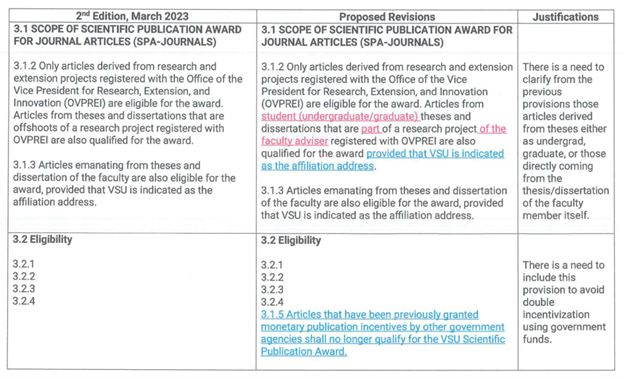
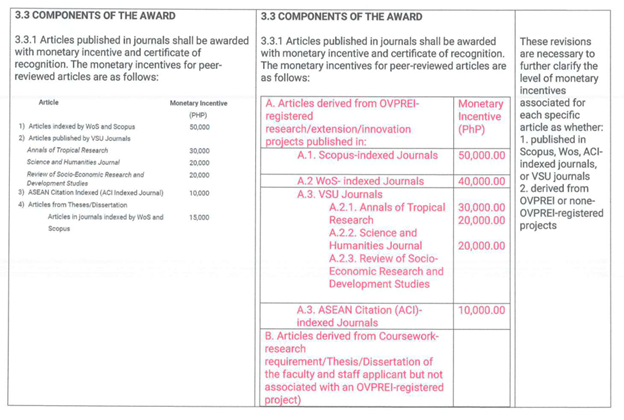
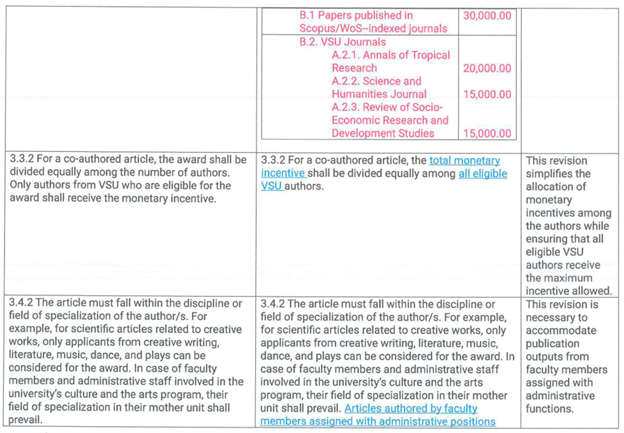
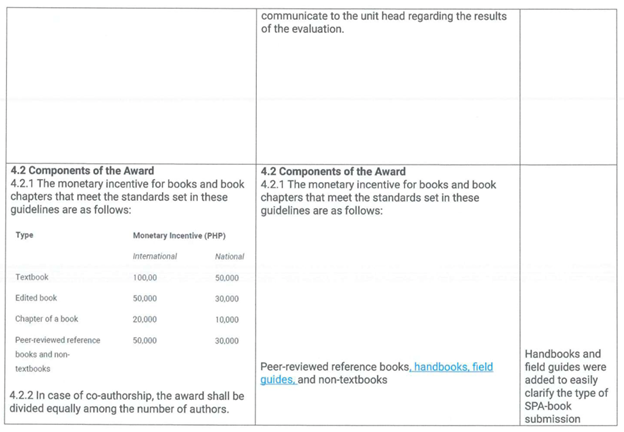
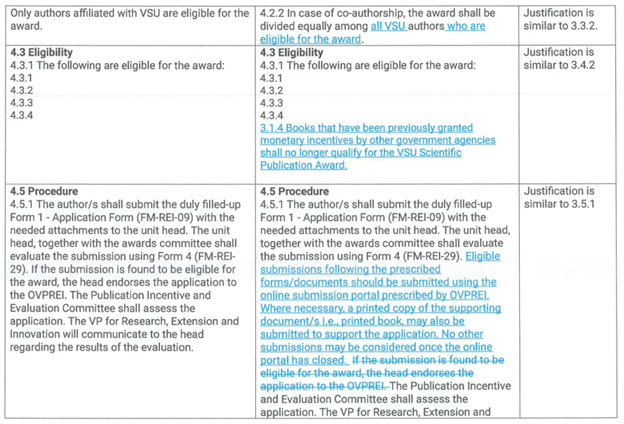
Proposed Revisions on the Guidelines of the Scientific Publications Award (BOR Resolution No. 161, s. 2024)
Proposed Revisions on the Guidelines of the Scientific Publications Award
(BOR Resolution No. 161, s. 2024)