
Approved-Policy
Institutional Promotion Guidelines for Faculty Members (Amendment of the BOR Resolution No. 135, s 2022 on Revised In-House Promotion for Faculty) (BOR Resolution No. 91, s. 2024)
Institutional Promotion Guidelines for Faculty Members
(Amendment of the BOR Resolution No. 135, s 2022 on Revised In-House Promotion for Faculty)
(BOR Resolution No. 91, s. 2024)
Rationale:
Promotion offers an opportunity for the faculty to demonstrate and gain recognition for their achievement over a period of time. It is a way to evaluate a faculty member's research, teaching, and service contributions, and to recognize their achievements and impact on the institution.
This process helps to maintain academic standards and ensures that faculty members are held to high standards. Most importantly, promotion can motivate faculty to stay at the institution and continue to contribute to its mission.
Since National Budget Circular (NBC) 461 and now the DBM-CHED Joint Circular 3 s. 2022 (Guidelines on the Reclassification for Faculty Positions in State Universities and Colleges), the upgrading of faculty members of the university was dependent solely on the national implementation of these circulars which was done every three (3) years only. In January 2023, the “Revised In-House Promotion” was duly approved by the Board of Regents through the passage of BOR Res. No. 135 s. 2022. Some faculty have been promoted specially the faculty-scholars who earned PhD degree after being sent to graduate studies.
Likewise, let it be emphasized that the number of faculty members with doctorate degrees matters a lot especially in VSU’s university rank endeavors, both international and local, like the QS Star, University Performance Metrics and accreditations such as AACCUP accreditation, CHED, Washington Accord, etc. There is therefore an intervention to make sure that its developed faculty will not be pirated by other SUCs to the disadvantage of the VSU. Not to mention also, that some nearly retiring faculty may no longer be able to avail of the reclassification of faculty positions in the next cycle/s of DBM-CHED JC 3 s. 2022.
The Institutional Promotion for Faculty Members will only be resorted if there is a vacant item due to retirement, promotion, transfer, etc.
However, the existing policy per BOR Res. 135 s. 2022 is limited to Instructor II to Assistant Professor IV vacant positions. Also, some provisions of BOR Res. 135 s. 2022 needs amendment. By amending the guidelines regularly, the university can ensure that its policies and procedures remain relevant, effective, and aligned with changing circumstances and requirements.
Coverage:
The policy shall apply to all deserving faculty of the university whose qualifications are validated by the Institutional Evaluation Committee and their entry into the new position is very significant in order to ensure their motivation, productivity and well-being.
Proposal:
The following provisions of the existing policy are proposed for amendment:
|
Existing |
Proposed |
|
Title: |
|
|
Revised In-House Promotion for Faculty |
Institutional Promotion Guidelines for Faculty Members |
|
Existing |
Proposed |
|
Guidelines: |
|
|
Vacant positions of Instructor II up to Professor VI shall be considered for Institutional Promotion for faculty members |
|
per CSC MC No. 1, s. 1997 “Revised Qualification Standard” |
|
From Assistant Professor to Associate Professor V positions, preference will be given to applicants with relevant PhD degrees. Only faculty who are first entrants to Associate Professor rank may qualify. From Associate Professor rank to Professor VI positions, preference will be given to applicants with relevant PhD degrees. Only faculty who are first entrants to full professor rank may qualify. |
|
|
|
|
|
|
|
|
|
|
Only faculty members who have been IEC-recommended for professorial rank shall be considered for promotion to a professorial rank using the JC 3 s. 2022 criteria. |
Effectivity:
These amended guidelines shall take effect upon approval of the Board of Regents.
Policies for the Center for Continuing Education and the Convention Center (BOR Resolution No. 124, s. 2024)
Policies for the Center for Continuing Education and the Convention Center
(BOR Resolution No. 124, s. 2024)
1. Policy Proposal for the Compensation of Job Order (JO) Personnel extended hours during events at CCE and Convention Center
Events hosted at CCE & Convention Center often extend beyond regular working hours, requiring the assistance of Job Order (JO) personnel for setup, operations, and restoration activities. To ensure fair compensation for their efforts, a structured compensation payment system is hereby proposed.
Payment Structure:
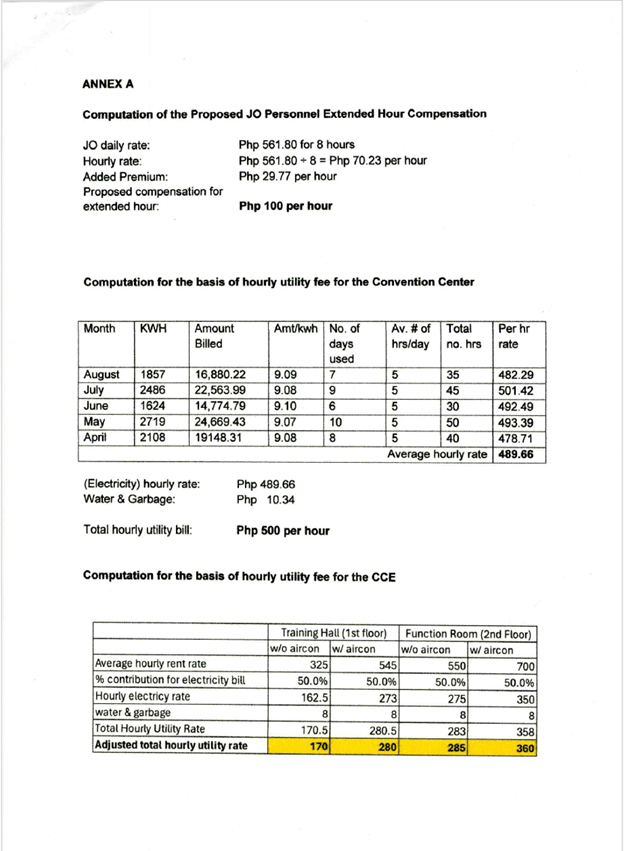
- For events extending beyond 5:00 PM, job order (JO) personnel shall be compensated at a rate of Php100 per hour for each additional hour worked (See Annex A for the basis of computation). Both the Center for Continuing Education (CCE) and the Convention Center require the presence of two (2) JO personnel each during such events.
- The cost of extended hour compensation shall be shouldered by the renting party. This ensures that the university does not incur additional expenses and that JO personnel are fairly compensated. For instance, if an event extends for three (3) hours past 5:00 PM at the Convention Center, the total compensation for two (2) JO personnel would amount to Php 600 (P100/hr x 3 hr x 2) which will be charged to the renting party. The renting party shall pay to the project manager or designated personnel, covering both the venue rental fee and the compensation for the Jo personnel. An official receipt shall be issued to the renting party itemizing the total amount paid.
- The contract of the job order (JO) personnel, as assigned by the project manager, shall explicitly state their entitlement to claim compensation for extended hours incurred during events that extend beyond 5:00 PM. This compensation shall be duly reflected in the payroll for the month in which the event occurred.
2. Policy Proposal for Complimentary Venue Use and Associated Utility Fees at CCE and Convention Center
The Center for Continuing Education (CCE) and the Convention Center operate as part of the Income Generating Projects of the University. Occasionally, certain group, organization, department and office request the use of such venues free of charge, while the university is committed to supporting various initiatives, it is essential to manage these requests carefully to avoid conflicts in scheduling and ensure that the costs associated with venue usage, such as electricity & other utilities are covered. Recent monitoring revealed that both venues have incurred significant utility expenses particularly on electricity during events where free venue use was granted, without charging the requesting parties for these costs. This has resulted in reduced income for both IP projects and has created a misleading impression of higher operating costs. In reality, these inflated costs stem from events where free usage was approved without the recovery of basic utility expenses. Therefore, it is crucial to implement a policy that requires all parties, even those granted free venue usage, to pay for the utility costs incurred during their events. This will ensure the venues' financial sustainability and provide a clearer picture of their operational efficiency.
Proposal for the Approval Process & Utility fee requirement:
- All requests for free venue usage must be addressed to the Office of the President with the recommending approval of the Project Manager and Vice President for Resource Generation & Auxiliary Services. The Project Manager will verify that there is no conflict with existing bookings and ensure the feasibility of the request.
- Even if the venue usage is approved as free, the requesting party shall still be required to pay for the utility bills (electricity & water usage, garbage fee).
- For the Convention Center the mandatory utility fee is Php 500 per hour (See Annex
A for the basis of computation)
For the Center for Continuing Education (CCE) the following utility fee will apply: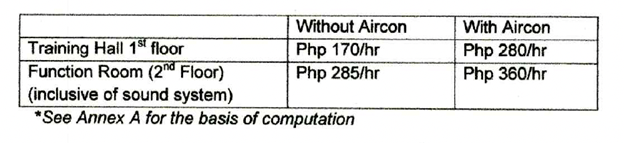
Implementation:
The proposed policies will take effect upon approval by the relevant university authorities (UADCO and BOR). Communication of these policies will be distributed to VSU constituents to ensure awareness and compliance.
Updated VSU Accommodation House Rules (VSU Hostel, Apartelle, Core Cottages, and Seafront Suites) (BOR Resolution No. 101, s. 2025)
Updated VSU Accommodation House Rules (VSU Hostel, Apartelle, Core Cottages, and Seafront Suites)
(BOR Resolution No. 101, s. 2025)
Rationale
This proposal is submitted to modernize and standardize the operational policies of the VSU Apartelle in response to the evolving needs of its guests and the university’s goal of improving facility management. The existing house rules have become outdated, lacking clarity in several critical areas such as reservations, guest conduct, and use of amenities. To address these gaps, the revised rules introduce comprehensive and structured guidelines covering check-in/out procedures, payment and cancellation terms, security deposits, amenity usage, and guest responsibilities.
Key enhancements include:
- Implementation of early check-in charges and security deposits to ensure orderly procedures and protection of property;
- Updated reservation and cancellation policies, including reduced reservation deposits and more guest-friendly cancellation terms;
- Defined fees for appliance usage, extra persons, and extra bed requests to promote fairness and cost recovery;
- Introduction of pet-friendly accommodations for guests traveling with animals;
- Formalized rental rates for amenities such as lawn spaces, projectors, and audio systems, supporting income generation;
- Stricter enforcement of guest conduct policies, including higher penalties for smoking and cooking violations;
- Refined rules on alcohol consumption and visitor curfews, to ensure safety, order, and respect for shared spaces.
These revisions are expected to yield multiple operational benefits: increased clarity and specificity of policies, enhanced revenue through new services and charges, improved damage control via security measures, more streamlined processes for staff, and better accommodation of diverse guest needs, such as travelers with pets.
Legal Basis:
- Republic Act No. 8292
- CHED Memorandum Order No. 20, series of 2911
- COA Memorandum No. 2022-014
Comparative Matrix of Old and New VSU Apartelle House Rules with Benefits Analysis
|
Feature/Aspect |
Old House Rules |
New House Rules |
Key Changes |
Benefits of the New Rules |
|
CHECK-IN AND CHECK-OUT |
||||
|
Check-in time |
2:00 PM |
2:00 PM |
No change |
- |
|
Check-out time |
12:00 NN |
12:00 NN |
No change |
- |
|
Early Check-in Charge |
No specific rule mentioned |
Php 100.00/hour |
Addition of early check-in charge |
Clear policy and fees for early check-in based on hotel standards/protocol |
|
Late Check-out Charge |
Php 100.00/hour |
Php 100.00/hour |
No change |
|
|
RESERVATIONS |
||||
|
Reservation Deposit |
50% of room rate (non-refundable but consumable) |
25% of the room’s total price |
Decrease in reservation deposit |
Lower initial cost for reservation |
|
Reservation cancellation |
*Less than two days before check-in: charges apply
*One day before check-in: 20% of room rate
*Day of the check-in/No show: 50% of room rate |
*Cancellation four (4) days before arrival: refund less than 10% of room rate
*Cancellation on arrival day: non-refundable |
Clearer and potentially more favorable cancellation policy if done 4 days prior. |
Provides guests with a clearer understanding of the cancellation process and potential refunds. |
|
Guaranteed reservations |
No specific rule mentioned |
Full payment or 100% of room price required. |
Addition of guaranteed reservation policy |
Clear policy for guaranteed reservations based on hotel standards/protocols. |
|
Payment of Balance |
Settle account one hour before check-out |
Full room balance due upon check-in/check-out |
Changes in payment timing |
Clarifies when full payment is due. |
|
Security Deposit |
No specific rule mentioned |
Php 1,000.00 collected, refunded if no damages; additional charges if damages exceed Php 1,000.00 |
Addition of security deposit |
Protects establishment from damages, clarifies charges for damages that are based on hotel standards/protocols. |
|
EXTRAS |
||||
|
Extra bed |
No specific rule mentioned |
Php 300.00 (includes blanket, pillow, sheets, towel, morning kit) |
Addition of extra bed fee and inclusions |
Clear pricing and inclusions for extra bed. |
|
Extra Person |
*Children below 8 years old: free if sharing with parents, no extra bed/accessories
*Maximum of 4 guests |
*1-7 years old: no charge
*8 years old and above: Php 100.00/pax |
Changes in extra person policy |
Clearer policy and fees for extra persons, specifically addressing charges for children. |
|
Ironing |
Ironing of clothes inside the room is strictly prohibited |
Iron rental available for Php 100.00 (Php 50.00 extra per day if not returned) |
Change from prohibition to rental |
Provides option for guests to iron with fee, clarifies rental terms and charges |
|
Electrical Appliances |
No specific rule mentioned |
Electrical charge for hair blower, hair iron/curler, clothing iron, ring light, etc. (except laptop): Php 50.00 for the first 2 days, Php 50.00 per succeeding day |
Addition of electrical appliance usage charges |
Covers costs associated with electricity usage for specific appliances. |
|
Housekeeping |
Cleaning rooms: inform front desk between 6:00 AM to 11:00 AM for use of “Make-up Room” sign |
Housekeeping until 4:00 PM; additional requests before 4:00 PM |
Change in housekeeping request times |
Sets clear expectations for housekeeping service availability. |
|
Room Keys |
Front door keys provided
Room keys to be returned upon check-out.
Php 500.00 charge for stolen/lost keys |
Room keys are encouraged to be surrendered when leaving the room (key deposit box at front desk/lobby
Php 1,500 charge for lost/stolen keys. |
Changes in key handling and lost key changes |
Encourages proactive key management, increases lost key charge. |
|
Visitors |
Visitors allowed 8:00 AM to 10:00 PM in lounge or room with front desk consent
Visitors to log in through the log book |
Visitors not allowed to stay after 10:00 PM; strict adherence to 10:00 PM curfew |
Stricter rule on visitor curfew |
Aims to maintain order and security by enforcing a visitor curfew. |
|
Valuables |
Guests are advised not to leave valuables. Apartelle is not responsible for any losses. |
Management/staff not responsible for unattended items; 3-month retrieval period for lost and found items |
Minor changes in wording, addition of retrieval period. |
Clarifies management’s responsibility and provides a retrieval timeframe |
|
Smoking |
Strictly prohibited in rooms; Smoking area designated
Php 500.00 fine for smoking in rooms |
Prohibited in rooms; designated smoking area can be utilized
If caught, guest charged according to original room price |
Increase in potential fine for smoking in roms |
Reinforces smoking prohibition with a potentially higher penalty. |
|
Alcohol |
Drinking alcohol at the lobby area is strictly prohibited |
Alcohol permitted in rooms; excessive drinking discouraged; drinks allowed at VSU Beach Garden; minors not allowed to consume alcohol |
Change in rules regarding alcohol consumption |
Provides more clarity around alcohol can be consumed and sets expectations around responsible consumption |
|
Lawn/Cottage Rental |
No specific rule mentioned |
Php 100.00/day rental fee |
Addition of Rental Fee |
Sets a clear price for renting the lawn area and for restoration and maintenance. |
|
Projector/Screen Rental |
No specific rule mentioned |
Php 600.00/day rental fee |
Addition of Rental Fee |
Sets a clear price for projector and screen rental |
|
Speaker/Microphone rental |
No specific rule mentioned |
Php 600.00/day rental fee |
Addition of Rental Fee |
Sets a clear price for speaker/microphone rental |
|
Pets |
Pets not allowed in rooms |
Pets allowed in Pet-friendly rooms only |
Change in pet policy |
Provides specific accommodation for guests with pets in designated rooms |
|
Cooking |
Cooking inside the rooms is strictly prohibited |
Strictly NO COOKING inside the rooms. If caught, the guest will be fined according to the original room price |
Reinforcement with a specified penalty |
Reinforces the prohibition of cooking in rooms with a clearer consequence. |
|
Other Prohibitions |
Do not flush sanitary products
Vandalism prohibited
Drugs prohibited
Gambling prohibited
Moving furnishings/interfering with electrical network prohibited |
No similar rules explicitly listed. |
- |
- |
|
Silence |
Silence should be observed, especially at night; keep TV volume to minimal |
No similar rules explicitly listed. |
- |
- |
|
Door policy |
Keep doors closed at all times; use the “Do not disturb” sign |
No similar rules explicitly listed. |
- |
- |
|
Towel Provision |
Dormitory guests not provided shampoo, soap, towels; towels can be rented for Php 50.00. |
Extra bed inclusion of towel |
Change in towel provision with extra bed. |
A towel is provided with an extra bed. |
Key observations and General Benefits:
- Increased Clarity and Specificity: The new rules tend to be more specific, outlining fees for various services (early check-in, extra bed, appliance usage) and clarifying policies (e.g., cancellation, security deposit). This reduces ambiguity and sets clear expectations to requests.
- Enhanced Revenue Generation: Several new rules focus on generating revenue through additional services and penalties (e.g., appliance charges, rentals, increased fines).
- Emphasis on Damage Control: The security deposit and increased fines for violations (smoking, cooking) highlight a focus on protecting the property and minimizing damage. Streamlined Operations: Some changes, like encouraging key deposits, may aim to streamline operations for the staff.
- Accommodation of Specific Needs: The introduction of pet-friendly rooms caters to a broader range of guests.
Proposed Consolidated Amendments of the Existing VSU Scholarship Policies (BOR Resolution No. 166, s. 2024)
Proposed Consolidated Amendments of the Existing VSU Scholarship Policies
(BOR Resolution No. 166, s. 2024)
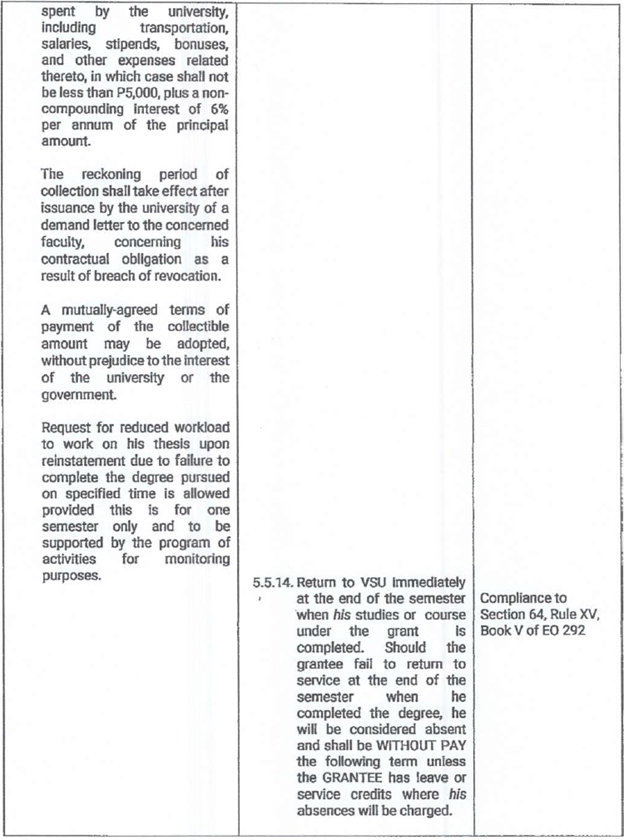
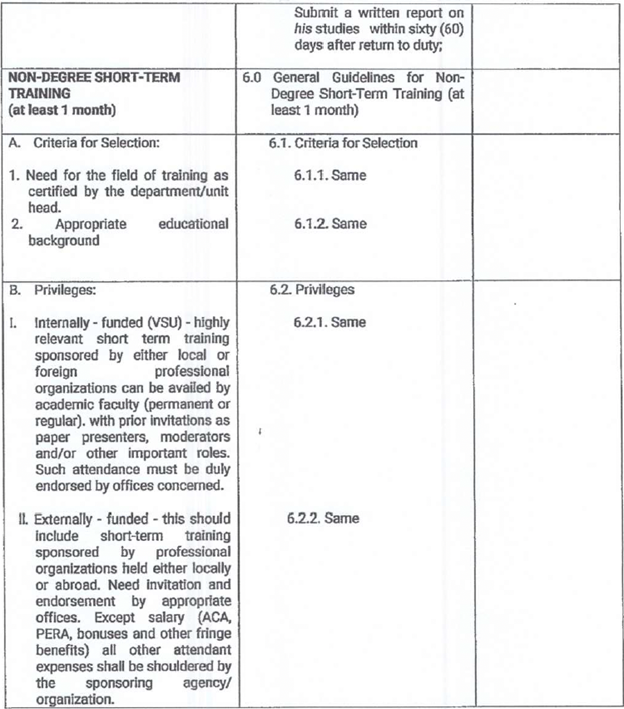
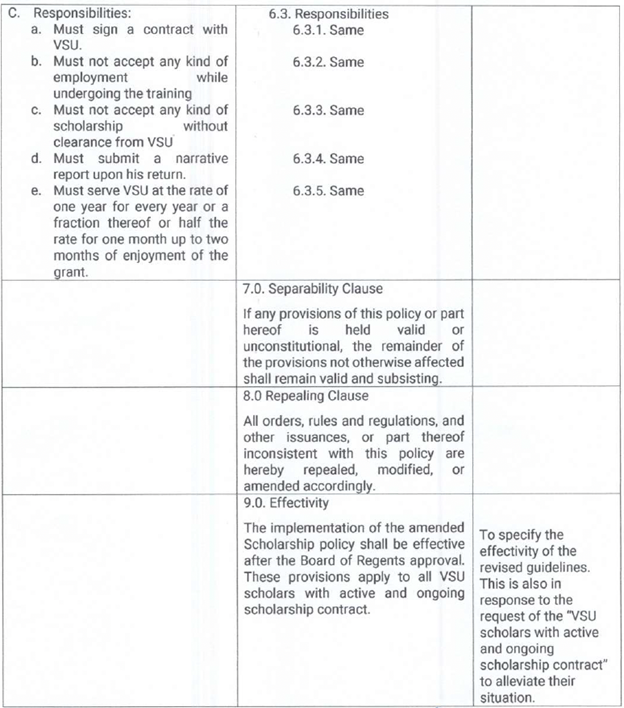
Rationale:
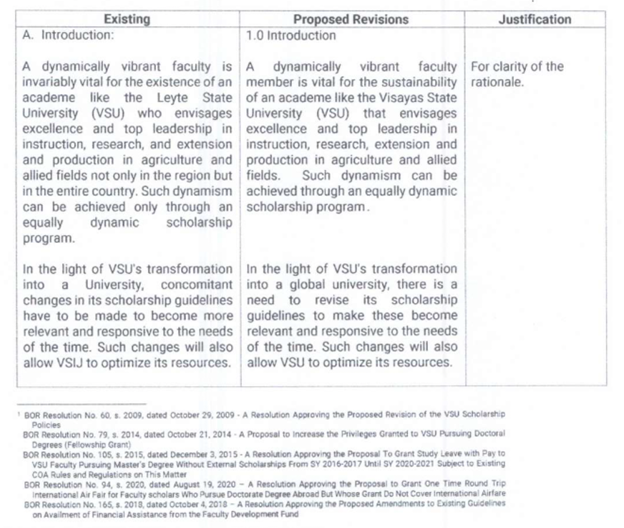
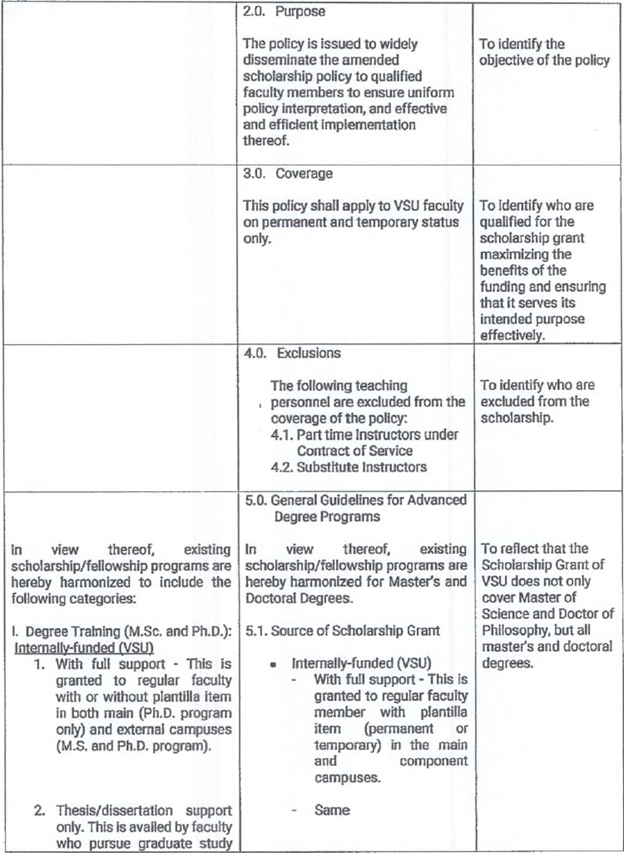
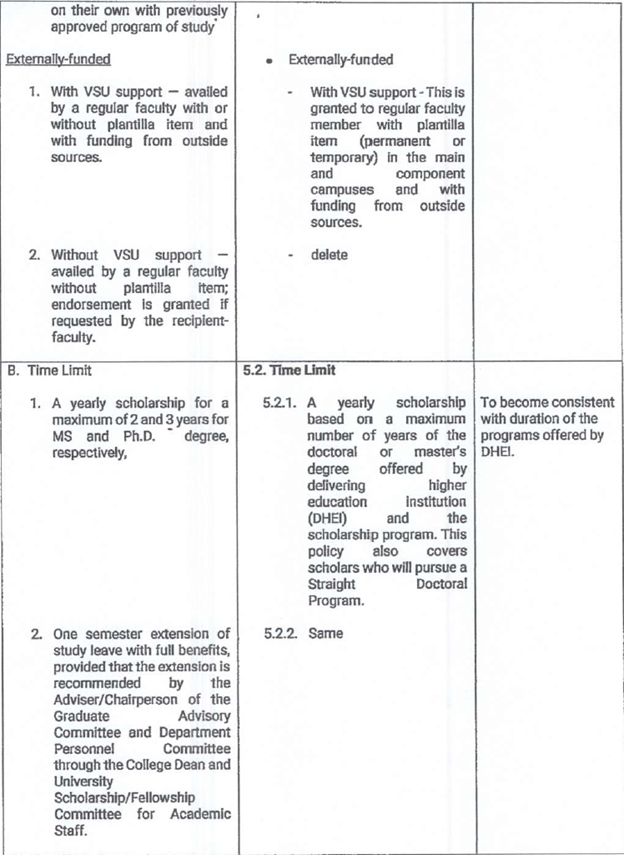
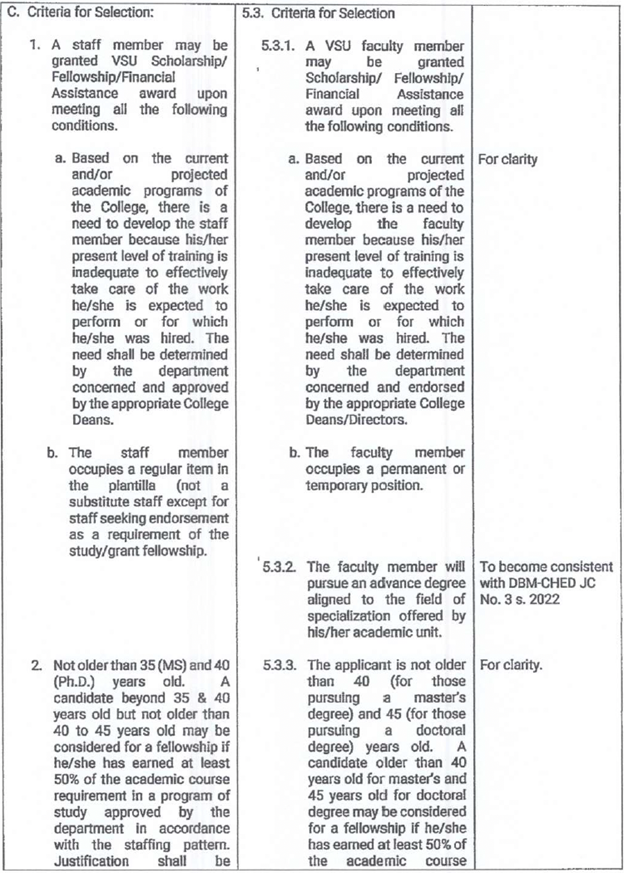
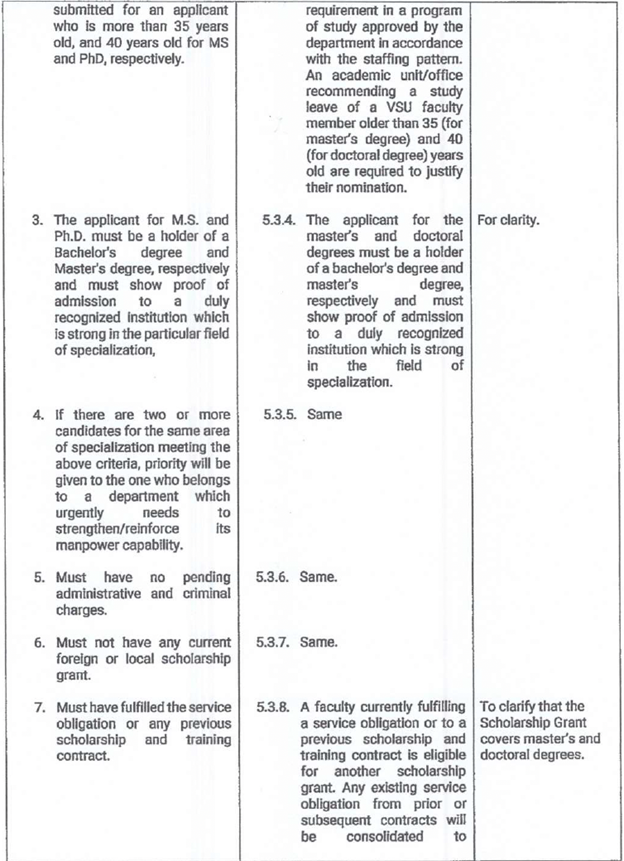
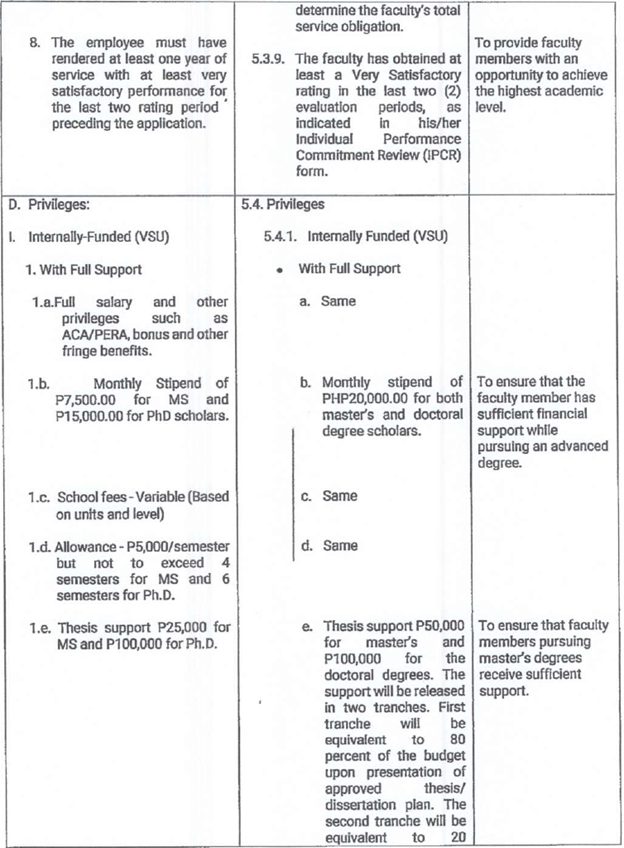
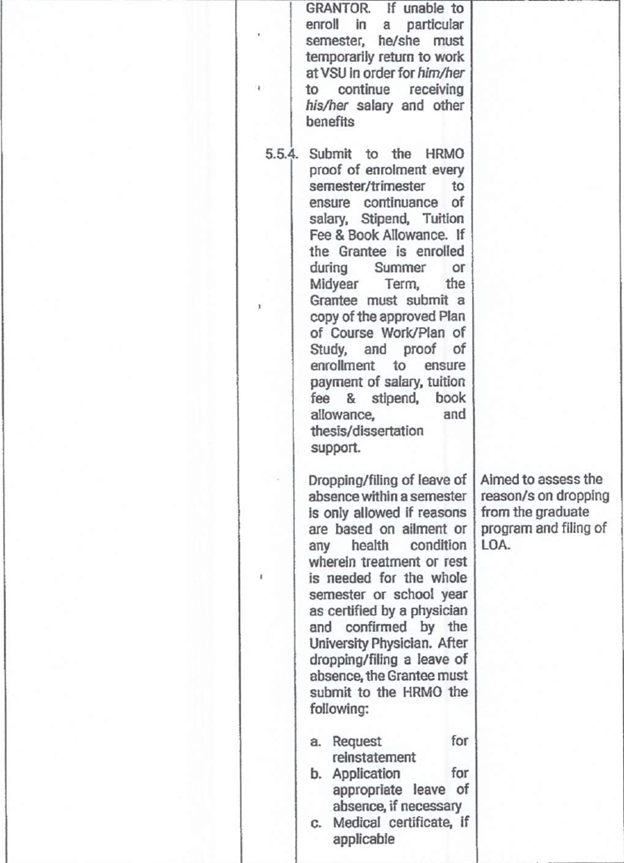
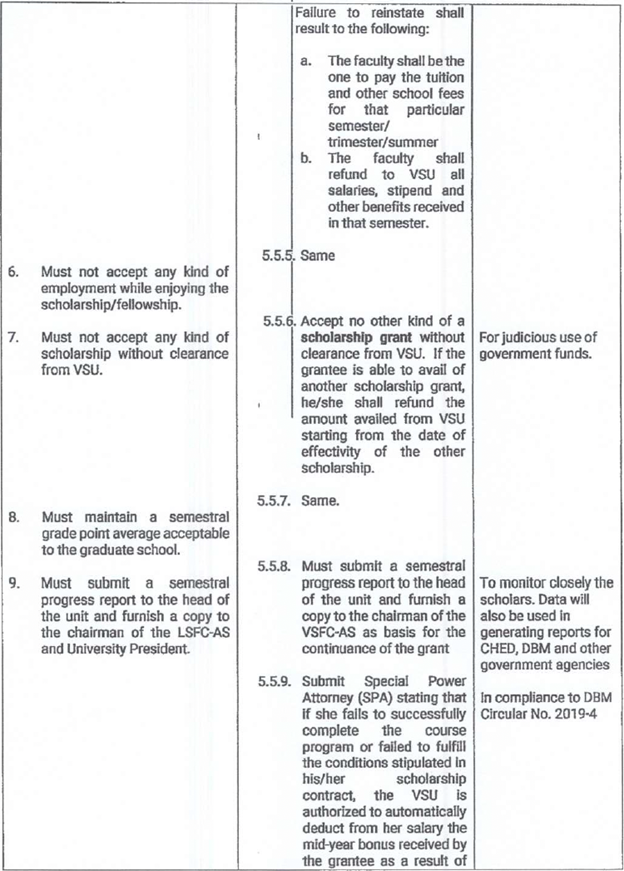
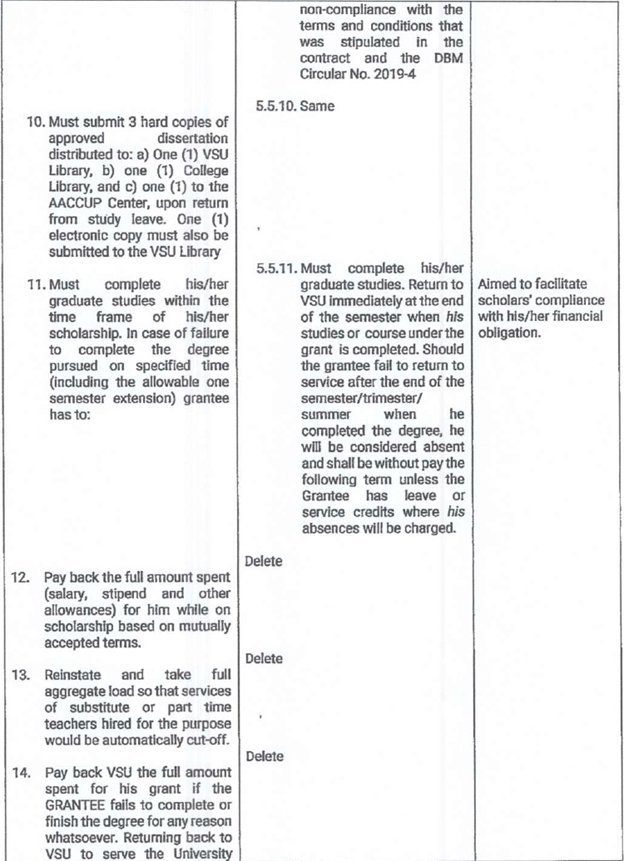
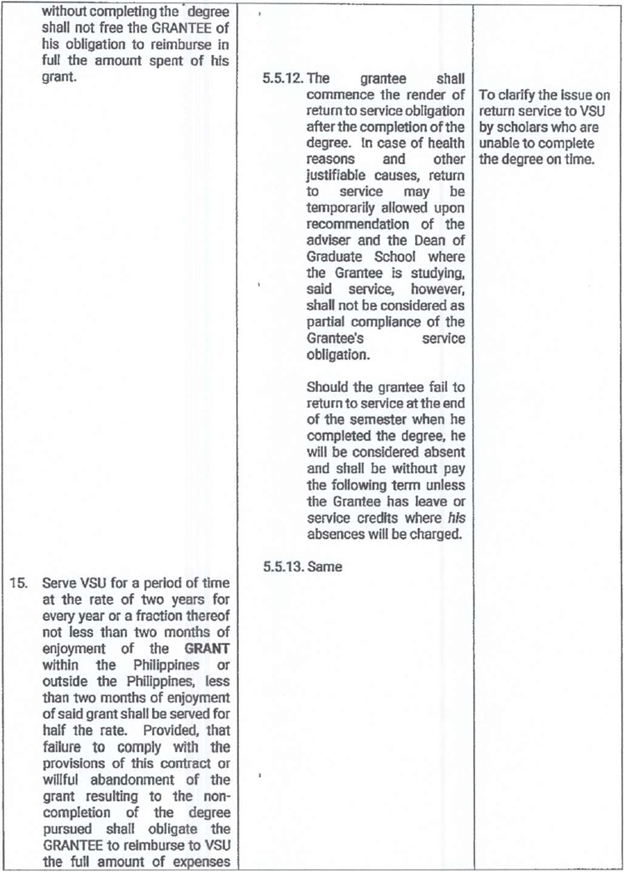
The Visayas State University (VSU) is at the forefront in promoting quality education and academic excellence. Through the years, the university has been providing scholarship programs for its faculty members of academic units and research centers. Recently, however, the global landscape has changed significantly. Thus, to align the scholarship policy with the changing global landscape and t o ensure that scholars receive the best possible support, there is a need t o review and amend certain aspects of the existing scholarship policy. This proposal outlines proposed amendments to the current scholarship policy to address key concerns and enhance the overall effectiveness of the program.
Below are the proposed revisions and justifications.
Proposal on the Compensation of Contract of Service (COS) Faculty via Two-payment Methods (BOR Resolution No. 101, s. 2025)
Proposal on the Compensation of Contract of Service (COS) Faculty via Two-payment Methods
(BOR Resolution No. 101, s. 2025)
Rationale
Currently, COS faculty at the university are compensated based on the number of contact hours rendered within a semester. While this system offers flexibility, it also presents several challenges:
- Income unpredictability, which can impact faculty morale and financial planning.
- Administrative complexities in accurately tracking and validating hours.
- Limited incentives for faculty t o engage beyond scheduled contact hours.
To address these issues, the university is considering the adoption of an additional compensation method, a fixed monthly rate. This proposal outlines a flexible remuneration framework for COS faculty, incorporating two payment methods: compensation based on contact hours and on a fixed monthly pay.
Implementing these dual payment methods provides flexibility to align COS faculty compensation with course requirements, workload variations, and institutional planning strategies. This approach offers multiple solutions including fostering a more stable and efficient work environment, enhancing teaching quality, and promoting institutional stability.
Approval from the Board o f Regents (BOR) is BOR approval is hereby sought to formalize this dual approach, aiming to establish a fair and motivating environment for COS faculty members.
Legal Bases:
- National Budget Circular No. 591 dated January 10, 2023. Implementation of the Fourth Tranche of the Modified Salary Schedule for Civilian Personnel in the National Government Pursuant t o Republic Act (RA) No. 11466
- COA-DBM Joint Circular No. 2 s. 2020 dated October 20, 2020. Updated Rules and Regulations Governing Contract of Service (COS) and Job Order (JO) Workers in the Government
Section 11.5. Services of individuals engaged through COS basis, excluding persons or entities engaged through RA No. 9184, and JO shall be paid wages equivalent to the daily wage/salary of comparable positions in government.
Subject to the availability of funds, the COS and JO workers may also be granted a premium of up to 20% of their respective wages/salaries.
The premium payment may be paid monthly, in a lump sum, or in tranches (i.e., mid-year and year-end payments) as may be stated in the agreement o r contract with the agency. The payment of services shall be charged against the MOOE in the approved agency budget.
Objectives:
- To provide equitable and transparent compensation options for Contract of Service faculty.
- To accommodate diverse teaching arrangements, including variable contact hours and fixed workloads.
- To foster increased faculty motivation and maintain teaching quality.
Proposed Compensation Structure
Below is the proposed compensation structure of the two-payment methods:
| Nature | Method of Payment | |
| Fixed monthly rate | Contact-hour based | |
| Scope | The monthly rate will cover all scheduled classes, administrative duties, and related responsibilities as outlined in the COS faculty contract. | For Part-time engagements or suitable for courses with variable schedules and responsibilities outlined in the COS faculty contract. |
| Compensation | COS faculty will receive a predetermined fixed amount each month, regardless of the exact contact hours within that month |
COS faculty are paid based on the number of contract hours rendered within a semester. Payment varies according to the total number of hours taught. |
| Rate |
Instructor I rate or Salary Grade 12 of the applicable yearly Tranche of the Salary Schedule for Civilian Personnel issued by DBM Plus 2% premium. No Preparation Pay |
P182.28 per hour for BS degree holder* P228.87 per hour for MS degree holder P320.98 per hour for PhD degree holder |
| Payment schedule | Per quincena or monthly, whichever the concerned COS faculty prefers. | Per quincena or monthly, whichever the concerned COS faculty prefers. |
| Attendance to work |
Report to the office daily from 8:00 AM to 12:00 NN and 1:00 PM to 5:00 PM, subject to actual class schedules and institutional needs or render service for a total of 40 hours per week. In the event of absence from work, the monthly pay shall be deducted based with a daily computation of: Amt. of deduction per day = monthly rate/30 days |
Report to class based on registered class schedules issued by the Registrar’s Office. |
| Documentation of claim wages |
Approved/notarized contract of service (original for first salary) Certificate of Assumption Approved DTR BIR withholding certificate Philhealth payment |
Approved/notarized contract of service (original for first salary)
Certificate of Assumption Approved DTR BIR withholding certificate Philhealth payment |
| Workload | The average teaching workload units required per semester shall be at least 24 teaching workload units plus administrative duties and related responsibilities for the overall workload units. The monthly rate will be calibrated to reflect the average contact hours required per semester, ensuring fair compensation between regular faculty and those under COS. |
The average teaching workload units required per semester shall be at least 24 teaching workload units plus administrative duties and related responsibilities for the overall workload units. The monthly rate will be calibrated to reflect the average contact hours required per semester, ensuring fair compensation between regular faculty and those under COS. |
| Duration |
Start: Five (5) working days before the start of classes of the academic term or on the actual date of assumption to work. End: Ten (10) working days after the last day of the final exam of the academic term. |
Start: Five (5) working days before the start of classes of the academic term or on the actual date of assumption to work. End: Ten (10) working days after the last day of the final exam of the academic term. |
| Advantages |
Predictable income for faculty Simplifies payroll processing and record keeping Enhanced administrative planning |
Fairly aligns pay with workload, flexible to course demands. |
*Existing compensation
Effectivity:
This compensation shall be immediately implemented upon its final approval by the VSU Board of Regents.